
CVE-2026-62869: Microsoft Entra ID Spoofing Bug - What It Means for Your Business and How to Respond
Introduction
CVE-2026-62869 matters because it affects Microsoft Entra ID, the identity platform that controls access to Microsoft 365, Azure resources, business applications, and many hybrid cloud environments. An attacker who can successfully exploit a spoofing weakness in an identity platform may be able to make systems or services accept untrusted information as legitimate, undermining the trust that your security controls depend on.
If your organization uses Microsoft 365, Azure, Entra ID for single sign-on, or a hybrid identity model that connects on-premises Active Directory to the cloud, this vulnerability deserves prompt attention. The risk is particularly relevant for organizations with distributed workforces, partner access, privileged cloud accounts, or sensitive customer and financial data.
This post explains what the vulnerability means in business terms, who may be affected, and how to respond. It also includes a technical appendix for security engineers, penetration testers, and IT teams responsible for detection, verification, and remediation.
Background & History
Microsoft published CVE-2026-62869 on August 11, 2026, and the National Vulnerability Database listed the entry the same day, with a subsequent update on August 13, 2026. The vulnerability affects Microsoft Entra ID, Microsoft’s cloud-based identity and access platform.
The issue is classified as insufficient verification of data authenticity, identified as CWE-345. In practical terms, a system may fail to adequately confirm that data it receives genuinely came from a trusted source or has not been altered. Microsoft describes the resulting impact as spoofing over a network, meaning an authorized attacker could potentially impersonate a trusted identity, service, or data source.
Microsoft assigned the vulnerability a CVSS v3.1 base score of 8.8, which is High severity. The score reflects a network-based attack with low complexity, low required privileges, no user interaction, and high potential impact on confidentiality, integrity, and availability.
Public vulnerability trackers identify Microsoft as the CVE Numbering Authority and point to Microsoft’s Security Response Center advisory as the authoritative source for remediation guidance. Organizations should treat the Microsoft advisory, rather than third-party summaries, as the final word on patch availability and affected configurations.
What This Means for Your Business
Your identity platform is not just another cloud service. It decides who can reach email, files, financial systems, customer records, development tools, and administrative consoles. When that platform contains a spoofing weakness, the concern is not simply that an attacker may gain access. It is that your environment may accept an attacker or attacker-controlled data as legitimate.
For operations, this can disrupt the confidence your teams place in automated access decisions. A spoofed identity or falsified authentication context can lead to unauthorized changes, misplaced approvals, or access to systems that should have remained restricted. In organizations that rely heavily on cloud collaboration, even a short period of uncertainty can interrupt normal work.
For data protection, the risk includes exposure of sensitive business information and the possibility that an attacker can alter records, permissions, or communications. That risk is heightened when Entra ID is connected to Microsoft 365, Azure resources, customer-facing applications, or third-party software that trusts Entra ID for sign-in.
Reputation and compliance exposure follow closely behind. Customers, partners, and regulators expect organizations to protect access to personal, financial, and confidential information. A confirmed identity-related incident can require notification, forensic investigation, customer communication, and evidence that your organization responded appropriately. The cost is rarely limited to the technical fix; it includes management time, legal review, and lost trust.
Real-World Examples
Regional financial services firm: A regional bank uses Entra ID to control employee access to Microsoft 365, loan-processing applications, and Azure-hosted analytics. A successful spoofing attempt could allow an attacker to appear as a trusted internal user, increasing the chance of unauthorized access to customer records or fraudulent transaction activity. The institution could face regulatory scrutiny, incident-response costs, and reduced customer confidence.
Mid-sized healthcare organization: A healthcare provider uses Entra ID for staff sign-in to electronic records, scheduling tools, and cloud storage. If an attacker can spoof a trusted identity context, protected health information could be exposed or altered. Beyond the immediate security impact, the organization may need to assess whether patient data was accessed and whether notification obligations apply.
SaaS company with hybrid identity: A growing software company federates its on-premises Active Directory with Entra ID to support developers, sales teams, and contractors. A spoofing issue in the identity layer could put source code, deployment pipelines, customer tenant data, and administrative access at risk. Recovery may require revoking sessions, rotating credentials, and validating that no unauthorized changes were made to production systems.
Professional services firm: A 150-person consulting firm relies on Microsoft 365 and Entra ID for email, document sharing, and client collaboration. An attacker who can impersonate a trusted user could send convincing messages, access client files, or alter shared documents. The firm may lose a client relationship even if the technical impact is contained quickly.
Am I Affected?
- You use Entra ID for single sign-on to business applications, Microsoft 365 services, or third-party cloud tools.
- You operate a hybrid identity environment in which on-premises Active Directory is connected or federated with Entra ID.sentinelone
- You allow employees, contractors, partners, or customers to authenticate through Entra ID.
- You use privileged Entra ID roles, such as global administrator, application administrator, or conditional access administrator.
- You have integrations, automation, or service principals that depend on Entra ID tokens or identity assertions.
- You have not yet reviewed the Microsoft Security Response Center advisory for CVE-2026-62869 and confirmed the current remediation status for your tenant.
Because Microsoft lists Microsoft Entra ID as affected without publishing a specific vulnerable version range in the public CVE record, organizations should not assume that a particular tenant configuration is exempt. Treat all Entra ID-dependent environments as potentially exposed until Microsoft guidance and your own verification confirm otherwise.
Key Takeaways
- CVE-2026-62869 is a High-severity spoofing vulnerability in Microsoft Entra ID caused by insufficient verification of data authenticity.
- The vulnerability was published on August 11, 2026, and carries a Microsoft-assigned CVSS v3.1 score of 8.8.
- Any organization using Entra ID for Microsoft 365, Azure, single sign-on, or hybrid identity should assess exposure promptly.
- The principal business risks are unauthorized access, data exposure or alteration, operational disruption, regulatory exposure, and loss of customer trust.
- Your response should prioritize Microsoft’s official advisory and patch guidance, followed by identity logging review, credential and session hygiene, and validation of privileged access.
Call to Action
Identity is the front door to your business systems, and a weakness at that layer deserves a disciplined response rather than guesswork. IntegSec can help your organization assess exposure to CVE-2026-62869, test the strength of your identity and access controls, and reduce the risk of privilege misuse across cloud and hybrid environments. Contact IntegSec for a penetration test and a practical cybersecurity risk-reduction plan at https://integsec.com.
Technical Appendix
A — Technical Analysis
CVE-2026-62869 arises from insufficient verification of data authenticity in Microsoft Entra ID, classified as CWE-345. The weakness concerns the platform’s handling of data whose authenticity must be established before it is trusted for identity, authentication, or authorization decisions. Microsoft characterizes the security impact as spoofing over a network.
The affected component is Microsoft Entra ID. The public NVD record lists the affected product as Microsoft Entra and does not provide a granular version range, which is consistent with a cloud service vulnerability rather than a conventional on-premises software build issue.
The CVSS v3.1 vector is CVSS:3.1/AV:N/AC:L/PR:L/UI:N/S:U/C:H/I:H/A:H. This indicates a network attack vector, low attack complexity, low privileges required, no user interaction, unchanged scope, and high impact across confidentiality, integrity, and availability. The NVD entry records Microsoft as the CVE Numbering Authority and assigns the 8.8 High base score.
Security teams should review Microsoft’s advisory at https://msrc.microsoft.com/update-guide/vulnerability/CVE-2026-62869 for the authoritative description, remediation status, and any service-side mitigation details. Public trackers note that no broadly published remediation was identified in early third-party aggregations, so teams must verify the current Microsoft guidance rather than relying on cached vulnerability data.
B — Detection & Verification
Version enumeration is not the primary verification method because Microsoft Entra ID is a cloud service and the public record does not expose a vulnerable software version. Teams should instead determine tenant reliance on Entra ID and review identity telemetry for anomalous authentication or 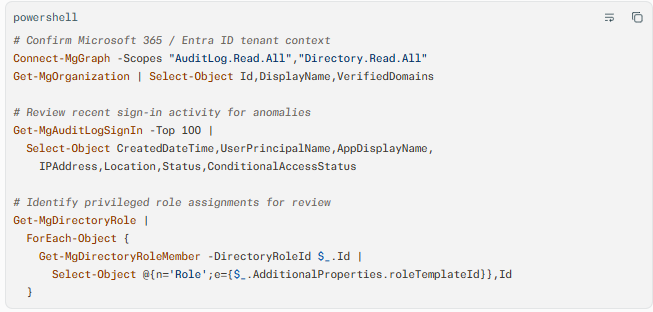
Scanner signatures should be treated as secondary confirmation because the vulnerability is service-side. Prioritize vendor-provided detection guidance, Microsoft Sentinel analytics, and cloud-native audit logs over generic network signatures.
Log indicators include sign-ins from unfamiliar IP addresses or geographies, impossible-travel patterns, unusual application consent activity, unexpected privileged-role changes, service principal credential additions, and authentication events involving uncommon user agents. Behavioral anomalies include a user accessing resources outside their normal pattern, sudden mailbox-rule creation, or administrative actions immediately followed by persistence-related changes.
Network exploitation indicators may include unexpected authentication traffic to Microsoft identity endpoints, anomalous token requests, or traffic patterns associated with identity spoofing attempts. Because the vulnerability is described as spoofing over a network, correlate network telemetry with Entra ID sign-in and audit records rather than relying on packet captures alone.
C — Mitigation & Remediation
- Immediate (0–24h): Review the Microsoft Security Response Center advisory for CVE-2026-62869 and apply any Microsoft-recommended tenant configuration, service update, or mitigation. Microsoft is the authoritative source for Entra ID remediation because the platform is cloud-hosted and the public CVE record does not provide a customer-deployable version number.
- Immediate (0–24h): Review privileged role assignments, remove unused elevated access, and validate that administrative accounts use phishing-resistant multifactor authentication. Investigate recent sign-ins, consent grants, service-principal credential changes, mailbox rules, and conditional access modifications for unexplained activity.
- Short-term (1–7d): Revoke suspicious refresh tokens and sessions where compromise is suspected, rotate exposed application secrets and certificates, and enforce conditional access policies that restrict legacy authentication, require compliant devices where feasible, and limit privileged sessions. Confirm that break-glass accounts are monitored and excluded only from necessary policies.
- Short-term (1–7d): Improve detection coverage by forwarding Entra ID sign-in logs, audit logs, and Microsoft 365 unified audit logs to a security information and event management platform. Create alerts for privileged-role elevation, new enterprise application consents, service-principal secret creation, and high-risk sign-ins.
- Long-term (ongoing): Adopt continuous identity governance. Conduct periodic access reviews, enforce least privilege, monitor dormant privileged accounts, and test recovery procedures for identity compromise. Include Entra ID-dependent applications and hybrid identity paths in penetration tests and purple-team exercises.
- Long-term (ongoing): Maintain a vendor advisory process that maps Microsoft security releases to asset owners, application teams, and incident-response runbooks. For cloud identity issues, patch verification means confirming that Microsoft’s service-side fix or required tenant action has been applied and validated through logging and control testing.
Where immediate patching is not possible because Microsoft has not published a customer-applied fix, use interim controls: restrict privileged access, tighten conditional access, increase logging retention, monitor high-risk sign-ins, and limit application consent to approved publishers and administrators.
D — Best Practices
- Enforce phishing-resistant multifactor authentication for all privileged identities and high-risk user populations.
- Apply least privilege to Entra ID roles, service principals, and application permissions, and remove standing administrative access where just-in-time elevation is possible.
- Require administrator approval for third-party application consent and regularly review enterprise applications with privileged permissions.
- Monitor Entra ID audit and sign-in logs for privilege changes, suspicious consent grants, token anomalies, and impossible-travel activity.
- Include identity spoofing, token abuse, and hybrid identity attack paths in regular penetration tests and incident-response exercises
Leave Comment