
CVE-2026-9586: Sangoma Switchvox SQL Injection Bug - What It Means for Your Business and How to Respond
CVE-2026-9586 is a critical vulnerability in Sangoma Switchvox, a business phone and communications platform. An attacker who can reach an affected system over the network does not need a password to exploit it, and security agencies have confirmed that attackers are using it in real attacks.
If your organization operates Switchvox on premises, especially an internet-facing deployment, this issue deserves immediate attention. This post explains the business risk, helps you determine whether you are affected, and provides practical response guidance. A technical appendix follows for security engineers, penetration testers, and IT teams.
Background & History
Sangoma published Switchvox version 8.4.0.2 on July 14, 2026, and the vulnerability was publicly recorded as CVE-2026-9586 on July 17, 2026. Security Risk Advisors credited Cam Lischke as the finder and assigned the issue a CVSS v4.0 base score of 9.3, placing it in the Critical severity range.
The affected product is Sangoma Switchvox SMB Edition. NVD lists vulnerable configurations from version 8.2.2.1 through versions before 8.4.0.2, while the CVE record specifically identifies version 8.3, build 104997, as affected.
In plain language, this is a SQL injection flaw: the phone system accepts information from an incoming request and incorrectly treats part of it as a database command. A remote attacker can send one specially crafted request to manipulate the underlying database and, in demonstrated attack paths, cause the server to run operating-system commands.
The situation escalated on September 2, 2026, when CISA added CVE-2026-9586 to its Known Exploited Vulnerabilities Catalog, citing active exploitation and setting a September 5 remediation due date for federal civil executive branch organizations.
What This Means for Your Business
Your phone system is not just a telephone line. For many organizations, it carries customer calls, sales conversations, support tickets, voicemail, call recordings, authentication prompts, and integrations with CRM or ticketing systems. A compromise of Switchvox can therefore disrupt the communications layer that connects your staff to customers and partners.
The most immediate operational risk is availability. An attacker with control over the server could interrupt calling, delete or alter configuration, impair voicemail, or use the system as a foothold to reach other internal systems. Because exploitation requires no valid account and no user action, the barrier to attack is low when the vulnerable endpoint is reachable.
Confidentiality is another major concern. Call detail records, user information, recordings, and database contents may be exposed or modified. If your organization records calls for quality, compliance, or dispute resolution, unauthorized access to those recordings can create privacy, contractual, and regulatory exposure.
Reputational harm can follow quickly. Customers may lose confidence if calls fail, if their information is exposed, or if attackers use your phone infrastructure for fraud or further intrusion. For organizations in healthcare, financial services, legal, government, and other regulated sectors, an incident involving communications systems can also trigger notification, investigation, and audit obligations.
Real-World Examples
Regional bank: A regional bank uses Switchvox for branch and contact-center communications. An attacker exploits the flaw, accesses call records, and attempts to move from the phone server into systems that handle customer service workflows. Beyond restoration costs, the bank faces heightened scrutiny over customer data protection and evidence that a critical, known-exploited vulnerability remained unpatched.
Mid-sized healthcare provider: A multi-site healthcare organization relies on Switchvox for appointment scheduling and clinical coordination. Attackers disrupt inbound calling during business hours, forcing staff to fall back on manual processes. Even if patient records are not directly accessed, the interruption can delay care coordination and create operational and compliance concerns.
Growing professional-services firm: A 200-person law or accounting firm exposes its Switchvox appliance to support remote workers and client calls. An attacker gains access to call metadata and voicemail storage, creating a risk of privileged business information leaking. The firm must notify clients, preserve evidence, and explain why internet-facing infrastructure was not patched promptly.
Municipal government: A local government uses Switchvox for public-facing non-emergency lines and internal coordination. Exploitation leads to server compromise and potential use of the appliance for lateral movement. The incident diverts limited IT staff from other priorities and undermines public confidence in the municipality’s ability to protect citizen-facing services.
Am I Affected?
- You are running Sangoma Switchvox SMB Edition on premises.
- You are running Switchvox version 8.2.2.1 or later but earlier than 8.4.0.2.
- You are specifically running Switchvox 8.3, build 104997, which is identified in the CVE record as affected.
- Your Switchvox server is reachable from the internet, a partner network, a guest network, or another segment where untrusted users can send requests to it.
- You have not confirmed installation of the vendor fix included in Switchvox version 8.4.0.2 or later.
- You have not reviewed logs and configuration for signs of unexpected requests to the
/paendpoint, unexplained database activity, or unfamiliar processes and outbound connections. - You use Switchvox in a regulated environment or store sensitive call recordings, increasing the potential impact even if exploitation is not yet confirmed.
Key Takeaways
- CVE-2026-9586 is a critical, unauthenticated SQL injection vulnerability in Sangoma Switchvox that can lead to remote code execution.
- Switchvox deployments from version 8.2.2.1 through versions before 8.4.0.2 are within the affected range identified by NVDnvd.nist
- CISA added the vulnerability to its Known Exploited Vulnerabilities Catalog, confirming that it is not merely a theoretical risk.
- A compromise can disrupt business calling, expose call data and recordings, and provide attackers with a foothold into broader networks.
- The primary response is to apply the official Sangoma update to version 8.4.0.2 or later, then investigate for signs of prior compromise.
Call to Action
If your organization runs Switchvox or any internet-facing communications platform, do not wait for a security alert to confirm exposure. IntegSec can assess your attack surface, validate whether this vulnerability is exploitable in your environment, test the effectiveness of compensating controls, and help you prioritize remediation based on real business risk. Visit https://integsec.com to schedule a penetration test and take a practical step toward reducing your cybersecurity risk.
Technical Appendix
A — Technical Analysis
CVE-2026-9586 is an unauthenticated SQL injection vulnerability in the /pa HTTP endpoint of Sangoma Switchvox SMB Edition. The endpoint processes XML content beginning with <PolycomIPPhone> and extracts the attacker-controlled PhoneIP field.
The application directly concatenates that value into a PostgreSQL query without sanitization or parameterized statements. As a result, a remote, unauthenticated attacker can submit a single crafted XML request that alters the intended SQL statement, performs arbitrary database operations, and can achieve operating-system command execution.
The attack vector is network-based, attack complexity is low, no privileges are required, and no user interaction is required. The CNA-assigned CVSS v4.0 vector is CVSS:4.0/AV:N/AC:L/AT:N/PR:N/UI:N/VC:H/VI:H/VA:H/SC:N/SI:N/SA:N, producing a CVSS-B score of 9.3.
The weakness is classified as CWE-89, Improper Neutralization of Special Elements Used in an SQL Command, commonly known as SQL injection. The authoritative record and technical references are available through NVD and the CVE Program.
B — Detection & Verification
Version enumeration should begin with the Switchvox administrative interface, installed-package inventory, or vendor-supported version reporting mechanisms. Confirm whether the deployment is at version 8.4.0.2 or later; versions from 8.2.2.1 through before 8.4.0.2 fall within NVD’s affected configuration range.
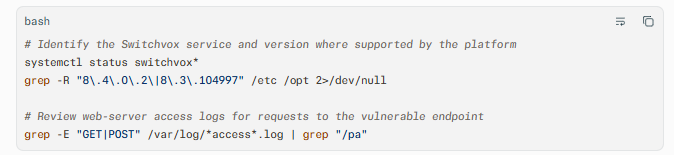
Scanner signatures should look for unauthenticated HTTP requests to /pa containing XML with a <PolycomIPPhone> element and a PhoneIP value containing SQL metacharacters, PostgreSQL-specific syntax, stacked queries, or command-execution payloads.
Log indicators include unexpected POST requests to /pa, XML payloads referencing PhoneIP, unusual SQL errors, anomalous PostgreSQL query volume, new database rows or configuration changes, and unexpected operating-system command execution.
Behavioral anomalies include new cron jobs, unfamiliar binaries, reverse-shell or outbound connection activity from the Switchvox host, modified authentication records, and calls or administrative actions that cannot be tied to a legitimate user. Network exploitation indicators include external sources sending crafted XML to /pa followed by outbound connections from the appliance.
C — Mitigation & Remediation
- Immediate (0–24h): Apply the official Sangoma fix by upgrading Switchvox to version 8.4.0.2 or later. If internet exposure is not required, restrict access to the Switchvox management and
/painterfaces immediately through a firewall, VPN, allowlist, or reverse proxy. - Short-term (1–7d): For systems that cannot be patched immediately, place the appliance behind an access-controlled gateway, limit source IPs to trusted management or telephony systems, and block untrusted inbound access to
/pa. Review web, database, authentication, and system logs for exploitation; preserve relevant evidence before remediation. - Long-term (ongoing): Maintain a vulnerability-management process that prioritizes internet-facing systems and CISA Known Exploited Vulnerabilities. Segment voice infrastructure from general user networks, enforce least privilege for integrations, monitor for anomalous database and process activity, and validate patches through controlled testing.
The vendor update is the definitive remediation. Interim network restrictions reduce exposure but do not repair the unsafe handling of attacker-controlled input in the affected endpoint.
D — Best Practices
- Use parameterized queries or prepared statements for every database operation that incorporates external input, eliminating string concatenation in SQL construction.
- Validate and normalize structured input, including XML fields, against strict expected formats before it reaches application logic or the database.
- Restrict administrative and integration endpoints to trusted networks, and avoid exposing voice infrastructure directly to the internet without a compensating control.
- Monitor Switchvox, web-server, PostgreSQL, and operating-system logs centrally, with alerts for unexpected
/patraffic, SQL errors, and outbound connections. - Patch internet-facing systems on an accelerated schedule, prioritizing vulnerabilities listed in CISA’s Known Exploited Vulnerabilities Catalog
Leave Comment