
CVE-2026-78683: NLTK Unsafe Model Loading Bug - What It Means for Your Business and How to Respond
Introduction
CVE-2026-78683 affects organizations that use Python-based natural language processing tools, especially applications that load machine learning or language model files from external sources. The vulnerability is significant because a malicious file can potentially give an attacker control over the system running the application.
Your business may be exposed even if your team does not directly develop software. Many customer support platforms, document processing tools, chatbots, search products, and analytics systems rely on open-source language libraries behind the scenes. If one of those systems accepts uploaded files, downloads models, or processes third-party content, it may create a path for exploitation.
This post explains what CVE-2026-78683 means for your organization, the business consequences of an exploit, how to determine whether you are affected, and the practical steps to reduce risk. A technical appendix provides detection and remediation guidance for security engineers, IT teams, and penetration testers.
Background & History
CVE-2026-78683 was published on August 25, 2026, and concerns the Natural Language Toolkit, commonly known as NLTK, a widely used Python library for text and language processing. The issue affects NLTK versions before 3.10.0, including version 3.9.4 and earlier releases.
The vulnerability was reported through VulnCheck and documented in NLTK’s security advisory, GHSA-rhp5-r9x4-f5g2. It is classified as unsafe deserialization of untrusted data, a weakness that occurs when software converts data from a file or network source back into an executable program object without sufficiently verifying that the data is safe.
In practical terms, an attacker can craft a model file that, when loaded by a vulnerable application, causes the application to run attacker-controlled code. The National Vulnerability Database lists a CVSS 4.0 base score of 9.4, rated Critical, with a CVSS 3.1 score of 9.6.
The fix was released in NLTK 3.10.0. Organizations should treat any NLTK-dependent application that loads externally sourced parser or model files as potentially exposed until it is updated and validated.
What This Means for Your Business
The core business risk is loss of control over an application server. If an attacker can execute code through a vulnerable NLTK-based workflow, they may be able to access files, steal credentials, alter data, install additional malicious tools, or move from the affected system into other parts of your network.
Operational disruption is a immediate concern. A compromised text-processing service could stop handling customer inquiries, delay document review, corrupt analytical outputs, or force your team to take systems offline for investigation and rebuilding. For organizations that depend on automated customer communication or high-volume document processing, even a short outage can affect revenue and service commitments.
Data exposure is equally important. An application that processes customer messages, contracts, support tickets, medical text, financial records, or employee information may hold sensitive data in memory, logs, databases, or connected storage. Code execution can give an attacker a route to that information.
There are also compliance and contractual consequences. Businesses in the United States and Canada may face notification duties, regulatory scrutiny, customer obligations, and litigation risk after a breach involving personal or regulated data. A vulnerability that enables remote code execution can turn a software defect into a reportable security incident.
Finally, reputation matters. Customers and partners increasingly expect vendors to demonstrate timely patching, secure software supply chains, and credible incident response. A preventable compromise of an AI or automation component can undermine trust well beyond the affected system.
Real-World Examples
Regional financial services firm: A regional bank uses an internal document-classification service built with Python and NLTK to process loan applications and customer correspondence. If the service accepts documents or model updates from a partner system, a malicious file could compromise the processing server and expose applicant data or internal banking workflows.
Mid-sized healthcare technology provider: A healthcare software vendor operates a transcription and clinical-note summarization platform for clinics. A crafted language model file loaded during a maintenance update could allow an attacker to access protected health information, disrupt clinical documentation, and trigger breach-notification obligations.
E-commerce retailer: An online retailer uses an NLTK-based product search and customer-support chat system. An attacker who can influence uploaded content, third-party integrations, or model artifacts could compromise the service, manipulate product recommendations or support responses, and access customer inquiry data.
Small professional services firm: A small legal or accounting firm uses a vendor’s document-review tool that relies on NLTK in its backend. Even without in-house developers, the firm may be affected if its vendor runs a vulnerable version and the tool processes externally supplied files or model updates.
Am I Affected?
- You are running NLTK version 3.9.4 or earlier in any production, staging, development, or embedded environment.
- You use a Python application, API, platform, or vendor product that includes NLTK as a dependency.
- Your application loads NLTK
TransitionParsermodel files, particularly files supplied by users, partners, public repositories, or third-party pipelines. - Your system accepts uploaded documents, model artifacts, plugins, or configuration files that may reach an NLTK parsing workflow.
- Your software supply chain includes machine learning models or serialized Python objects obtained from external sources.
- You cannot confirm that every NLTK-dependent service has been updated to version 3.10.0 or later.
- Your vendor has not provided written confirmation that its product is patched or does not use the affected functionality.
Key Takeaways
- CVE-2026-78683 is a critical unsafe deserialization vulnerability in NLTK versions before 3.10.0.
- The flaw can allow arbitrary code execution when a vulnerable application loads a malicious model file.
- Businesses that process documents, customer communications, or third-party model files face operational, data, compliance, and reputational risk.
- Exposure is not limited to software developers; vendor products and internal automation platforms may also be affected.
- The primary response is to identify every NLTK dependency, upgrade to NLTK 3.10.0 or later, and restrict the sources of model files.
Call to Action
If you cannot confidently identify every application that uses NLTK or verify that its model-loading pathways are secure, treat this as an unresolved risk. IntegSec can help you assess exposure, test exploitable paths, validate remediation, and strengthen the controls that prevent similar software supply chain attacks. Visit https://integsec.com to schedule a penetration test and a practical cybersecurity risk assessment.
Technical Appendix
A — Technical Analysis
CVE-2026-78683 is an unsafe pickle deserialization vulnerability in NLTK’s TransitionParser.parse() method, located in nltk/parse/transitionparser.py. The method calls pickle_load() with restricted=False, causing deserialization to use WarningUnpickler. Because
An attacker who can supply a crafted model file can embed pickle gadget chains that execute arbitrary Python code when the application parses the file. The resulting code runs with the privileges of the user or service account executing the NLTK application.
The attack vector is network-based, with low attack complexity and no privileges required. User interaction is required in the CVSS 4.0 calculation because a user or automated workflow must trigger loading of the malicious model file. The CVSS 4.0 vector is CVSS:4.0/AV:N/AC:L/AT:N/PR:N/UI:P/VC:H/VI:H/VA:H/SC:H/SI:H/SA:H, producing a CVSS-B score of 9.4. The CVSS 3.1 vector is CVSS:3.1/AV:N/AC:L/PR:N/UI:R/S:C/C:H/I:H/A:H, producing a score of 9.6.
The weakness is mapped to CWE-502, Deserialization of Untrusted Data. NLTK includes a RestrictedUnpickler, but the vulnerable production code path does not use it. The issue is resolved in NLTK 3.10.0.
B — Detection & Verification
Version enumeration commands:
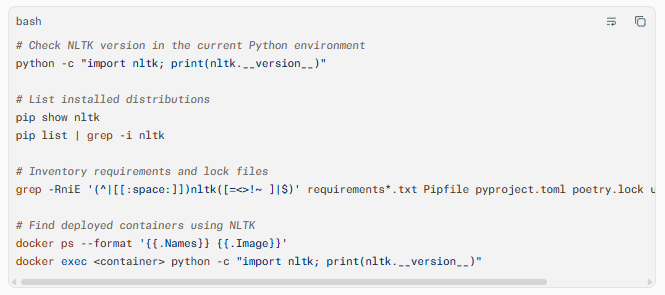
Scanner signatures: Configure vulnerability scanners to flag nltk versions below 3.10.0, including CPE cpe:2.3:a:nltk:nltk:*:*:*:*:*:*:*:* where the version is earlier than 3.10.0. Scanner plugins should also identify Python package manifests, virtual environments, and container images containing affected versions.
Log indicators: Review application logs for TransitionParser.parse() activity, model-file loading events, unexpected pickle errors, and Python exceptions involving nltk.parse.transitionparser. Retain source file paths, request identifiers, uploader identities, and hashes of loaded model artifacts.
Behavioral anomalies: Look for Python worker processes making unusual outbound connections, spawning shells or unexpected child processes, writing executable files, modifying cron or service definitions, or accessing credential stores shortly after loading a model file.
Network exploitation indicators: Monitor for outbound connections from NLP services to unfamiliar IP addresses, unusual DNS requests, HTTP callbacks to attacker-controlled infrastructure, or lateral authentication attempts from service accounts associated with document or model-processing workloads.
C — Mitigation & Remediation
- Immediate (0–24h): Inventory all NLTK dependencies across hosts, containers, serverless functions, and vendor products. Upgrade NLTK to version 3.10.0 or later using the official package release, then rebuild and redeploy affected images and environments.

- Short-term (1–7d): Where immediate patching is not possible, prevent vulnerable services from loading model files from untrusted sources. Disable or restrict
TransitionParserworkflows, require cryptographic signatures for model artifacts, enforce allowlists for approved model repositories, and isolate NLP services in restricted network segments. Review authentication, secrets, and outbound network permissions for affected service accounts. - Long-term (ongoing): Adopt secure deserialization controls across the software supply chain. Use NLTK’s
RestrictedUnpickleror safer formats such as JSON, MessagePack, ONNX, or signed model containers where appropriate. Add software composition analysis to build pipelines, continuously scan container registries, verify artifact integrity, and include model-file handling in application security testing.
Official vendor guidance and the NLTK security advisory should be followed first. Interim controls reduce risk but do not replace upgrading to NLTK 3.10.0 or later.
D — Best Practices
- Treat serialized model files as untrusted input and never load them from unauthenticated or unverified sources.
- Use restricted deserialization mechanisms and deny arbitrary class resolution by default.
- Sign and verify model artifacts before deployment, including hashes, signatures, and provenance metadata.
- Run NLP services with least-privilege service accounts, limited filesystem access, and tightly controlled egress networking.
- Include third-party Python dependencies and machine learning artifacts in continuous vulnerability scanning and penetration testing
Leave Comment