
CVE-2026-78207: ExcelJS Prototype Pollution Bug - What It Means for Your Business and How to Respond
Introduction
If your organization operates a web application, internal portal, reporting platform, or data pipeline that accepts Excel files, CVE-2026-78207 deserves immediate attention. The vulnerability affects ExcelJS, a widely used JavaScript library for reading, creating, and modifying spreadsheet files in Node.js environments. Because many businesses quietly depend on this library through custom applications, vendor software, and automation tools, the exposure may exist in systems that do not prominently advertise Excel functionality.
This flaw allows an attacker to manipulate the way JavaScript objects behave across an application. In practical terms, a malicious spreadsheet or crafted JSON input could interfere with application logic, corrupt data handling, or contribute to broader compromise depending on how the affected application is built. Businesses in finance, healthcare, logistics, insurance, government, and professional services are especially relevant because spreadsheet ingestion is often central to customer onboarding, claims processing, invoicing, reporting, and data exchange.
This post explains the business impact of CVE-2026-78207, helps you determine whether your organization is exposed, and provides a practical response plan. A technical appendix follows for security engineers, penetration testers, and IT teams responsible for remediation.
Background & History
CVE-2026-78207 was published on August 24, 2026, by VulnCheck, which also served as the CVE Numbering Authority. The vulnerability was reported by Matéo Florian Callec. It affects ExcelJS versions from the earliest releases through version 4.4.0, making the entire documented affected range vulnerable at the time of disclosure.
The issue is a prototype pollution vulnerability in ExcelJS’s deepMerge helper. In plain language, the library fails to block specially named properties when merging note objects associated with spreadsheet cells. An attacker can supply malicious JSON through a cell note, causing changes to JavaScript’s shared object foundation and potentially affecting many parts of the application.
The vulnerability carries a CVSS v4.0 base score of 9.3, classified as Critical, with a CVSS v3.1 score of 9.4. It is tracked as CWE-1321, Improperly Controlled Modification of Object Prototype Attributes, commonly known as prototype pollution.
Key timeline events include the public CVE publication on August 24, 2026, an NVD record update on August 31, 2026, and public references to the affected ExcelJS source code and a related GitHub security advisory. Organizations should treat the disclosure date as the starting point for inventory, patching, and verification efforts.
What This Means for Your Business
For a business leader, the central concern is not the JavaScript detail itself. It is that an attacker may be able to submit a specially crafted spreadsheet or JSON payload to an application that uses a vulnerable version of ExcelJS. If that application processes the input without adequate controls, the attacker may alter how the application behaves.
The most direct risk is application integrity. A compromised application process could make incorrect decisions, expose unexpected behavior, bypass intended validation, or produce unreliable outputs. In a billing system, that could mean incorrect invoices. In an insurance workflow, it could affect claim routing or data transformation. In a reporting platform, it could undermine confidence in business-critical numbers.
There is also a data protection concern. Prototype pollution does not automatically mean an attacker can read every database record, but it can be one step in a broader attack chain. If your application combines spreadsheet processing with authentication, file storage, administrative functions, or downstream integrations, the flaw may increase the likelihood of unauthorized access or data manipulation.
Operationally, exploitation could cause application errors, failed jobs, corrupted exports, or outages in workflows that depend on spreadsheet processing. Recovery may require more than applying a patch if attackers have already altered data or introduced persistent changes.
Finally, consider compliance and reputation. Organizations subject to privacy, financial, healthcare, or sector-specific security obligations may need to assess whether the vulnerability created unauthorized access to personal, financial, or regulated information. Customers and partners increasingly expect vendors and service providers to identify vulnerable dependencies quickly and communicate clearly. A timely, documented response can reduce regulatory and reputational damage.
Real-World Examples
Regional bank onboarding portal: A regional bank accepts Excel-based customer and transaction templates through its commercial onboarding portal. An attacker uploads a crafted spreadsheet containing a malicious cell note, potentially interfering with application behavior during file validation. The bank could face fraudulent onboarding activity, disrupted account-opening workflows, and a formal review of customer data handling.
Mid-sized insurance carrier: A claims platform uses ExcelJS to convert adjuster spreadsheets into structured claim records. A malicious file could manipulate processing logic or cause inconsistent claim data. Beyond immediate remediation costs, the carrier may need to notify partners, revalidate affected claims, and demonstrate that policyholder information remained protected.
Healthcare analytics provider: A healthcare analytics vendor ingests Excel exports from hospitals and clinics to generate operational reports. Exploitation could disrupt report generation or alter data transformations used by clinical and administrative stakeholders. Even without confirmed data theft, the provider may face customer concerns about the reliability and security of regulated health data.
Small logistics company: A small logistics firm runs a Node.js dashboard that accepts carrier spreadsheets for shipment updates. A successful attack could interrupt daily operations or corrupt shipment records, delaying deliveries and creating customer-service problems. For a smaller organization, limited security staff can make detection and recovery especially challenging.
Am I Affected?
- You are running ExcelJS version 4.4.0 or earlier in any Node.js application, service, container, or serverless function.
- Your application allows users, partners, customers, or third-party systems to upload Excel files that are processed with ExcelJS.
- Your application accepts JSON input that is merged into spreadsheet cell notes or passed through ExcelJS note serialization.
- You use a commercial product, vendor platform, or internal tool that bundles ExcelJS, even if ExcelJS is not visible in the user interface.
- Your software inventory, container images, or dependency lock files include
exceljswithout a confirmed safe version. - You cannot confirm whether spreadsheet uploads are restricted to trusted internal users or validated before processing.
- You have no detection in place for suspicious
__proto__,constructor, orprototypeproperties in uploaded JSON or spreadsheet-derived data.
If any statement applies, assume potential exposure until your team has completed an inventory and verified the version and usage context.
Key Takeaways
- CVE-2026-78207 is a critical prototype pollution vulnerability in ExcelJS versions through 4.4.0.
- Any application that processes untrusted Excel files or related JSON using a vulnerable version should be treated as potentially exposed.
- Business impact can include disrupted operations, unreliable data processing, unauthorized behavior, compliance concerns, and reputational harm.
- The vulnerability may be hidden inside vendor software, internal tools, containers, and automation pipelines, so dependency inventory is essential.
- Patching is the primary remedy, but input validation, monitoring, and penetration testing reduce the chance that a dependency flaw becomes a business incident.
Call to Action
IntegSec helps organizations identify hidden software dependencies, validate exploitation risk, and prioritize remediation based on real business impact. Our penetration testing team can assess the applications, APIs, and file-processing workflows that may expose your organization to CVE-2026-78207. Visit https://integsec.com to schedule a conversation and take a practical step toward reducing cybersecurity risk.
Technical Appendix
A — Technical Analysis
CVE-2026-78207 is a prototype pollution vulnerability in ExcelJS through version 4.4.0. The root cause is insufficient key filtering in the deepMerge utility, located in lib/utils/under-dash.js in version 4.4.0. The function merges note objects without rejecting dangerous keys such as __proto__, constructor, and prototype.
The reachable path involves note serialization associated with spreadsheet cell notes. An attacker who can cause the application to parse attacker-controlled JSON into a cell note can supply a malicious __proto__ property. During merging, that property modifies Object.prototype, affecting subsequently created plain JavaScript objects within the process.
The attack vector is network-based, with low attack complexity, no required privileges, and no user interaction beyond delivering or causing processing of malicious input. The CNA-assigned CVSS v4.0 vector is CVSS:4.0/AV:N/AC:L/AT:N/PR:N/UI:N/VC:H/VI:H/VA:L/SC:N/SI:N/SA:N, producing a CVSS-B score of 9.3. A CVSS v3.1 score of 9.4 is also recorded.
The weakness is classified as CWE-1321, Improperly Controlled Modification of Object Prototype Attributes, also known as prototype pollution. NVD notes that its enrichment assessment has not yet been provided, so organizations should rely on the CNA record, vendor advisory, and internal verification when prioritizing remediation.
B — Detection & Verification
Version enumeration commands:
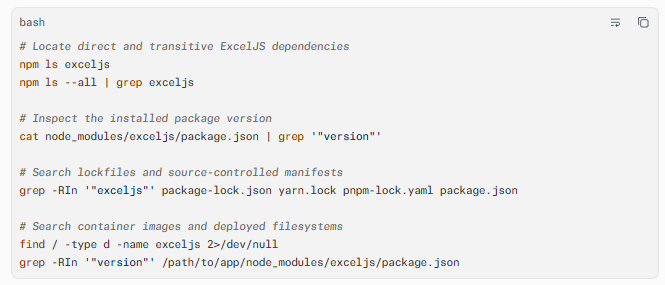
Scanner signatures: Configure dependency scanning for exceljs versions less than or equal to 4.4.0. Software composition analysis tools should flag the package using CVE-2026-78207, GHSA-qwr4-7h29-chpf, and CWE-1321. Container and serverless image scans should include both production and build-time dependency layers.
Log indicators: Review application logs for spreadsheet uploads followed by JSON parsing errors, unexpected property assignment failures, exceptions in note processing, or abnormal behavior in code that creates or reads plain objects. Preserve the original uploaded file, request metadata, user identity, source IP, and downstream job results.
Behavioral anomalies: Look for unexplained changes in application behavior after spreadsheet ingestion, including altered validation outcomes, unexpected object properties, failed background jobs, corrupted exports, or privilege-related logic behaving inconsistently.
Network exploitation indicators: Monitor for uploads containing cell notes or JSON structures that include __proto__, constructor, or prototype keys. Treat repeated attempts to submit these keys as high-priority investigation events, particularly when they originate from untrusted networks or accounts.
C — Mitigation & Remediation
1. Immediate (0–24h): Inventory every application, container, serverless function, and vendor product that includes ExcelJS. Identify versions and determine whether the application processes untrusted Excel files or JSON. Block or quarantine spreadsheet uploads to affected services where feasible. Apply virtual patching at the web application firewall or API gateway to reject request payloads containing suspicious prototype-related keys, while recognizing that this is an interim control rather than a complete fix.
2. Short-term (1–7d): Apply the official vendor patch or upgrade as soon as a fixed ExcelJS release is available and validated in your environment. The CVE record identifies all versions through 4.4.0 as affected, so do not assume that remaining on 4.4.0 is safe. Rebuild container images, redeploy serverless functions, update lockfiles, and verify that no transitive dependency reintroduces a vulnerable version. Add regression tests using malicious __proto__, constructor, and prototype keys in note-related JSON.
3. Long-term (ongoing): Implement secure JSON merging practices that explicitly reject dangerous keys, use objects without inherited prototypes where appropriate, and avoid recursively merging untrusted input into sensitive application objects. Enforce strict schema validation for spreadsheet-derived data, limit upload size and file types, isolate file-processing workloads, and continuously monitor dependencies through software composition analysis. Include spreadsheet ingestion paths in regular penetration tests and threat modeling.
D — Best Practices
- Reject
__proto__,constructor, andprototypekeys before merging any untrusted JSON into application objects. - Validate spreadsheet content against a strict schema before it reaches parsing, transformation, or persistence logic.
- Keep ExcelJS and all transitive dependencies current through automated dependency scanning and patch management.
- Isolate file-processing services so a compromised parsing workload cannot directly access databases, administrative interfaces, or production credentials.
- Test upload and import functionality with adversarial spreadsheet and JSON inputs during routine penetration testing.
- Maintain an accurate software bill of materials so vulnerable JavaScript libraries can be located quickly across applications, containers, and vendor products
Leave Comment