
CVE-2026-75501: Calix GS7 XGS Router UPnP Authentication Bug - What It Means for Your Business and How to Respond
CVE-2026-75501 concerns a reported missing-authentication issue in Calix GS7 XGS residential routers that could have allowed an internet-facing attacker to change network address translation port-forwarding rules. The report was serious because those routers are commonly used by broadband providers, and successful exploitation could expose devices behind a home or small-office network to the public internet.
Your organization should pay attention if it manages remote employees, branch offices, executive home networks, or small business locations that use ISP-provided Calix equipment. The issue was initially assessed as high severity, but subsequent investigation by CERT/CC and Calix concluded that the reported behavior could not be reproduced and that the vulnerability was not valid under normal Calix firmware and configuration.
This post explains the original disclosure, the practical business risk, how to determine whether your environment warrants review, and the detection, mitigation, and hardening actions security teams should still consider. It also explains the important retraction, so your team can respond based on the current evidence rather than acting on outdated alerts.
Background & History
CVE-2026-75501 was publicly disclosed on August 21, 2026, through CERT/CC vulnerability note VU#756733. The researcher credited in the advisory is Brian Khan Quintana.
The reported issue involved Calix GS7 XGS residential gateways, specifically the GS5239XG model, running EXOS/6.6.47 firmware. The researcher reported that the router’s UPnP WANIPConnection service, implemented through MiniUPnPd, was reachable from the public WAN interface on TCP port 5000 and accepted SOAP requests without authentication.
In plain language, UPnP is a convenience feature that lets devices inside a network automatically ask the router to open pathways through its firewall. The reported flaw was that an outsider might be able to make those requests too, creating port-forwarding rules that exposed internal devices. CISA’s Added Data Program assigned a CVSS 3.1 base score of 7.5, High, with the vector CVSS:3.1/AV:N/AC:L/PR:N/UI:N/S:U/C:N/I:H/A:N.
The timeline changed materially after disclosure. Calix was notified on July 7, 2026, published a vendor statement on September 9, 2026, and CERT/CC revised the advisory on September 15, 2026, retracting the vulnerability note after joint analysis found the reported remote access path could not be reproduced.
What This Means for Your Business
Even though CVE-2026-75501 was retracted, it remains a useful case study in third-party network risk. If your employees work from home or your organization operates small sites using ISP-managed routers, the boundary between those locations and your corporate systems may depend on equipment you do not directly administer.
Had the reported issue been exploitable, an attacker could have created port-forwarding rules that exposed cameras, storage devices, printers, development systems, or other equipment on a home network. That could have led to unauthorized access, data theft, ransomware entry points, or use of an employee’s network as a staging area for attacks against your business systems.
The business consequences would extend beyond the immediate technical incident. A compromised remote-work network can interrupt operations, expose customer or employee data, trigger breach-notification obligations, damage customer trust, and complicate contractual or regulatory obligations. Organizations in healthcare, financial services, legal services, and government contracting often face heightened scrutiny when remote access controls fail.
The current status is reassuring: Calix stated that its default WAN firewall blocks inbound traffic to TCP port 5000 before it reaches the UPnP service, and CERT/CC found that the security controls performed as designed across multiple devices, firmware releases, and configurations. Your response should therefore emphasize verification and network hygiene, not emergency patching for this specific CVE.
Real-World Examples
Regional bank with hybrid staff: A regional bank allows loan officers to work from home using ISP-provided routers. If a router flaw exposed an employee’s file-sharing device, attackers could attempt to reach corporate credentials, documents, or remote-access tools stored or used on that network.
Small medical practice: A small clinic uses a home-style router at an administrative office. Exposure of a network-attached storage device containing patient scheduling information could create a privacy incident, disrupt appointment operations, and require notification review under applicable health-privacy rules.
Regional utility contractor: A field-services contractor relies on home-office networks for project bids, site plans, and client communications. A router compromise could expose intellectual property and client data, while also undermining confidence during contract renewals or security reviews.
Mid-market software company: A software company supports remote engineers whose home networks connect to development environments. If an internal device were exposed, attackers could probe for unpatched services, stolen credentials, or misconfigured remote-access software, increasing the risk of source-code or customer-data exposure.
Am I Affected?
- You use Calix GS7 XGS gateways, particularly the GS5239XG model, at employee homes, branch offices, or small business sites.
- Those devices were reported as running EXOS/6.6.47 firmware at the time of the original disclosure.
- Your broadband provider provisioned the router and you cannot directly inspect its firmware, firewall rules, or UPnP configuration.
- UPnP is enabled on routers used for remote work, even though this specific reported issue was retracted.
- TCP port 5000 is reachable from the public internet on any network device you manage.
- Your organization permits employees to access internal systems from home networks without a managed VPN, zero-trust access solution, or equivalent control.
- You have unmanaged IoT devices, cameras, storage systems, printers, or test equipment connected to remote-work networks.
- Your incident-response or vendor-risk process has no way to confirm router firmware, configuration, and ISP security responsibilities.
Key Takeaways
- CVE-2026-75501 was originally reported as a high-severity missing-authentication flaw in Calix GS7 XGS routers that could allow unauthenticated changes to port-forwarding rules.
- CERT/CC retracted the vulnerability after further testing, and Calix reported that its default WAN firewall blocks the reported access path.
- Organizations with remote workers or ISP-managed routers should still verify device models, firmware status, UPnP settings, and internet-facing exposure.
- The main business risk is not this retracted CVE alone, but the broader dependence on home and small-office network equipment that may sit outside normal IT oversight.
- Disabling unnecessary UPnP, filtering unnecessary inbound ports, and requiring managed remote access reduce risk from both known and future router weaknesses.
Call to Action
If your organization supports remote work, distributed offices, or third-party-managed network equipment, IntegSec can help you validate exposure and strengthen the controls that matter most. Our penetration testing team assesses internet-facing systems, remote-access paths, network segmentation, and the human and technical gaps that attackers actually exploit. Visit https://integsec.com to schedule a conversation and turn vulnerability alerts into a practical, prioritized risk-reduction plan.
Technical Appendix
A — Technical Analysis
CVE-2026-75501 was reported against the Calix GS7 XGS GS5239XG residential gateway running EXOS/6.6.47 firmware. The reported root cause was missing authentication for a security-critical UPnP function: the MiniUPnPd 2.3.7 WANIPConnection SOAP service was described as bound to the public WAN interface on TCP port 5000 without access controls.
The reported attack vector was network-based and required no privileges, user interaction, or special conditions. An unauthenticated remote attacker could allegedly send crafted SOAP requests to add, delete, or enumerate NAT port mappings, or query the gateway’s external IP address. The reported impact was an integrity failure because an attacker could alter the NAT boundary and expose internal LAN services.
CISA-ADP assigned CWE-306, Missing Authentication for Critical Function, and a CVSS 3.1 score of 7.5 High: CVSS:3.1/AV:N/AC:L/PR:N/UI:N/S:U/C:N/I:H/A:N. NVD itself had not provided its own base score at the time of enrichment and marked the record as awaiting enrichment.
Critically, CERT/CC retracted VU#756733 on September 15, 2026. Calix’s testing found that the default WAN firewall drops inbound traffic to TCP port 5000 before it reaches the UPnP daemon, and the behavior could not be reproduced across multiple models, firmware releases, laboratory gateways, and a live gateway with a public IP address.
B — Detection & Verification
Version enumeration should begin with asset inventory and ISP coordination. For managed Calix devices, identify the model, serial number, EXOS firmware release, provisioning profile, and administrative ownership. The originally reported affected version was EXOS/6.6.47 on the GS5239XG.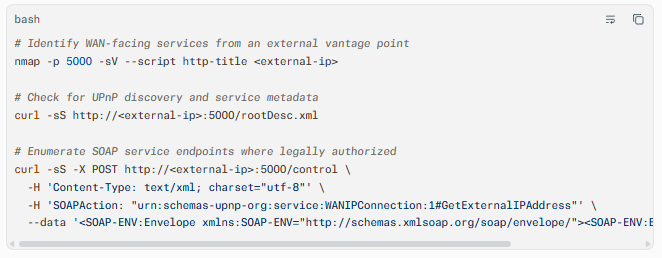
Scanner signatures should look for an HTTP service on TCP port 5000, MiniUPnPd identification, UPnP WANIPConnection SOAP endpoints, and unauthenticated AddPortMapping, DeletePortMapping, GetGenericPortMappingEntry, or GetExternalIPAddress actions.
Log indicators include unexpected inbound TCP/5000 connections, SOAP requests containing AddPortMapping, DeletePortMapping, or WANIPConnection, and new or unexpected NAT forwarding rules. Behavioral anomalies include a camera, NAS device, administrative interface, or internal service becoming reachable from the internet without a documented change.
C — Mitigation & Remediation
- Immediate (0–24h): Confirm current vendor status and exposure. Do not treat CVE-2026-75501 as an active, exploitable flaw in standard Calix deployments: CERT/CC retracted the advisory and Calix stated that no customer configuration change, software update, or corrective action is required. Confirm device models, firmware versions, ISP provisioning, and whether TCP port 5000 is reachable from an external testing vantage point.
- Short-term (1–7d): Reduce unnecessary router functionality and exposure. Disable UPnP where business needs do not require it, especially on networks used for remote work or sensitive processing. Where UPnP is required, restrict it to explicitly approved devices and review NAT mappings. If the router administrative interface does not permit UPnP changes, ask the ISP to disable it or filter inbound TCP port 5000 at the provider or perimeter firewall.
- Long-term (ongoing): Govern third-party network equipment. Maintain an inventory of employee-home and branch-office routers, require managed VPN or zero-trust access for corporate resources, and establish a vendor process for firmware, configuration, and vulnerability verification. Include ISP-managed devices in asset management, incident response, and periodic external attack-surface reviews.
Official vendor guidance takes precedence. Calix’s position is that standard EXOS firmware blocks the reported WAN access path, and CERT/CC’s retraction means organizations should validate their own environment rather than deploy a patch for this CVE.
D — Best Practices
- Disable UPnP by default and permit it only for documented, business-required devices.
- Block unsolicited inbound traffic to router management and UPnP service ports, including TCP port 5000 where not required.
- Require managed VPN or zero-trust access for corporate systems rather than relying on home-router port forwarding.
- Maintain an inventory of ISP-managed routers, firmware versions, administrative contacts, and network boundaries.
- Test internet-facing exposure regularly and retain evidence of configuration, patch, and vendor-communication decisions
Leave Comment