
CVE-2026-68770: sentence-transformers Security Control Bypass - What It Means for Your Business and How to Respond
Introduction
This vulnerability matters because it undermines a security control that many AI-dependent applications rely on to safely load machine learning models. Your organization faces risk if it uses the sentence-transformers library in any AI pipeline, especially where models are loaded from local directories or shared storage. This post explains the business implications, helps you determine whether you are affected, and outlines practical steps to reduce exposure. You will learn how this flaw could disrupt operations, compromise sensitive data, and damage your reputation with customers and partners. We also provide clear guidance on detection, verification, and remediation actions your team can take immediately.
Background & History
CVE-2026-68770 was publicly disclosed on July 31, 2026, and affects the sentence-transformers library, a widely adopted Python package for generating text embeddings used in search, recommendation, and natural language processing applications. The vulnerability was reported through coordinated disclosure channels and carries a CVSS v3.1 base score of 9.8, marking it as critical severity. At its core, this is a security control bypass that enables arbitrary code execution through a logic flaw in how the library validates whether to trust remote code. The affected component is the import_module_class helper function located in sentence_transformers/util/misc.py. The National Vulnerability Database (NVD) published details on August 1, 2026, and the flaw is classified under CWE-94, which covers improper control of code generation. Versions 5.5.1 and earlier of sentence-transformers are impacted, and the vendor has since released patched versions to address the issue.
What This Means for Your Business
Your business faces direct operational risk if AI-powered features depend on sentence-transformers for tasks such as semantic search, document classification, or customer intent analysis. An attacker who can place malicious files in a model directory your application accesses could execute arbitrary code on your systems without triggering the trust_remote_code=False safeguard your developers may have explicitly configured. This means sensitive customer data, proprietary algorithms, or internal communications processed by affected systems could be exposed or altered. Beyond immediate technical compromise, your organization could face regulatory scrutiny under data protection laws in the United States and Canada, including potential violations of sector-specific requirements in finance, healthcare, or government contracting. Reputational damage is another serious concern—customers and partners expect AI systems to operate securely, and a breach traced to a known but unaddressed vulnerability could erode trust significantly. Compliance teams should also consider how this flaw intersects with software supply chain risk management expectations increasingly embedded in procurement and audit frameworks.
Real-World Examples
Regional Financial Institution: A credit union uses sentence-transformers to power its internal document search system for loan applications. An insider with access to the shared model storage directory places a malicious Python file referenced in modules.json. When the search service reloads the model overnight, the code executes with service account privileges, exfiltrating customer financial records to an external server.
Healthcare Technology Vendor: A company providing patient intake automation loads embedding models from a network-mounted directory to support multiple clinic locations. An attacker who compromises a low-privilege workstation gains write access to the model folder. Subsequent model loads at each clinic execute the attacker's code, creating a foothold for lateral movement across the healthcare network.
E-Commerce Platform: An online retailer runs a recommendation engine that uses sentence-transformers to match product descriptions with customer queries. The model directory is writable by a continuous integration pipeline that pulls updated models from a third-party repository. A compromised build artifact introduces malicious code, leading to unauthorized access to the retailer's customer database and payment processing logs.
Legal Services Firm: A mid-sized law firm deploys an internal research tool that embeds case documents using sentence-transformers. The model files reside on a shared drive accessible to contract staff. A temporary worker with limited training inadvertently downloads a tampered model package from an unverified source, triggering code execution that exposes confidential client communications.
Am I Affected?
Use this checklist to determine whether your organization is exposed to CVE-2026-68770:
- You are running sentence-transformers version 5.5.1 or earlier in any production, staging, or development environment.
- Your application loads embedding models from local directories, network shares, or any filesystem path an attacker could influence.
- Your AI pipeline downloads or caches models from external sources without strict integrity verification.
- Your development or operations teams rely on trust_remote_code=False as the primary safeguard against untrusted model code.
- Your software supply chain includes third-party packages or containers that bundle sentence-transformers without explicit version pinning.
Key Takeaways
- CVE-2026-68770 is a critical vulnerability that bypasses security controls in sentence-transformers, enabling arbitrary code execution even when trust_remote_code=False is set.
- Organizations using sentence-transformers version 5.5.1 or earlier in AI applications face significant operational, data, and compliance risks.
- Attackers can exploit this flaw by placing malicious files in model directories your application accesses, making supply chain and filesystem access controls essential.
- Immediate patching to a vendor-released version is the most effective remediation, with interim mitigations available for environments that cannot patch right away.
- Proactive verification of model provenance and strict access controls on model storage locations reduce the likelihood of successful exploitation.
Call to Action
Your AI infrastructure deserves the same rigorous security scrutiny as your core business systems. IntegSec specializes in penetration testing for AI and machine learning environments, helping organizations in the United States and Canada identify and remediate vulnerabilities before attackers do. Contact us today for a comprehensive assessment of your AI stack, including deep analysis of third-party dependencies like sentence-transformers. Visit https://integsec.com to schedule your engagement and take a confident step toward meaningful cybersecurity risk reduction.
Technical Appendix
A — Technical Analysis
The root cause of CVE-2026-68770 lies in a logic flaw within the import_module_class helper function in sentence_transformers/util/misc.py. The guard condition intended to enforce trust_remote_code=False includes an "or os.path.exists(model_name_or_path)" clause, which satisfies the trust gate whenever the supplied path exists on the local filesystem. This allows attackers who can control or influence the contents of a model directory to place malicious Python files—such as modeling_*.py referenced via modules.json—that execute at import time. The attack vector is network-based (AV:N) with low complexity (AC:L), requires no privileges (PR:N), and involves no user interaction (UI:N). The CVSS v3.1 vector string is CVSS:3.1/AV:N/AC:L/PR:N/UI:N/S:U/C:H/I:H/A:H, reflecting high impact across confidentiality, integrity, and availability. The vulnerability is tracked in the NVD under CVE-2026-68770 and maps to CWE-94 (Improper Control of Generation of Code) and CWE-454 (External Influenced Control Variable).
B — Detection & Verification
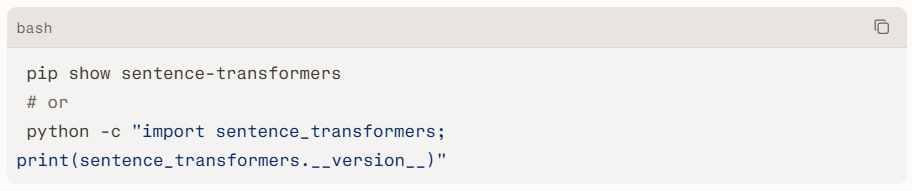
Version Enumeration:
Scanner Signatures:
- Vulnerability scanners should flag sentence-transformers <= 5.5.1 as affected.
- Software composition analysis (SCA) tools can detect the package version in requirements.txt, Pipfile, or pyproject.toml.
Log Indicators:
- Unexpected Python module imports during model loading, particularly modeling_*.py files not part of the official distribution.
- Anomalous subprocess execution or network connections initiated during SentenceTransformer initialization.
Behavioral Anomalies:
- Model loading times that deviate significantly from baseline due to additional code execution.
- Unusual file system activity in model directories during application startup.
Network Exploitation Indicators:
- Outbound connections from AI service hosts to unknown IPs or domains during model import.
- DNS queries for domains not associated with legitimate model repositories or Hugging Face infrastructure.
C — Mitigation & Remediation
1. Immediate (0–24h): Upgrade to patched version
- Update sentence-transformers to the latest vendor-released version that addresses CVE-2026-68770.
- Command:
pip install --upgrade sentence-transformers - Verify the installed version is greater than 5.5.1.
2. Short-term (1–7d): Restrict model directory access
- Apply strict filesystem permissions to model storage locations, limiting write access to trusted service accounts only.
- Audit all directories from which models are loaded and remove write permissions for non-essential users.
- Implement integrity checks (e.g., SHA-256 hashes) for model files and validate before loading.
3. Long-term (ongoing): Harden AI supply chain
- Pin dependency versions in requirements files and use lock files (e.g., Pipfile.lock, poetry.lock) to prevent unintended upgrades or downgrades.
- Integrate SCA tools into CI/CD pipelines to detect vulnerable versions of sentence-transformers and other AI libraries.
- Adopt a policy of loading models only from verified, immutable sources—preferably signed artifacts from trusted registries.
- Consider containerizing AI workloads with read-only filesystems for model directories where feasible.
Interim Mitigations for Unpatchable Environments:
- If immediate patching is not possible, isolate model loading processes in sandboxed environments with minimal privileges.
- Disable network access for services that load models until patches can be applied.
- Monitor model directories with file integrity monitoring (FIM) tools to detect unauthorized changes.
D — Best Practices
- Always verify the provenance and integrity of third-party AI models before loading them into production environments.
- Treat trust_remote_code=False as a defense-in-depth control, not a standalone safeguard against untrusted code.
- Implement strict access controls and audit logging for any filesystem paths used to store or cache AI models.
- Incorporate AI-specific threat modeling into your secure development lifecycle to identify supply chain risks early.
- Regularly review and update dependency versions in AI pipelines using automated tools and vendor security advisories.
Leave Comment