
CVE-2026-6727: TPM 2.0 RSA OAEP Timing Side-Channel Vulnerability - What It Means for Your Business and How to Respond
Introduction
CVE-2026-6727 matters because it affects a foundational security component used to protect laptops, servers, and cloud workloads: the Trusted Platform Module, or TPM. A successful attack could expose protected cryptographic material and, in some cases, make a device appear more trustworthy than it really is.
Your organization may be exposed if it uses Windows or Linux endpoints, servers with TPM-backed disk encryption or certificate protection, or virtual machines that rely on a software TPM. The issue is especially relevant to organizations that use device health checks, secure boot evidence, or hardware-backed identity as part of their security controls.
This post explains who is affected, what the vulnerability could mean for operations and compliance, and how to prioritize remediation. A technical appendix provides detection, verification, and remediation guidance for security engineers and IT teams.
Background & History
CVE-2026-6727 was publicly disclosed on August 11, 2026, through a coordinated advisory from CERT/CC and the Trusted Computing Group, under advisory reference TCGVRT0011. The issue was reported by security researchers from Intel: Liran Perez, Zecharye Galitzky, Shai Sarfati, and Yanai Moyal.
The flaw exists in the TPM 2.0 reference implementation, specifically in its RSA OAEP decryption routine. In plain language, the implementation takes slightly different amounts of time depending on the data it processes. An attacker who can repeatedly send commands to the TPM and measure those timing differences may be able to recover information that should remain secret.
The Trusted Computing Group lists TPM 2.0 reference code through version v184 as affected. CISA’s authoritative vulnerability enrichment assigns a CVSS 3.1 base score of 5.9, Medium severity, although AMD separately rates the issue High at 8.3 under CVSS 4.0 because of its potential confidentiality and integrity consequences.
What This Means for Your Business
A TPM is designed to protect sensitive keys and prove that a device is in a trustworthy state. If an attacker can extract protected information or forge attestation evidence, the impact extends beyond a single endpoint. It can weaken the trust your organization places in the devices and workloads that access corporate systems.
Operationally, exploitation requires privileged local access to the TPM command interface. That means a remote attacker cannot simply scan your network and trigger the flaw. The greater concern is an attacker who already gains access to a privileged workstation, server, administrative session, or compromised virtual machine and then uses the TPM as a stepping stone to deeper access.
From a data-protection perspective, the vulnerability could expose ciphertext protected by TPM-managed RSA keys, including import blobs, credential blobs, session salts, and data encrypted to the RSA Endorsement Key. If those materials protect disk encryption keys, credentials, or certificate-related secrets, the result could be unauthorized access to systems or data.
Reputation and compliance risks follow from the integrity impact. Many security frameworks rely on device attestation to demonstrate that endpoints are healthy and trustworthy. If an attacker can create fraudulent TPM 2.0 attestations, your organization may need to reevaluate whether attestation-based access decisions can still be trusted, document the incident response, and notify customers or regulators where contractual or legal obligations apply.
Real-World Examples
Regional financial services firm: A privileged contractor workstation is compromised through a phishing-derived credential theft attack. The attacker uses local TPM access to attempt recovery of protected key material and forge a device attestation, potentially gaining access to a payment-processing environment while appearing to use a compliant corporate device.
Mid-sized healthcare provider: Clinician laptops use TPM-backed encryption and device compliance checks. If an attacker compromises an IT administrator workstation and exploits the flaw, stolen credential or key material could expose patient systems and create evidence challenges during a HIPAA-related security assessment.
SaaS company operating cloud workloads: Virtual machines use a software TPM for workload identity and attestation. A compromised tenant workload with elevated privileges could target the TPM interface, potentially undermining assurances that only approved workloads can access sensitive customer data or production services.
Public-sector agency: A fleet of managed endpoints relies on TPM-backed certificates for VPN and internal application access. A successful local attack against a privileged endpoint could enable fraudulent device identity or attestation, allowing an attacker to bypass controls that assume hardware-backed trust.
Am I Affected?
- You are running a TPM 2.0 implementation derived from the Trusted Computing Group reference code at version v184 or earlier.
- You use devices with firmware TPMs from vendors that have confirmed exposure, including AMD and Intel platforms identified in vendor advisories.
- You operate Windows endpoints or servers and have not applied the relevant August 2026 or later operating system and firmware updates.
- You run cloud or virtualized workloads that depend on a software TPM implementation built from the affected TCG code, particularly builds that avoid OpenSSL RSA functions.
- You use TPM-backed disk encryption, credential protection, certificate enrollment, secure boot evidence, or device attestation in access decisions.
- You allow broad local administrative privileges on endpoints, servers, or virtual machines, increasing the number of users and processes that could reach the TPM command interface.
- You cannot confirm that your device manufacturer, TPM vendor, hypervisor provider, or cloud provider has issued and deployed a fix.
Key Takeaways
- CVE-2026-6727 is a timing side-channel flaw in TPM 2.0 RSA OAEP decryption that may allow a privileged local attacker to recover protected cryptographic information.
- The most serious business risk is not a simple remote attack, but an attacker using an already compromised privileged endpoint, server, or virtual machine to weaken device trust.
- Potential consequences include exposure of TPM-protected ciphertext and, under certain conditions, forged TPM 2.0 attestations.
- Organizations using TPM-backed encryption, certificates, secure boot evidence, or device compliance should treat affected firmware and software TPMs as a priority remediation item.
- Apply vendor-provided TPM firmware, operating system, hypervisor, or cloud-provider updates, and reduce privileged local access while remediation is underway.
Call to Action
If your organization relies on TPM-protected endpoints, servers, or cloud workloads, do not wait for an attacker to test your assumptions about hardware-backed trust. IntegSec can help you identify exposed platforms, validate patch coverage, assess privileged-access pathways, and test whether your attestation and key-protection controls hold up under realistic attack conditions. Contact IntegSec for a penetration test and a practical cybersecurity risk-reduction plan at https://integsec.com.
Technical Appendix
A — Technical Analysis
CVE-2026-6727 is an observable timing discrepancy, classified as CWE-208, in the RSA OAEP decryption implementation of the Trusted Computing Group TPM 2.0 reference code. The affected component processes RSA OAEP ciphertext through TPM commands, and variations in execution time can leak information about protected plaintext or intermediate cryptographic values.
The attack vector is local, with the attacker requiring access to the TPM command interface. Public scoring differs by scoring system: CISA-ADP assigns CVSS 3.1 5.9 with the vector CVSS:3.1/AV:L/AC:H/PR:N/UI:N/S:C/C:H/I:N/A:N, while AMD assigns CVSS 4.0 8.3 with AV:L/AC:L/AT:N/PR:H/UI:N/VC:H/VI:H/VA:N/SC:N/SI:N/SA:N. The difference reflects differing assumptions about attack complexity and required privileges.
Successful exploitation may allow decryption of ciphertext encrypted to TPM-managed RSA keys, including the RSA Endorsement Key, and may expose import blobs, credential blobs, and session salts. Under certain conditions, it may also enable forgery of TPM 2.0 attestations. The NVD reference is https://nvd.nist.gov/vuln/detail/CVE-2026-6727.
B — Detection & Verification
Version enumeration commands:
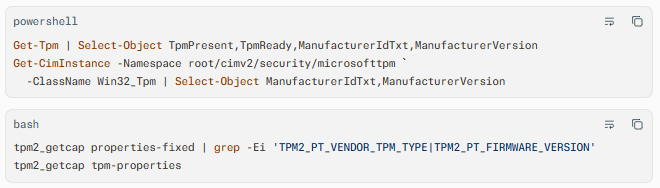
Scanner signatures: Vulnerability scanners should flag TCG TPM 2.0 reference-derived implementations at version v184 or earlier, as well as vendor-specific firmware, OS, hypervisor, or cloud-agent versions identified in vendor advisories. Intel identifies affected CSME and SPS firmware families and fixed versions, including 11.13.6, 11.23.6, and 11.9.6 depending on platform generation.
Log indicators: Review privileged-process creation around TPM tooling and device-management interfaces, unexpected execution of tpm2_* utilities, unusual use of Windows TPM WMI interfaces, and administrative sessions immediately followed by TPM command activity. Correlate these events with endpoint detection alerts, credential-access behavior, and lateral-movement indicators.
Behavioral anomalies: Look for repeated TPM command execution against RSA OAEP-related operations, unusually high command rates from a single privileged process, and timing-measurement patterns that do not match normal attestation or key-use workflows.
Network exploitation indicators: Direct network exploitation is not the expected pattern because the attack requires local TPM command-interface access. In virtualized environments, monitor for a guest workload repeatedly invoking the virtual TPM device or hypervisor TPM backend, particularly from a compromised or unusually privileged workload.
C — Mitigation & Remediation
- Immediate (0–24h): Inventory and contain exposure. Identify all physical endpoints, servers, virtual machines, and cloud workloads with TPM 2.0 enabled. Prioritize privileged administrative systems, domain controllers, certificate authorities, payment systems, and workloads using TPM-backed attestation. Restrict local administrator rights, enforce privileged access workstations, and monitor TPM-related command activity on high-value assets.
- Short-term (1–7d): Apply vendor fixes and validate coverage. Install the official vendor patch first. For Windows environments, deploy the applicable August 2026 or later cumulative updates identified by Microsoft and verify the underlying TPM or platform firmware update from the device manufacturer. For Intel CSME and SPS platforms, install the latest firmware supplied by the system manufacturer; Intel identifies fixed versions including 11.13.6, 11.23.6, and 11.9.6 by platform family. For AMD platforms, apply the updated fTPM firmware or system firmware provided through AMD and OEM channels. Where immediate patching is not possible, use interim mitigations: remove unnecessary local administrator rights, prevent untrusted code from running with sufficient privilege to access the TPM interface, isolate affected virtual machines from sensitive management networks, and avoid making high-risk access decisions solely on TPM attestation until remediation is confirmed.
- Long-term (ongoing): Harden hardware trust and patch management. Maintain a hardware and firmware inventory that includes TPM model, firmware version, OEM, and patch status. Require vendor advisories to trigger firmware update workflows, not only operating system patches. Use layered controls around privileged access, validate attestation policies against current vendor guidance, and include TPM and firmware checks in routine vulnerability management and penetration testing.
Vendor guidance: CERT/CC recommends installing TPM firmware, operating system, or software patches supplied by the platform or TPM vendor. Cloud customers using software-based TPM implementations should follow their provider’s guidance to determine whether additional tenant-side action is required.
D — Best Practices
- Maintain an authoritative inventory of TPM implementations, firmware versions, OEM platforms, and virtual TPM dependencies across endpoints, servers, and cloud workloads.
- Apply TPM, chipset, system firmware, operating system, hypervisor, and cloud-provider updates through a coordinated patch-management process.
- Limit local administrative privileges and restrict which users, services, and automation tools can invoke TPM command interfaces.
- Avoid relying exclusively on TPM attestation for high-value access decisions; combine it with identity, endpoint posture, network context, and continuous monitoring.
- Include firmware and hardware-root-of-trust assumptions in penetration tests, threat models, and incident response playbooks
Leave Comment