
CVE-2026-6726: TPM 2.0 Information Leakage Bug - What It Means for Your Business and How to Respond
CVE-2026-6726 is a high-severity vulnerability affecting the Trusted Computing Group’s TPM 2.0 reference code, a foundation used in hardware and firmware that helps organizations establish trusted device identities and protect cryptographic keys. The flaw matters because it can weaken assurance in TPM-backed credentials and device attestations, controls many businesses use to support secure access, endpoint management, encryption, and certificate-based authentication.
Your organization may be at risk if it uses endpoints, servers, embedded systems, virtualized platforms, or cloud services with TPM implementations derived from affected reference code. Exploitation requires elevated local access, so this is not an unauthenticated internet attack. Still, a compromised administrator account, malicious insider, or attacker who has already gained high privileges could use the weakness to undermine a deeper layer of trust. This post explains the business implications, practical exposure checks, and remediation priorities.
Background & History
CVE-2026-6726 was publicly disclosed on August 11, 2026, and is tracked by the Trusted Computing Group as TCGVRT0010. It affects TPM 2.0 reference-code revisions through version 184. TPMs are security components, implemented as hardware chips, firmware, or software, that support cryptographic operations and help systems demonstrate that a device or key should be trusted.
The issue was reported by Intel researchers Liran Perez, Zecharye Galitzky, Shai Sarfati, and Yanai Moyal, with coordination involving the Trusted Computing Group and CERT Coordination Center. The vulnerability received a CVSS 3.1 score of 7.9 out of 10, rated High by CISA’s Authorized Data Publisher assessment. In plain language, it is an information-leakage flaw that could allow a local attacker who already has elevated privileges to obtain a certificate for a falsified TPM key, then use that key to create fraudulent TPM attestations. Vendors were notified during the coordinated disclosure process, and firmware, operating-system, and software updates began appearing around the public release.
What This Means for Your Business
For your business, CVE-2026-6726 is primarily a trust-integrity problem. It does not mean every device with a TPM has been breached, and it is not known as a remote, one-click attack. However, if an attacker first obtains high-level access to a vulnerable endpoint or server, this weakness may help them make a false device identity or key appear legitimate to systems that rely on TPM-backed proof.
That can affect decisions your environment makes about whether a device is healthy, whether a certificate request should be approved, or whether a workload should be treated as trusted. In an organization that uses TPM-backed authentication or device compliance for access controls, the resulting risk is not limited to a single laptop. It can extend to identity workflows, remote-access policies, protected keys, and evidence used during security investigations.
Operationally, remediation requires coordination across information technology, endpoint management, infrastructure, and possibly cloud teams. You may need to schedule firmware updates, verify recovery procedures, and identify critical systems that use TPM-based attestation. From a compliance perspective, organizations subject to U.S. or Canadian privacy, financial-services, healthcare, or contractual security requirements should document their exposure assessment, remediation decisions, and compensating controls. Prompt, evidence-based action also protects customer confidence if questions arise about the reliability of your security controls.
Real-World Examples
A regional bank: A regional bank uses TPM-backed device certificates to help determine whether employee laptops are eligible to access internal financial systems. If an attacker gains privileged control of an unpatched endpoint, they could potentially obtain credentials for a falsified TPM key and make a fraudulent device identity appear trustworthy. The business impact could include unauthorized access investigations, interruption to employee access, and heightened scrutiny of device-trust controls.
A Canadian healthcare provider: A healthcare network uses managed Windows endpoints and certificate-based authentication to support access to patient systems. A compromised administrator-level account on a vulnerable device could create a path to falsify evidence that a device or key is TPM-protected. Even without confirmed patient-data theft, the organization could face costly containment work, audit obligations, and reputational damage from uncertainty around trusted endpoint access.
A North American manufacturer: A mid-sized manufacturer relies on TPM-backed keys across engineering workstations and servers supporting production planning. A malicious insider with elevated privileges could exploit a vulnerable implementation to weaken trust in authentication keys used by internal systems. The organization may need to isolate affected assets, reissue credentials, and delay operational changes while validating the integrity of its environment.
A software-as-a-service provider: A growing provider uses cloud and virtualized workloads where TPM functionality may be software-based or platform-provided. If its trust architecture accepts TPM attestations without carefully tracking vendor remediation status, it could make security decisions based on forged evidence. That may create contractual exposure with customers who depend on the provider’s device and workload assurance processes.
Am I Affected?
- You may be affected if you operate devices, servers, firmware-based TPMs, virtual TPMs, or software TPM implementations based on Trusted Computing Group TPM 2.0 reference code through version 184.
- You may be affected if you use TPM-backed device attestation, attestation keys, DevID keys, certificate enrollment, or Transport Layer Security authentication keys.
- You may be affected if your environment includes AMD firmware TPM technology, which CERT/CC lists as affected for this CVE.cert
- You should investigate if your hardware, operating-system, or TPM vendor has issued a firmware, software, or platform security advisory referencing CVE-2026-6726 or TCGVRT0010.
- You are at lower immediate risk if attackers cannot obtain elevated local privileges or direct access to TPM command interfaces, though this does not eliminate the need to patch.
- You should not assume you are unaffected simply because a vendor is absent from a public list. CERT/CC lists many vendors as unknown while vendor assessments and updates continue.cert
- You may be unaffected if your vendor confirms that its TPM implementation does not use the vulnerable code path or that the applicable update is already installed.
Key Takeaways
- CVE-2026-6726 is a High-severity TPM 2.0 information-leakage vulnerability with a CVSS 3.1 score of 7.9.
- Exploitation requires elevated local privileges, making strong administrative access controls an important immediate safeguard.
- The key business risk is weakened trust in TPM-backed credentials and attestations, not merely a routine endpoint software defect.
- Your first priority is to identify affected TPM implementations and apply official firmware, platform, operating-system, or software updates from the relevant vendor.cert
- Your response should include credential and attestation review where TPM-backed trust is used to authorize sensitive systems or workloads.
Call to Action
CVE-2026-6726 shows why security cannot stop at routine patch reporting. You need confidence that privileged access paths, endpoint controls, device trust, certificate workflows, and firmware-management processes work together under real attack conditions. IntegSec helps organizations identify exploitable weaknesses and prioritize the remediation that most reduces business risk. Engage IntegSec for penetration testing and a focused assessment of your endpoint, identity, and infrastructure security posture.
Technical Appendix
A — Technical Analysis
CVE-2026-6726 is an information-leakage vulnerability in the Trusted Computing Group TPM 2.0 reference implementation, affecting revisions through v184. The weakness is classified as CWE-704, Incorrect Type Conversion or Cast. It can enable a privileged local attacker with access to a TPM command interface to obtain a credential from a TPM-aware certificate authority for a falsified TPM key, including an Attestation Key, DevID key, or TLS authentication key. The resulting credential can then be used to generate fraudulent TPM 2.0 attestations.
CISA’s Authorized Data Publisher entry assigns CVSS 3.1 vector CVSS:3.1/AV:L/AC:L/PR:H/UI:N/S:C/C:H/I:H/A:N, with a base score of 7.9. The vector describes local attack access, low attack complexity, high privileges required, no user interaction, changed scope, and high confidentiality and integrity impact without an availability impact. NVD has not independently provided a score and marks the record as awaiting enrichment.
B — Detection & Verification
Verify exposure through vendor-specific TPM firmware and platform inventories. Generic local commands can identify TPM presence and basic status, but they do not alone establish whether the vulnerable reference code is present:
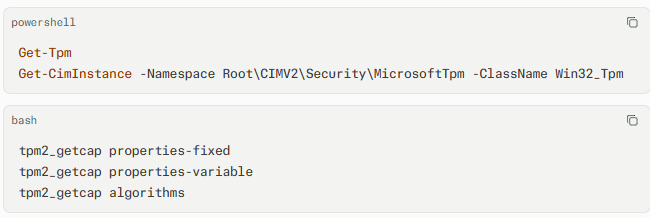
- Correlate TPM manufacturer, firmware version, model, operating-system build, and hardware platform against official advisories that explicitly reference CVE-2026-6726 or TCGVRT0010.
- Use endpoint-management inventories to identify assets with TPM 2.0 enabled, then prioritize systems supporting attestation, certificate enrollment, secure remote access, privileged administration, or sensitive workloads.
- Search certificate-authority and identity-service logs for unexpected enrollment or issuance events involving attestation keys, DevID keys, or TPM-backed TLS client-authentication keys.
- Investigate device attestation results that change unexpectedly, duplicate key identities, key enrollment from unusual hosts, or certificate issuance following privileged-account anomalies.
- Monitor endpoint telemetry for suspicious TPM command-interface access from administrative processes that do not normally perform provisioning, attestation, or key-management functions.
No reliable network-only scanner signature can confirm exploitation because the attack requires privileged local access to a TPM command interface. Verification should combine vendor guidance, firmware inventory, endpoint telemetry, and certificate lifecycle analysis.
C — Mitigation & Remediation
- Immediate (0–24h): Identify all systems with TPM 2.0 capabilities, including laptops, desktops, servers, virtualized systems, cloud workloads, and embedded platforms. Query device-management, configuration-management, and hardware inventories for TPM manufacturer and firmware data. Restrict privileged local access, review administrator-group membership, enforce multifactor authentication for administrative accounts, and monitor certificate issuance and TPM-attestation activity for anomalies.
- Short-term (1–7d): Apply official firmware, operating-system, or software updates from the platform, TPM, or cloud vendor that address CVE-2026-6726 or TCGVRT0010. Firmware updates should follow vendor instructions, tested deployment rings, recovery planning, and change-control requirements. Confirm successful installation with post-update inventory collection. For systems that cannot be patched immediately, reduce reliance on TPM attestation for high-risk authorization decisions, require additional identity signals, restrict TPM command access to approved administrative tools, and isolate highly sensitive workloads where feasible.cert
- Long-term (ongoing): Establish a firmware and TPM lifecycle-management process equivalent to your operating-system patch process. Maintain a current inventory of TPM-dependent services, certificate authorities, device-trust policies, and attestation consumers. Review whether certificates or attestations issued before remediation require revalidation, revocation, or reissuance based on vendor guidance and your risk assessment. Test recovery and key-rotation procedures regularly, and ensure security monitoring can correlate privileged endpoint activity with certificate-enrollment and device-attestation events.
The official vendor patch remains the preferred remediation. Do not substitute a generic operating-system update for a confirmed TPM, platform, or cloud-vendor fix without verifying that it applies to the affected implementation.
D — Best Practices
- Enforce least privilege so few accounts can obtain the elevated local access required to reach TPM command interfaces.
- Treat TPM firmware as a managed security dependency, with inventory, testing, staged deployment, and post-update verification.
- Require strong approval and monitoring controls for certificate enrollment involving TPM-backed attestation, DevID, and client-authentication keys.
- Combine TPM attestation with other device and identity signals rather than relying on one hardware-backed assertion for high-risk access decisions.
- Maintain certificate lifecycle procedures that support rapid investigation, revocation, reissuance, and rotation when hardware-backed trust assumptions change.
- Correlate endpoint privilege escalation alerts with certificate-authority and device-attestation logs to detect suspicious trust-establishment activity early
Leave Comment