
CVE-2026-66803: Azure Cosmos DB Remote Code Execution Bug - What It Means for Your Business and How to Respond
Introduction
CVE-2026-66803 is a critical security issue involving Microsoft Azure Cosmos DB, a cloud database service used by organizations across many industries. The vulnerability matters because a weakness in a shared cloud platform could have created serious consequences for confidentiality, business operations, customer trust, and regulatory obligations.
The issue has been fully remediated by Microsoft, and Microsoft reports that it found no evidence of unauthorized activity or customer data access beyond the security researchers’ testing. However, the incident remains important for every organization that uses Azure Cosmos DB or depends on applications and services built on it. This post explains what happened, which businesses should review their exposure, what the potential consequences could have been, and how security leaders can strengthen cloud risk management after a high-impact platform vulnerability.
S1 — Background & History
CVE-2026-66803 concerns improper access control in Azure Cosmos DB. In plain language, the service did not sufficiently prevent an attacker from reaching functions and credentials outside the permissions intended for a database query. The vulnerability was classified as CWE-284, Improper Access Control, and received a critical CVSS score of 10.0. NVD lists the vulnerability as published on July 30, 2026, with Microsoft as the source.
Wiz Research discovered and reported the issue to Microsoft on November 20, 2025. Microsoft acknowledged the report the same day and deployed an emergency mitigation on November 22, 2025. Microsoft then completed a longer-term architectural fix across all regions in July 2026 before public disclosure on July 30, 2026.
The affected system was Azure Cosmos DB, particularly the service’s Gremlin query capability and supporting gateway infrastructure. Wiz named the vulnerability chain “CosmosEscape.” Microsoft states that no customer action is required because the remediation was performed at the platform level.
S2 — What This Means for Your Business
For your organization, the most important point is that this was a cloud-platform security issue, not an ordinary software flaw that your IT team could resolve by installing a file on each server. The potential exposure involved a shared service layer that processes customer requests and supports multiple Cosmos DB application programming interfaces.
If exploited, the issue could have enabled unauthorized access to databases across customer boundaries. An attacker might have read sensitive records, changed business data, disrupted applications, or used trusted cloud infrastructure as a starting point for further attacks. The consequences could have included downtime, corrupted transactions, fraudulent changes, exposed personal information, and loss of confidence among customers and business partners.
The risk would have been particularly serious for organizations using Cosmos DB for customer profiles, financial records, health information, identity data, inventory, telemetry, or operational workflows. A compromise could also have affected services that depend on those databases, even when the organization did not directly expose a database to the public internet.
You should also consider legal and compliance responsibilities. Depending on the information involved, a security incident could trigger breach assessment, contractual notification, privacy reporting, or sector-specific requirements in the United States or Canada. Microsoft’s investigation found no evidence of customer impact, but your organization should still document its review, retain relevant cloud records, and confirm that no related indicators require escalation.
S3 — Real-World Examples
Regional Bank: A regional bank uses Cosmos DB for mobile-banking profiles and transaction support. If an attacker had obtained unauthorized read and write access, the bank could have faced altered account information, service interruptions, fraud investigations, customer notifications, and scrutiny from regulators.
Healthcare Provider: A healthcare provider stores appointment, patient-portal, and clinical workflow data in Cosmos DB. Unauthorized access could have exposed personal health information, interrupted care coordination, and created reporting obligations under applicable privacy and healthcare rules.
Online Retailer: A growing retailer relies on Cosmos DB for product catalogs, shopping carts, and customer preferences. An attacker who changed inventory or pricing records could have caused lost sales, fulfillment errors, refund costs, and reputational damage during a high-volume period.
Large Software Company: A software company operates applications for customers in both the United States and Canada. If a shared database platform were compromised, the company could have faced cross-customer exposure, contractual disputes, incident-response costs, and difficult questions about tenant separation and cloud-provider oversight.
S4 — Am I Affected?
- You use Azure Cosmos DB for production, development, testing, analytics, identity, or internal applications.
- You operate Cosmos DB through the Gremlin API or maintain applications that depend on graph database functionality.
- You rely on a third-party application or managed service that uses Azure Cosmos DB without clear visibility into its underlying architecture.
- You cannot identify which subscriptions, tenants, regions, or applications depend on Cosmos DB.
- You have not reviewed Microsoft’s advisory and recorded the vendor’s remediation status in your vulnerability-management system.
- You are treating “no customer action required” as a reason to skip internal validation, logging review, or dependency mapping.
Microsoft reports that CVE-2026-66803 has been fully remediated at the Azure platform level and that no customer action is required. Your organization should nevertheless verify its inventory, document the review, and investigate any unusual activity during the relevant period.
Key Takeaways
- CVE-2026-66803 was a critical Azure Cosmos DB access-control vulnerability with a maximum CVSS score of 10.0.
- The potential impact included unauthorized database access, data alteration, service disruption, and cross-customer exposure.
- Microsoft blocked the reported attack path within 48 hours and completed a broader architectural remediation across all regions by July 2026.
- Microsoft reports no evidence of unauthorized activity or customer data access beyond the researchers’ testing.
- You should document your exposure review, confirm cloud dependencies, and preserve relevant security evidence even when the provider has completed remediation.
Call to Action
CVE-2026-66803 demonstrates why cloud-provider remediation does not replace independent risk validation. IntegSec can help you assess your Azure environment, test application and tenant boundaries, review identity and access controls, and identify weaknesses that automated tools may miss. Contact IntegSec to schedule a penetration test and build a stronger, more defensible cybersecurity program.
TECHNICAL APPENDIX
A — Technical Analysis
CVE-2026-66803 was rooted in improper access control within Azure Cosmos DB’s Gremlin query environment. Wiz reported that the service translated Gremlin queries into .NET code and executed them in a restricted sandbox. The sandbox did not adequately account for .NET reflection, allowing researchers to develop file access and arbitrary code execution primitives.
The affected execution path reached a multi-tenant database gateway running on Service Fabric clusters. From that gateway, the researchers reported access to a platform-wide signing secret, which they called the Cosmos Master Key. The key could retrieve the primary key for Cosmos DB accounts and support enumeration of account metadata through the configuration store.
The attack was network reachable and did not require user interaction. NVD records CWE-284 and links to the Microsoft advisory. NVD has not supplied its own CVSS assessment, while the published CVSS 3.1 vector is AV:N/AC:L/PR:N/UI:N/S:C/C:H/I:H/A:H, with a score of 10.0.
The public description characterizes the issue as remote code execution. Wiz’s detailed research indicates that the practical chain involved an authenticated Azure customer’s access to the Gremlin service as the initial entry point, followed by privilege escalation across the shared platform boundary. Technical teams should distinguish the formal CVSS privileges value from the service-level access conditions described in the research.
B — Detection & Verification
- Enumerate Cosmos DB accounts, APIs, regions, and application dependencies with Azure Resource Graph or the Azure command-line interface:
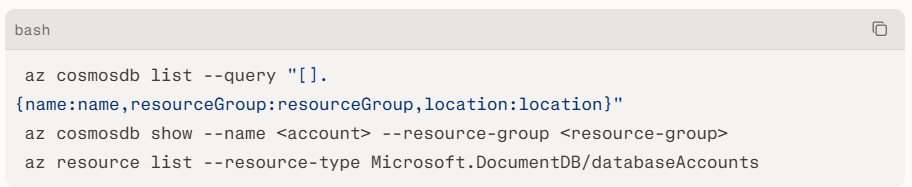
- Confirm the current service state and Microsoft guidance through the Microsoft Security Response Center advisory for CVE-2026-66803. Do not infer exposure solely from a local package version because Azure Cosmos DB is an exclusively hosted service.
- Review Azure activity logs, Microsoft Entra sign-in records, Cosmos DB diagnostic logs, gateway diagnostics, and security-information-and-event-management alerts for unexpected account enumeration, unusual Gremlin activity, anomalous regions, unexpected administrative operations, or access outside established application patterns.
- Investigate unexplained reads or writes involving configuration metadata, sudden changes to network rules, unusual key-retrieval operations, or database access that bypasses expected private-network paths.
- Network indicators may include unexpected outbound connections from application components, access to Cosmos DB endpoints from unfamiliar autonomous systems, unusual query volume, and Gremlin requests that generate errors associated with reflection, file access, process creation, or sandbox escape attempts.
- Scanner validation should use an authenticated Azure posture assessment and a signature that identifies Azure Cosmos DB exposure and Microsoft remediation status. Generic host-based scanners cannot reliably prove whether Microsoft has repaired a hosted-service control plane.
C — Mitigation & Remediation
- Immediate, 0–24 hours: Confirm that Microsoft’s platform-level remediation covers the organization’s Cosmos DB regions and APIs. Record the advisory, service status, affected subscriptions, and responsible owners. Restrict administrative access through just-in-time controls, review privileged identities, and ensure diagnostic logging is enabled. Preserve relevant logs before retention periods expire.
- Short-term, 1–7 days: Inventory every application and supplier that uses Cosmos DB, including indirect dependencies. Review database firewall rules, private endpoints, virtual network integration, managed identities, role assignments, diagnostic settings, and secret-handling practices. Rotate customer-managed Cosmos DB keys and related credentials when internal investigation identifies suspicious access, unexplained key exposure, or uncertainty about the integrity of the environment. Coordinate any rotation with application owners to avoid unnecessary outages.
- Long-term, ongoing: Adopt continuous cloud configuration monitoring and test tenant isolation as part of recurring penetration testing. Segment sensitive workloads, minimize service identities, remove unused APIs, and alert on abnormal query behavior and administrative changes. Maintain a documented cloud shared-responsibility process that defines what Microsoft remediates and what the organization must validate.
Microsoft’s official remediation comes first because customers do not install a conventional server patch for this exclusively hosted service. Microsoft states that it blocked the reported Gremlin entry point within 48 hours, introduced additional platform hardening, strengthened service-to-service authentication, added network protections and monitoring, and completed the long-term fix across all regions by July 2026.
For environments that cannot immediately validate their status, interim controls should include disabling unused Gremlin workloads, restricting application access to approved networks, removing unnecessary identities and permissions, increasing logging and alerting, and placing sensitive workloads behind compensating access controls. These measures reduce exposure but do not substitute for Microsoft’s service remediation or an internal investigation.
D — Best Practices
- Treat query engines and tenant-controlled execution environments as untrusted, and isolate them from platform credentials, internal APIs, and configuration stores.
- Apply least privilege to managed identities and service principals so a compromised gateway or workload cannot retrieve broad account secrets.
- Prefer narrowly scoped, short-lived credentials and customer-managed key controls over platform-wide or long-lived secrets.
- Monitor for unusual cross-region access, account enumeration, key operations, network-rule changes, and unexpected database writes.
- Include cloud isolation, hosted-service dependencies, and privilege-boundary testing in recurring penetration tests and supplier-risk reviews.
Leave Comment