
CVE-2026-66147: SonicWall GMS Dispatcher Service Bug - What It Means for Your Business and How to Respond
Introduction
CVE-2026-66147 is a critical vulnerability in SonicWall Global Management System (GMS) that could allow an attacker to take control of an affected management server without signing in. Because GMS is often used to administer SonicWall security appliances across an organization, compromise of this platform can expose the systems and policies it manages.
Organizations in the United States and Canada that operate SonicWall GMS, particularly versions 9.5.1 or earlier, should treat this issue as a priority. The risk is greatest where the GMS management interface or Dispatcher Service is reachable from the internet or from broadly accessible internal networks.
This post explains what the vulnerability means for your business, who may be affected, and the practical steps to reduce exposure. A technical appendix provides detection, verification, and remediation guidance for security engineers, penetration testers, and IT teams.
Background & History
SonicWall disclosed CVE-2026-66147 on August 11, 2026, through advisory SNWLID-2026-0011. The issue affects the GMS Dispatcher Service in SonicWall GMS version 9.5.1 and all earlier versions, including supported Windows and virtual appliance or Linux deployments.
The flaw is an unauthenticated command injection vulnerability. In plain language, an attacker can send a specially crafted request that causes the GMS server to run attacker-controlled commands on its underlying operating system. Successful exploitation can result in remote code execution, meaning the attacker may be able to install software, change configurations, access stored information, or disrupt the server.
The vulnerability carries a CVSS v3.1 base score of 9.4 out of 10 and is rated Critical by CISA’s Assigned Vulnerability Analysis Program. Its vector is CVSS:3.1/AV:N/AC:L/PR:N/UI:N/S:U/C:L/I:H/A:H, reflecting network reachability, low attack complexity, no required privileges, and no user interaction.
What This Means for Your Business
If your organization uses an affected version of SonicWall GMS, an attacker may not need a password, VPN session, or employee interaction to attempt exploitation. A successful attack could compromise the management server that centralizes administration of your SonicWall security environment.
The operational impact can be significant. Attackers with control of a GMS server may be able to interfere with security policies, monitor administrative activity, access configuration data, deploy malicious changes, or disrupt the availability of managed network security controls. This can affect branch offices, remote workers, cloud connections, and internal network segmentation.
Data and reputational risks follow closely behind. A compromised management platform may reveal network architecture, device inventories, credentials, and security policy details that help an attacker move deeper into the environment. For organizations subject to obligations such as HIPAA, PCI DSS, state or provincial privacy laws, or contractual security requirements, an unpatched critical vulnerability in an internet-facing management system can complicate incident response and regulatory reporting.
The central business question is not simply whether GMS is installed. It is whether the affected Dispatcher Service is exposed to people or systems that should not be able to reach it.
Real-World Examples
Regional financial institution: A regional bank uses GMS to manage firewalls across its headquarters, branches, and data centers. If an attacker compromises the GMS server, they could potentially alter firewall rules or disrupt security controls, creating downtime and increasing the risk of unauthorized access to customer-facing systems.
Mid-sized healthcare provider: A healthcare organization uses GMS to administer perimeter security for clinics and a central data center. A compromise could expose network details and configuration information, potentially affecting patient-data systems and requiring notification, forensic investigation, and corrective action under applicable privacy and security obligations.
Multi-site retailer: A retailer relies on GMS to manage security appliances at distribution centers and stores. An attacker could target the central management platform to interfere with network protections during a high-traffic period, disrupting payment processing, inventory systems, and store operations.
Growing professional-services firm: A firm with a small IT team uses GMS to manage a limited set of SonicWall appliances. Even without a large security team, it may face severe consequences if the management server is exposed online, because a single compromise could provide a foothold across multiple offices and remote-worker connections.
Am I Affected?
- You are running SonicWall Global Management System (GMS) version 9.5.1 or an earlier version.
- Your GMS deployment includes the Dispatcher Service, which is the component identified in the vulnerability.
- Your GMS management interface or Dispatcher Service is reachable from the public internet.
- Your GMS server is accessible from broad internal network segments, partner networks, or third-party remote-access systems without restrictive access controls.
- You have not confirmed that your deployment is running a vendor-fixed release or applied the guidance in SonicWall advisory SNWLID-2026-0011.
- You cannot demonstrate that inbound access to GMS is limited to a small set of trusted administrative systems and personnel.
- You have not reviewed GMS server logs, firewall logs, and network telemetry for suspicious requests or post-exploitation activity.
If any of these statements applies, assume the issue requires urgent validation and remediation. The affected product versions are explicitly listed as GMS 9.5.1 and earlier.
Key Takeaways
- CVE-2026-66147 is a critical, unauthenticated command injection vulnerability in the SonicWall GMS Dispatcher Service.
- Organizations running GMS 9.5.1 or earlier should identify affected systems immediately and determine whether the service is network reachable.
- Successful exploitation can lead to remote code execution and compromise of a central security-management platform.
- The business impact can include operational disruption, exposure of sensitive configuration data, reputational harm, and compliance complications.
- Restricting GMS access to trusted administrative networks, applying vendor fixes promptly, and monitoring for exploitation are essential risk-reduction measures.
Call to Action
IntegSec can help your organization validate exposure to CVE-2026-66147, test the security of your SonicWall management environment, and prioritize practical remediation steps. Our penetration testing and risk-reduction services are designed to identify exploitable paths before attackers do. Contact IntegSec at https://integsec.com to schedule a focused assessment and strengthen your security posture.
Technical Appendix
A — Technical Analysis
CVE-2026-66147 is an unauthenticated command injection vulnerability in the Dispatcher Service of SonicWall Global Management System (GMS). The weakness is classified as CWE-94, Improper Control of Generation of Code (“Code Injection”), indicating that attacker-supplied input is insufficiently validated before being incorporated into a code or command execution context.
The vulnerability affects GMS version 9.5.1 and earlier releases. A remote attacker can send specially crafted requests to the Dispatcher Service and achieve remote code execution without authentication, without elevated privileges, and without user interaction.
The CISA-assigned CVSS v3.1 vector is CVSS:3.1/AV:N/AC:L/PR:N/UI:N/S:U/C:L/I:H/A:H, producing a base score of 9.4. The vector indicates a network attack vector, low attack complexity, no privileges required, no user interaction, an unchanged scope, low confidentiality impact, and high integrity and availability impact.
The authoritative NVD record is available at https://nvd.nist.gov/vuln/detail/CVE-2026-66147, and SonicWall’s vendor advisory is SNWLID-2026-0011.
B — Detection & Verification
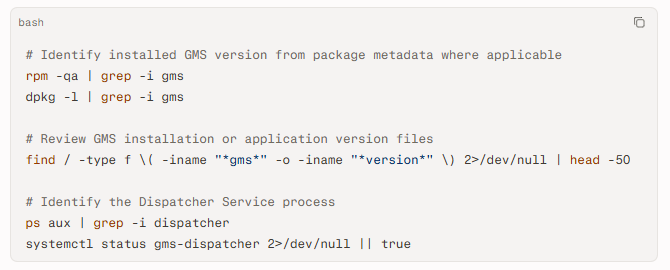
Version enumeration commands
Scanner signatures
- Run authenticated and unauthenticated vulnerability scans against GMS management hosts, specifically checking for CVE-2026-66147.
- Use vendor advisory and product-version checks to confirm whether the installed GMS release is 9.5.1 or earlier.
- Validate scan findings manually before remediation decisions, particularly where the Dispatcher Service is restricted to internal management networks.
Log indicators
- Review GMS application logs for unexpected Dispatcher Service requests, malformed parameters, command-like input, or errors immediately preceding service crashes or unusual process activity.
- Correlate GMS logs with operating-system authentication, process creation, service management, and command-history telemetry where available.
- Search for requests originating from unfamiliar IP addresses, especially those targeting the Dispatcher Service from the internet or non-administrative segments.
Behavioral anomalies
- Unexpected child processes spawned by the Dispatcher Service.
- New scheduled tasks, services, cron jobs, startup entries, or persistence mechanisms.
- Outbound connections from the GMS host to unfamiliar external systems.
- Unexplained changes to GMS configuration, user accounts, certificates, or managed-device policies.
Network exploitation indicators
- Inbound HTTP or HTTPS requests to the Dispatcher Service containing unusual parameter structures, encoded payloads, or command metacharacters.
- Requests from untrusted source addresses to management ports or Dispatcher Service endpoints.
- Sudden outbound command-and-control-like traffic or lateral connections immediately following Dispatcher Service requests.
C — Mitigation & Remediation
1. Immediate (0–24h): Restrict exposure and preserve evidence
- Identify every SonicWall GMS deployment and record its version, hosting platform, network location, and exposure status.
- Prevent internet-facing access to the GMS management interface and Dispatcher Service; allow access only from dedicated administrative networks or approved management systems.
- Apply firewall access-control lists that restrict inbound access to named administrator workstations, jump hosts, or VPN ranges.
- If the service cannot be safely restricted immediately, isolate the GMS host from untrusted networks while maintaining a controlled administrative access path.
- Preserve relevant logs, network flow records, and system snapshots before making broad configuration changes.
2. Short-term (1–7d): Patch, validate, and hunt
- Apply the official SonicWall remediation or upgrade path identified in advisory SNWLID-2026-0011 as soon as a validated vendor-fixed release is available for your deployment.
- Do not rely on network restrictions as a permanent substitute for patching; use them only as interim risk reduction where immediate patching is not possible.
- After remediation, verify the installed GMS version, confirm that the Dispatcher Service configuration is restricted, and rerun vulnerability scans.
- Conduct targeted threat hunting across GMS server logs, endpoint telemetry, firewall logs, and outbound network traffic for signs of prior exploitation.
- Rotate credentials associated with GMS administration and review privileged accounts, API credentials, certificates, and managed-device trust relationships if compromise is suspected.
3. Long-term (ongoing): Reduce management-plane risk
- Place security-management platforms on a dedicated management segment with strict segmentation, least-privilege access, and multi-factor authentication.
- Maintain an accurate asset inventory that includes GMS versions, Dispatcher Service exposure, patch status, and administrative access paths.
- Include internet-facing management interfaces in routine external attack-surface reviews and penetration tests.
- Establish a vulnerability-management SLA that prioritizes unauthenticated remote code execution flaws and publicly disclosed critical vulnerabilities.
- Monitor vendor advisories and CISA guidance continuously, particularly for SonicWall products and other centralized security-management platforms.
D — Best Practices
- Keep SonicWall GMS and all centralized security-management platforms current with vendor-supported releases.
- Never expose GMS management or Dispatcher Service interfaces directly to the public internet.
- Restrict administrative access through dedicated management networks, VPNs, jump hosts, and source-IP allowlists.
- Enforce multi-factor authentication and least-privilege access for all GMS administrators.
- Monitor management-server logs, endpoint activity, and outbound traffic for command execution, persistence, and lateral-movement indicators.
- Validate patches and configuration changes through controlled testing before broad deployment
Leave Comment