
CVE-2026-65770: Azure Managed Instance for Apache Cassandra Remote Code Execution - What It Means for Your Business and How to Respond
Introduction
CVE-2026-65770 is a critical vulnerability in Microsoft Azure Managed Instance for Apache Cassandra, a managed database service used by organizations that rely on Cassandra for high-volume, always-on applications. Because the flaw can allow an unauthorized attacker to execute code over a network, it deserves immediate attention from any organization using this service.
The issue is particularly significant because it carries the maximum CVSS severity rating and does not require an attacker to have valid credentials or trick an employee into taking action. For businesses in the United States and Canada, the practical concern is straightforward: a compromised managed database environment can expose customer records, disrupt revenue-generating applications, and create regulatory and reputational consequences.
This post explains what the vulnerability means in business terms, who should assess exposure, and how to respond. A technical appendix provides detection, verification, and remediation guidance for security engineers, IT teams, and penetration testers.
Background & History
Microsoft’s Azure Managed Instance for Apache Cassandra was affected by an argument injection vulnerability, publicly tracked as CVE-2026-65770. The CVE was published on August 20, 2026, and the National Vulnerability Database record was updated on August 25, 2026.
The weakness is classified as improper neutralization of argument delimiters in a command, known as argument injection and associated with CWE-88. In plain language, the service failed to properly separate user-controlled input from the instructions passed to an underlying command, creating a path for unauthorized code execution over the network.
The vulnerability received a CVSS v3.1 base score of 10.0, the highest possible rating, and is rated Critical. The published vector indicates network exploitation, low attack complexity, no privileges required, no user interaction required, and high confidentiality, integrity, and availability impact across changed scopes.
Microsoft has issued patch guidance, and public vulnerability trackers report that a patch is available. At the time of disclosure reporting, there was no evidence of a public proof of concept or confirmed exploitation in the wild, but the severity and automatable nature of the issue still warrant urgent remediation.feedly+1
What This Means for Your Business
If your organization uses Azure Managed Instance for Apache Cassandra, this vulnerability could place the database layer of your applications at risk. A successful attack may allow an unauthorized person to run code within the affected service environment, potentially accessing stored data, altering records, or interfering with database availability.
For customer-facing systems, the operational impact can be immediate. Applications that depend on Cassandra for session data, product catalogs, transaction histories, telemetry, or real-time personalization may slow down, produce incorrect results, or become unavailable. Even a short outage can affect sales, customer support, logistics, and internal decision-making.
The data impact may be more serious than the outage itself. Databases often contain personally identifiable information, payment-related metadata, authentication records, business partners’ information, or proprietary operational data. Unauthorized access or modification can trigger breach-notification obligations, customer communications, forensic investigation costs, and heightened scrutiny from regulators or contractual counterparties.
Your reputation is also at stake. Customers and partners expect cloud services to be managed securely, and a preventable database compromise can undermine confidence in your broader security program. For organizations subject to privacy, financial, healthcare, or critical-infrastructure requirements, an unremediated critical vulnerability may also complicate audits, vendor risk reviews, cyber-insurance claims, and contractual security commitments.
Real-World Examples
Regional financial services provider: A regional bank uses Cassandra to support fraud-detection dashboards and customer transaction lookups. An attacker who gains code execution could access sensitive account-related data or disrupt services customers depend on, creating regulatory exposure and eroding trust.
National e-commerce retailer: A retailer relies on Cassandra for inventory availability, shopping-cart state, and product recommendations. Exploitation could corrupt or expose customer and order data during a high-traffic period, leading to abandoned purchases, support backlog, and possible notification requirements.
Healthcare technology company: A healthcare platform uses Cassandra to store operational metadata and patient-facing application data. A compromise could expose protected health information or affect system availability, creating compliance, legal, and patient-safety concerns.
Mid-sized SaaS provider: A software company offers a multi-tenant analytics product backed by Cassandra. Code execution in the database environment could expose multiple customers’ data or disrupt service delivery, damaging renewals, triggering contractual remedies, and increasing acquisition and enterprise-sales friction.
Am I Affected?
- You are using Microsoft Azure Managed Instance for Apache Cassandra in any Azure subscription or environment.
- You have not yet confirmed that Microsoft’s official security update or service-side remediation for CVE-2026-65770 has been applied to every affected cluster.
- You operate applications, APIs, analytics platforms, or customer-facing services that depend on Azure Managed Instance for Apache Cassandra.
- You store regulated, confidential, proprietary, or customer data in affected Cassandra clusters.
- You cannot currently demonstrate through inventory, Azure resource reviews, or vulnerability scanning that no managed Cassandra instances are exposed.
- You rely on a managed service assumption that the cloud provider handles all security patching without validating the current status of this specific vulnerability.
Key Takeaways
- CVE-2026-65770 affects Microsoft Azure Managed Instance for Apache Cassandra and can permit unauthorized remote code execution.
- The vulnerability is rated Critical with a CVSS v3.1 score of 10.0 and requires no privileges or user interaction under the published scoring model.
- Business impact can include data exposure, application downtime, regulatory obligations, incident-response costs, and loss of customer trust.
- Any organization using Azure Managed Instance for Apache Cassandra should verify exposure rather than assume the managed service is automatically protected.
- Apply Microsoft’s official remediation first, then validate the update through inventory, scanning, and targeted security testing.feedly
Call to Action
If your organization uses Azure Managed Instance for Apache Cassandra, do not wait for an incident to confirm your exposure. IntegSec can help you assess the vulnerability, validate remediation, and identify the broader weaknesses that attackers could exploit across your cloud and application environment. Contact IntegSec for a professional penetration test and practical cybersecurity risk reduction at https://integsec.com.
Technical Appendix
A — Technical Analysis
CVE-2026-65770 is an argument injection vulnerability, mapped to CWE-88, in Microsoft Azure Managed Instance for Apache Cassandra. The root cause is improper neutralization of argument delimiters in a command, meaning attacker-controlled input can alter the arguments supplied to a command executed by the service.
The affected component is Azure Managed Instance for Apache Cassandra. The attack vector is network-based, with low attack complexity, no required privileges, and no user interaction. The CVSS v3.1 vector is CVSS:3.1/AV:N/AC:L/PR:N/UI:N/S:C/C:H/I:H/A:H/E:U/RL:O/RC:C, producing a base score of 10.0.
Successful exploitation can result in arbitrary code execution within the affected managed Cassandra service context. Public vulnerability intelligence describes the technical impact as total and the issue as automatable, while reporting no evidence of public proof-of-concept code or confirmed exploitation at the time of those assessments.feedly+1
The authoritative NVD reference is https://nvd.nist.gov/vuln/detail/cve-2026-65770. Microsoft’s security update guidance is available through the Microsoft Security Response Center at https://msrc.microsoft.com/update-guide/vulnerability/CVE-2026-65770.
B — Detection & Verification
Version enumeration commands:
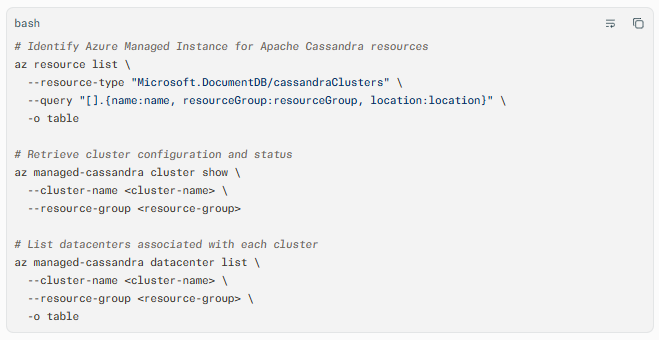
Scanner signatures: Search vulnerability management platforms for CVE-2026-65770, CWE-88, “Azure Managed Instance for Apache Cassandra,” and “argument injection.” Tenable and other scanners track the issue as a Critical finding with the CVSS v3.1 vector AV:N/AC:L/PR:N/UI:N/S:C/C:H/I:H/A:H.
Log indicators: Review Azure activity logs, diagnostic logs, Cassandra logs, and command-execution telemetry for unexpected process launches, unusual arguments, privilege or configuration changes, and access from unrecognized IP addresses or service principals.
Behavioral anomalies: Investigate abnormal database queries, unexpected data exports, new or modified authentication material, unusual CPU or memory consumption, and changes to cluster configuration outside approved change windows.
Network exploitation indicators: Monitor for unexpected inbound connections to management interfaces, anomalous east-west traffic from Cassandra nodes, and outbound connections to unfamiliar destinations following suspicious activity.
C — Mitigation & Remediation
- Immediate (0–24h): Inventory every Azure subscription for Managed Instance for Apache Cassandra resources and confirm whether Microsoft’s official patch or service-side remediation has been applied. Restrict network access to management planes and Cassandra endpoints to approved identities, IP ranges, and private network paths.feedly
- Short-term (1–7d): Apply Microsoft’s official vendor patch or follow Microsoft’s remediation instructions as the primary control. For clusters that cannot be updated immediately, use network segmentation, private endpoints, tightened firewall rules, least-privilege identity controls, and enhanced logging to reduce exposure while remediation is completed.feedly
- Long-term (ongoing): Establish continuous cloud asset discovery, vulnerability prioritization, and patch verification for managed Azure services. Incorporate Cassandra clusters into penetration testing, configuration reviews, and incident-response runbooks, and validate that backups, monitoring, and recovery procedures remain effective.
D — Best Practices
- Maintain a complete, continuously updated inventory of Azure managed database resources, including resource groups, regions, clusters, and datacenters.
- Apply vendor security updates promptly and verify remediation through independent scanning or targeted validation rather than assuming a managed service is fully protected.
- Limit administrative and network access to Cassandra management interfaces using private connectivity, conditional access, and least-privilege role assignments.
- Centralize and retain Azure activity, diagnostic, and database logs in a tamper-resistant location to support detection and investigations.
- Include argument injection, cloud misconfiguration, and managed-service exposure scenarios in regular penetration tests and purple-team exercises
Leave Comment