
CVE-2026-63509: Microsoft Fabric Elevation of Privilege Bug - What It Means for Your Business and How to Respond
Introduction
CVE-2026-63509 is a critical vulnerability in Microsoft Fabric, Microsoft’s unified analytics and data platform. It allows an authorized user to escalate privileges over a network, potentially turning limited access into broader control over sensitive analytics resources.
For organizations in the United States and Canada that rely on Microsoft Fabric for reporting, data warehousing, lakehouses, or business intelligence, this is not an ordinary software defect. Fabric often sits at the center of finance, operations, customer analytics, and executive decision-making. A compromise can expose proprietary data, alter reports, disrupt operations, and undermine regulatory confidence.
This post explains the vulnerability in business terms, identifies who should be concerned, provides practical scenarios, and gives security and IT teams a clear response plan. The technical appendix contains the deeper analysis needed for engineers, penetration testers, and administrators.
Background & History
Microsoft published CVE-2026-63509 on August 20, 2026, through its Microsoft Security Response Center advisory. The issue is titled “Microsoft Fabric Elevation of Privilege Vulnerability” and affects Microsoft Fabric, a cloud-hosted analytics service. Microsoft is both the affected vendor and the CVE Numbering Authority for the record.
The National Vulnerability Database rates the issue 9.9 out of 10, placing it in the Critical severity range. The weakness is a relative path traversal flaw, meaning an authenticated attacker may manipulate how the platform resolves paths or references in order to gain privileges beyond those originally assigned.
The vulnerability was updated on September 25, 2026, and the record identifies the issue as CWE-23, Relative Path Traversal. Microsoft’s advisory is the official patch reference, and organizations should treat the vendor guidance as the authoritative source for remediation status and deployment details.
What This Means for Your Business
If your organization uses Microsoft Fabric, assume that the primary risk is unauthorized access to data and analytics capabilities. An attacker who already has a low-privilege account could potentially obtain permissions they should not have, then access, modify, or disrupt business-critical information.
The operational impact can be significant. Fabric environments often support financial dashboards, sales forecasts, supply-chain reporting, customer analytics, and executive scorecards. If an attacker alters underlying data or reports, leaders may make decisions based on manipulated information. If they disrupt pipelines or workspaces, teams may lose access to the insights they need to operate.
There is also a data protection concern. Analytics platforms commonly consolidate information from many systems, including customer records, employee data, financial transactions, and operational metrics. A privilege escalation issue can therefore expose more data than a compromise of a single application.
For regulated organizations, the issue may create compliance exposure. Businesses subject to privacy, financial, healthcare, or sector-specific security obligations may need to assess whether sensitive data was accessible, notify stakeholders where required, and demonstrate that they responded promptly. Even without confirmed exploitation, a documented remediation and review process can reduce regulatory and reputational harm.
Real-World Examples
Regional financial services firm: A bank uses Fabric dashboards to monitor loan performance, fraud indicators, and branch operations. An attacker with a standard analytics account could escalate privileges, view sensitive portfolio data, or modify reports used by risk and compliance teams. The result could include delayed fraud detection, inaccurate regulatory reporting, and loss of customer trust.
Mid-sized healthcare provider: A provider network uses Fabric to consolidate patient volume, billing, and operational data. Unauthorized access to analytics workspaces could expose protected health information or business-sensitive payer data. Beyond potential regulatory consequences, leadership could face difficult questions about whether patient privacy safeguards were adequate.
Retail or e-commerce company: A retailer relies on Fabric for inventory, sales, pricing, and customer-behavior reporting. An attacker could manipulate reporting data or disrupt data pipelines during a high-volume sales period. That could lead to poor replenishment decisions, inaccurate performance reporting, and avoidable revenue loss.
Public-sector agency: A government organization uses Fabric to analyze service delivery, procurement, and citizen-facing program data. Privilege escalation could expose confidential records or allow tampering with performance metrics. Public confidence, audit findings, and procurement integrity could all be affected.
Am I Affected?
- You are using Microsoft Fabric in any capacity, including workspaces, lakehouses, data pipelines, semantic models, reports, or Fabric-connected analytics.
- You have users, service accounts, partners, contractors, or third-party integrations with access to Fabric.
- You have not yet reviewed Microsoft’s official advisory for CVE-2026-63509 and confirmed that your tenant and workloads are protected by the available remediation.
- You permit broad or unnecessary permissions within Fabric, especially for users who only need to view reports or consume selected datasets.
- You cannot confirm when privileged accounts, service principals, and external collaborators last received an access review.
- You rely on Fabric data for regulated, financial, healthcare, customer, or executive decision-making processes.
- You do not currently monitor Fabric and related identity platforms for unusual permission changes, anomalous data access, or unexpected administrative activity.
If any statement applies, prioritize a vulnerability and exposure review. Because Microsoft Fabric is an exclusively hosted service, traditional “patch the server” thinking does not fully apply; tenant configuration, identity controls, and vendor guidance are central to the response.
Key Takeaways
- CVE-2026-63509 is a critical privilege escalation vulnerability in Microsoft Fabric, rated 9.9 out of 10 by NVD.
- An authorized attacker may exploit relative path traversal to gain privileges over a network, potentially exposing or altering sensitive analytics data.
- Businesses that use Fabric for finance, healthcare, retail, government, or operational reporting should treat this as a priority risk.
- The impact extends beyond data theft to manipulated reporting, operational disruption, compliance exposure, and reputational damage.
- A prompt review of Fabric access, tenant configuration, monitoring, and Microsoft’s official remediation guidance is essential.
Call to Action
IntegSec helps organizations understand whether vulnerabilities such as CVE-2026-63509 create real business exposure. Our penetration testing and security assessment teams evaluate identity boundaries, privilege paths, cloud configurations, and the practical ways attackers could reach sensitive data. Visit https://integsec.com to schedule a conversation and take a measured, evidence-based step toward reducing cybersecurity risk.
Technical Appendix
A — Technical Analysis
CVE-2026-63509 is a relative path traversal vulnerability in Microsoft Fabric, classified as CWE-23. The vulnerability allows an authorized attacker to elevate privileges over a network. The published description indicates that an attacker must already possess some level of valid access; it does not describe an unauthenticated remote compromise.
The CVSS v3.1 base score is 9.9, with the vector CVSS:3.1/AV:N/AC:L/PR:L/UI:N/S:C/C:H/I:H/A:H. This reflects network attack vector, low attack complexity, low privileges required, no user interaction, changed scope, and high confidentiality, integrity, and availability impact.
The affected product is Microsoft Fabric. The CVE record tags the issue as an exclusively hosted service, so affected-version enumeration and remediation depend on Microsoft’s service-side update and tenant-specific advisory guidance rather than an on-premises software version alone. The official NVD entry is available at https://nvd.nist.gov/vuln/detail/cve-2026-63509.
B — Detection & Verification
Version enumeration commands:
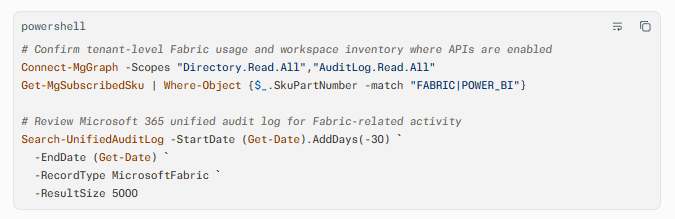
Scanner signatures: Validate that vulnerability scanners and exposure-management tools include a current CVE-2026-63509 check. Because Fabric is hosted, scanner results should be correlated with Microsoft tenant inventory, Fabric workspace ownership, and identity entitlement data rather than relying only on IP-based scanning.
Log indicators: Review Entra ID sign-in logs, Microsoft 365 unified audit logs, Fabric workspace activity, and privilege-change events. Prioritize unusual role assignments, service principal activity from unfamiliar locations, access to sensitive workspaces outside normal hours, and permission changes followed by data export or pipeline modification.
Behavioral anomalies: Look for a low-privilege identity suddenly accessing administrative functions, creating or changing artifacts across workspaces, modifying semantic models or data pipelines, or invoking APIs inconsistent with its assigned role.
Network exploitation indicators: Monitor for authenticated API calls associated with Fabric from unexpected source addresses, anomalous token use, repeated access-denied events followed by successful privileged operations, and data egress patterns that do not match established reporting workflows.
C — Mitigation & Remediation
- Immediate (0–24h): Review Microsoft’s official advisory and apply the vendor-provided remediation or confirm that Microsoft’s service-side fix applies to your tenant. Inventory all Fabric workspaces, owners, members, service principals, external guests, and delegated permissions. Revoke or suspend high-risk access that is unused, unowned, or broader than required.
- Short-term (1–7d): Perform a focused access review for privileged Fabric roles, workspace administrators, capacity administrators, and service principals. Enforce least privilege, require phishing-resistant multifactor authentication for interactive administrative access, restrict external sharing, and review conditional access policies. Search audit logs for suspicious permission changes, privileged API use, unexpected exports, and post-compromise behavior.
- Long-term (ongoing): Establish continuous identity governance for analytics platforms. Implement periodic certification of Fabric permissions, separate duties between data owners, developers, and administrators, monitor privileged activity, and include Fabric in cloud security assessments and penetration tests. Maintain an incident response playbook that covers analytics data integrity, report tampering, and data exposure scenarios.
Interim mitigations: Where immediate vendor remediation cannot be confirmed, reduce exposure by limiting interactive and programmatic access, disabling unnecessary external collaboration, applying conditional access restrictions, requiring privileged access workflows, and increasing logging retention and alerting around Fabric and identity events. Do not rely on network segmentation alone because the vulnerability is exploitable over a network by an authorized user.
D — Best Practices
- Apply least privilege to Fabric workspaces, datasets, pipelines, semantic models, and administrative roles.
- Review service principals, guest users, and third-party integrations with the same rigor applied to human administrators.
- Use phishing-resistant multifactor authentication and conditional access for privileged analytics access.
- Continuously monitor identity and Fabric audit events for privilege escalation, anomalous API use, and unexpected data movement.
- Include cloud analytics platforms in regular penetration tests, access reviews, and incident response exercises.
Leave Comment