
CVE-2026-59173: Apache Traffic Server HTTP/2 Denial-of-Service Bug - What It Means for Your Business and How to Respond
Introduction
CVE-2026-59173 affects organizations that use Apache Traffic Server to deliver, cache, or proxy web applications and digital services. The vulnerability can allow an unauthenticated internet user to consume the resources your business depends on to keep websites, applications, and customer-facing services available.
You may be exposed even if your organization does not operate a large content delivery network. Apache Traffic Server can support reverse proxies, caching layers, application gateways, and other internet-facing infrastructure across financial services, retail, healthcare, government, education, and technology.
This article explains why the vulnerability matters to your business, how an outage could affect operations and customers, how to determine whether your environment is exposed, and what actions you should take. A technical appendix provides version checks, detection guidance, remediation steps, and engineering recommendations for security and infrastructure teams.
S1 — Background & History
CVE-2026-59173 is an uncontrolled resource consumption vulnerability in Apache Traffic Server. In plain language, an attacker can cause the server to use excessive memory and other system resources, potentially interrupting service. The affected component is Apache Traffic Server’s HTTP/2 handling.
The Apache Traffic Server project identifies versions 9.0.0 through 9.2.13 and 10.0.0 through 10.1.2 as affected. Fixed releases are 9.2.14 and 10.1.3, with later releases also containing the correction.
The Okta Red Team reported the issue after identifying the condition on April 7, 2026. The coordinated public disclosure occurred on July 16, 2026, and Apache published its advisory during that release cycle. The National Vulnerability Database published the record on July 18, 2026.
The vulnerability has a Common Vulnerability Scoring System version 3.1 score of 7.5, rated High. The National Vulnerability Database’s version 4.0 assessment remains pending.
S2 — What This Means for Your Business
If you operate an affected Apache Traffic Server deployment, an attacker may be able to degrade or interrupt services without logging in and without stealing data directly. The primary business risk is loss of availability.
An outage can prevent customers from reaching websites, online banking portals, patient services, order systems, application programming interfaces, or employee tools. Even a short interruption can create abandoned transactions, delayed operations, missed service-level commitments, and increased pressure on support teams.
The impact may spread beyond the server under attack. A resource-starved proxy can affect connected application servers, load balancers, databases, and monitoring systems. Recovery may also take longer if the server exhausts memory, begins using swap heavily, or repeatedly restarts.
CVE-2026-59173 is not described as a direct confidentiality or data-integrity issue. However, prolonged unavailability can still create compliance and contractual concerns. Organizations in the United States and Canada may need to document the incident, assess notification obligations if other security events occurred, and demonstrate that reasonable safeguards and patch-management processes were in place.
The reputational impact can be significant when customers cannot access essential services or receive no clear explanation. Prompt patching reduces both the technical exposure and the business uncertainty surrounding an avoidable outage.
S3 — Real-World Examples
Regional bank: A regional bank uses Apache Traffic Server in front of online banking and customer information services. An attacker causes proxy resources to become exhausted, preventing legitimate customers from signing in or completing payments during business hours.
Online retailer: A mid-sized retailer relies on a caching layer to handle seasonal shopping traffic. A service interruption during a promotion causes checkout failures, lost sales, customer complaints, and additional advertising costs because the campaign sends traffic to an unavailable website.
Healthcare provider: A healthcare network uses the proxy to route requests to appointment scheduling and patient portal systems. An outage delays appointment requests and increases call-center volume while staff work around unavailable digital services.
Software company: A software-as-a-service provider operates several regional environments in the United States and Canada. If one exposed proxy becomes unstable, automated deployments, customer application requests, and internal monitoring may fail, creating a broader incident than the initial attack suggests.
S4 — Am I Affected?
- Yes, if you operate Apache Traffic Server 9.0.0 through 9.2.13 on any internet-facing or internal service path.
- Yes, if you operate Apache Traffic Server 10.0.0 through 10.1.2.
- Yes, if an affected instance accepts HTTP/2 traffic, even if the service appears to be protected by a firewall or load balancer. Confirm which systems can reach the listener and whether upstream components forward HTTP/2 connections.
- No, for a specific instance only after confirming that it runs Apache Traffic Server 9.2.14 or later, or 10.1.3 or later, and that every redundant node has been updated.
- Unknown, if your system comes from a Linux distribution, appliance, managed hosting provider, container image, or software package that may apply security fixes without changing the visible version number. Confirm the supplier’s backport status.
- Review immediately if your asset inventory does not identify Apache Traffic Server instances, because undocumented caching and proxy systems are common sources of delayed remediation.
Key Takeaways
- CVE-2026-59173 can interrupt web and application services by exhausting resources on affected Apache Traffic Server systems.
- Your exposure depends primarily on the installed Traffic Server version, deployment location, and use of HTTP/2.
- The vulnerability can be exploited remotely without authentication, so internet-facing instances should receive priority.
- You should upgrade to Apache Traffic Server 9.2.14 or later, or 10.1.3 or later, and verify every node in the deployment.
- If you cannot patch immediately, reduce exposure by disabling HTTP/2 where practical and applying strict connection, stream, memory, and timeout controls.
Call to Action
Do not wait for a customer-visible outage to reveal an unpatched proxy. Contact IntegSec for a penetration test that evaluates your internet-facing infrastructure, validates compensating controls, and identifies related weaknesses attackers could exploit. Our team can help you turn patching into a broader reduction of cybersecurity risk with practical, prioritized actions.
TECHNICAL APPENDIX (security engineers, pentesters, IT professionals only)
A — Technical Analysis
CVE-2026-59173 affects the HTTP/2 component of Apache Traffic Server. The root cause is insufficient enforcement of resource limits when outbound response data becomes blocked by client-controlled HTTP/2 flow control. A client can advertise a zero or very small receive window, or withhold WINDOW_UPDATE frames, while continuing to open streams and request resources.
In the vulnerable behavior, the server may continue processing requests and building response data even though the client is not allowing that data to be transmitted. The unsent data remains buffered, and memory consumption increases across concurrent streams. CERT’s vendor information states that Apache Traffic Server’s active-stream limit was advisory before the fix. Releases 9.2.14 and 10.1.3 hard-enforce the limit and can reject excess streams with REFUSED_STREAM.
The attack is remote, unauthenticated, low complexity, and requires no user interaction. The CVSS version 3.1 vector is CVSS:3.1/AV:N/AC:L/PR:N/UI:N/S:U/C:N/I:N/A:H, representing a high impact to availability with no direct confidentiality or integrity impact. The weakness is CWE-400, Uncontrolled Resource Consumption. The NVD record and Apache advisory are the primary references.
B — Detection & Verification
Version verification should begin with authenticated host and container checks. The following commands identify common installations and confirm the running Traffic Server binary:
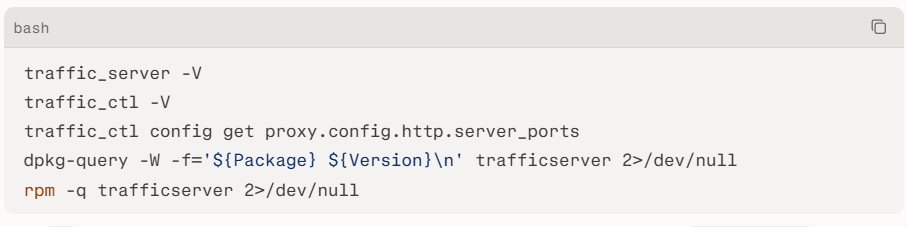
The -V option is supported by the Traffic Server command-line utilities. traffic_ctl can also retrieve active configuration records and reload configuration after an approved change.
Authenticated vulnerability scanners should match package versions and vendor backports rather than relying only on a server banner. Tenable lists Nessus Plugin ID 327669 for the vulnerability, but scanner coverage and plugin identifiers may change. An authenticated result should be reconciled with the installed package, running binary, container digest, and operating system security advisory.
No single log message proves exploitation. Review traffic.out, diags.log, access logs, operating-system memory telemetry, and load-balancer records for:
- HTTP/2 connections with unusually long lifetimes, low client-to-server byte volume, and many concurrent streams.
- Repeated requests for large responses from a small number of source addresses or network ranges.
- HTTP/2 sessions that advertise
SETTINGS_INITIAL_WINDOW_SIZE = 0or a very small value and do not provide correspondingWINDOW_UPDATEframes. - Sudden memory growth, swap activity, file-descriptor pressure, event-loop latency, connection queue growth, timeouts, dropped connections, or process restarts.
Packet capture and protocol telemetry should be used passively on production systems. Active reproduction or stress testing should be limited to an isolated, authorized laboratory environment.
C — Mitigation & Remediation
- Immediate (0–24h): Upgrade first using the official Apache Traffic Server release or the operating system vendor’s security package. The minimum fixed branches are 9.2.14 or later for the 9.x line and 10.1.3 or later for the 10.x line. Apache’s later 10.2.0 release is also beyond the affected range. Apply the update across origin-facing nodes, edge nodes, failover systems, container images, and disaster-recovery environments. Confirm the running binary after each change.trafficserver.apache If patching cannot occur immediately, disable HTTP/2 on affected listeners or individual server names where operationally acceptable. For listener-based configurations, remove
http2from the supported protocol list. For SNI-based configurations, set the relevanthttp2option tooff. Place the service behind a controlled gateway, restrict unnecessary source networks, rate-limit new connections, cap connection lifetimes, and terminate suspicious stalled sessions. These measures reduce exposure but do not replace the vendor patch. - Short-term (1–7d): Validate the upgrade in staging with representative response sizes, concurrent streams, failover behavior, and cache workloads. Review and tune
proxy.config.http2.max_concurrent_streams_inandproxy.config.http2.max_active_streams_inaccording to available memory and expected traffic. The latter was advisory in vulnerable releases, so configuration alone must not be treated as remediation.Establish alerts for memory usage, swap activity, active HTTP/2 streams, connection counts, event-loop delay, process restarts, and refused streams. Compare proxy health with origin health to distinguish an application failure from proxy resource exhaustion. Preserve relevant logs and network telemetry if suspicious activity is identified. - Long-term (ongoing): Add Apache Traffic Server to the organization’s software inventory, software bill of materials, authenticated vulnerability scans, and patch-service-level objectives. Track both upstream releases and operating-system backports. Treat internet-facing proxies and caching layers as production application components rather than passive network infrastructure. Security teams should periodically test HTTP/2 connection limits, stalled-stream handling, memory ceilings, and graceful failover in an isolated environment. Operations teams should maintain a playbook covering HTTP/2 disablement, node draining, traffic redistribution, evidence preservation, and customer communications. Penetration testing should verify that compensating controls remain effective after configuration, architecture, or provider changes.
D — Best Practices
- Enforce practical per-connection and process-wide limits for concurrent HTTP/2 streams, based on measured memory capacity.
- Terminate connections that keep response data flow-control blocked beyond a documented timeout.
- Set explicit memory ceilings and monitor swap, file descriptors, active streams, and event-loop latency.
- Expose HTTP/2 only on listeners and server names that require it, and disable it on unnecessary paths.
- Include low-bandwidth, high-resource HTTP/2 behavior in authorized resilience testing and incident-response exercises.
Leave Comment