
CVE-2026-56864: Go Module Integrity Verification Bypass - What It Means for Your Business and How to Respond
Introduction
CVE-2026-56864 is a software supply chain vulnerability affecting organizations that build, test, or deploy applications using the Go programming language. It matters because it can undermine a security control that development teams rely on to confirm that external software components are authentic and unchanged.
If your organization operates Go-based services, uses Go in internal development tools, runs continuous integration and delivery pipelines, or relies on commercial products built with Go, this issue deserves prompt review. The risk is not limited to production applications. A compromised dependency can enter during a developer build, an automated pipeline, or a container-image creation process, then travel through trusted deployment processes into sensitive environments.
This article explains the business significance of CVE-2026-56864, practical situations where it could affect North American organizations, and how to determine whether you need to act. A technical appendix provides engineering teams with detection, verification, and remediation guidance. The vulnerability was published on August 13, 2026.
Background & History
CVE-2026-56864 affects the Go module ecosystem, specifically the process that verifies downloaded Go software modules against a public integrity record. The flaw was disclosed on August 13, 2026, and credits researcher mundur in the official CVE record. It is classified as CWE-347, improper verification of a cryptographic signature.
In plain language, an attacker who controls or influences both a Go software download source and the related verification service may be able to provide altered software dependencies that appear legitimate to a vulnerable Go client. The affected client can accept module content that does not appear in the expected public transparency log, weakening a key safeguard against tampering.
The CNA-assigned CVSS v3.1 rating is 7.5 out of 10, categorized as High, using the vector CVSS:3.1/AV:N/AC:L/PR:N/UI:N/S:U/C:H/I:N/A:N. This reflects potential network-based exploitation without authentication or user interaction, although exploitation depends on a victim trusting attacker-controlled or compromised module-delivery infrastructure.
Key upstream fixes and ecosystem advisories followed the disclosure. Fixed Go releases include Go 1.25.13 and later in the 1.25 branch, Go 1.26.6 and later in the 1.26 branch, and the corrected 1.27 release candidate. The golang.org/x/mod/sumdb package is fixed in version 0.40.0 and later.
What This Means for Your Business
For your business, CVE-2026-56864 is primarily a software supply chain trust issue. Your applications may depend on hundreds or thousands of third-party components. When a development system retrieves one of those components, your organization needs confidence that it received the expected software and not a modified substitute.
A successful attack could introduce malicious code during software development or automated builds. That code could be embedded in an internal application, a customer-facing service, a container image, or a product update. The immediate operational impact may be hard to recognize because the altered component can pass through normal testing and deployment workflows as if it were approved software.
For organizations in the United States and Canada, the business consequences may include exposure of customer information, theft of credentials or cloud access tokens, unauthorized access to internal systems, interrupted software releases, and expensive incident-response work. Regulated organizations may also face notification, contractual, audit, and compliance obligations if a compromised application handles personal, financial, health, or confidential business data.
The vulnerability does not mean every Go environment is exposed. The attack requires a malicious or compromised checksum database endpoint working with a malicious or compromised module proxy that your Go clients trust. Still, you should treat unreviewed private proxy settings and outdated Go toolchains as meaningful risk factors.
Real-World Examples
Regional bank: A regional bank uses Go-based internal services to process customer account events and build operational dashboards. If its build pipeline retrieves a modified dependency through compromised trusted infrastructure, malicious code could be incorporated into an internal service and gain access to application secrets, service accounts, or transaction-related data. The bank could face service disruption, investigation costs, and heightened scrutiny of its vendor and software-development controls.
Healthcare software provider: A midsize healthcare technology provider builds patient scheduling and billing integrations in Go. A tampered module entering a continuous integration environment could collect credentials used for cloud services or development platforms, creating a path to protected health information and delaying critical releases while the organization rebuilds and validates software artifacts.
Canadian e-commerce business: A growing Canadian online retailer uses Go services for order processing and inventory synchronization. If an affected build system accepts a malicious module, attackers could potentially implant code that later accesses payment-related workflows, customer data, or administrative credentials. Even without a direct outage, the organization could experience reputational damage and increased costs from forensic reviews and customer communication.
Manufacturing enterprise: A North American manufacturer uses Go-based automation and data-collection services across several facilities. A supply chain compromise in a centralized build process could require the company to halt deployments, rebuild container images, rotate credentials, and validate whether affected services reached production. That response can affect delivery schedules and operational technology support teams even when the original issue began in a development environment.
Am I Affected?
- You are running Go versions earlier than 1.25.13 on the 1.25 release branch, Go 1.26.0 through 1.26.5, or an affected 1.27 release candidate in developer, build, or deployment environments.
- You use
golang.org/x/mod/sumdbat a version earlier than 0.40.0 in software that independently handles Go module checksum verificationwiz - Your developers or continuous integration systems download Go modules through private, third-party, or internally hosted proxy services.
- Your build environments use a custom checksum database configuration rather than a verified trusted endpoint.
- You operate self-hosted development runners, build agents, or container-build systems where Go environment variables are unmanaged or inherited from shared images.
- You consume vendor products, container images, or developer tools built with Go and have not confirmed whether the supplier has applied relevant updates.
- You have no current inventory of Go versions, module proxy settings, or checksum-database settings across developer and build environments.
- You are likely not directly affected if your organization does not build, run, or distribute software using Go and does not use Go-based tooling in a manner that retrieves external modules.
Key Takeaways
- CVE-2026-56864 is a high-severity Go software supply chain vulnerability that can weaken verification of downloaded software dependencies.
- Your highest-priority systems are developer workstations, continuous integration pipelines, container-build environments, and services that fetch Go modules from configured external sources.
- The practical risk increases when your environment trusts private, third-party, misconfigured, or compromised Go module proxies and checksum database services.
- Updating affected Go toolchains and the
golang.org/x/mod/sumdbdependency is the primary remediation path. - You should pair patching with an investigation of proxy settings, regenerated dependency metadata, code-signing controls, and credentials exposed to affected build systems.
Call to Action
A patch is essential, but patching alone does not prove that your software supply chain has not already been exposed. IntegSec helps organizations identify exploitable weaknesses across development pipelines, cloud environments, applications, and internal infrastructure through focused penetration testing and security assessments.
Engage IntegSec to validate your exposure, test the controls surrounding your build and deployment processes, and reduce the cybersecurity risks that can reach your business through trusted software dependencies.
Technical Appendix
A — Technical Analysis
CVE-2026-56864 is an integrity-verification bypass in the Go module checksum database client, affecting Go toolchain module retrieval and the golang.org/x/mod/sumdb component. The vulnerable logic could accept arbitrary module content from a malicious GOSUMDB even when that content was not present in the transparency log. A coordinated malicious GOPROXY could deliver altered module content while the malicious checksum database response allowed the client to accept it.
The official CVE record classifies the weakness as CWE-347, improper verification of cryptographic signature. The CNA-assigned CVSS v3.1 vector is CVSS:3.1/AV:N/AC:L/PR:N/UI:N/S:U/C:H/I:N/A:N, yielding a 7.5 High base score. It indicates network reachability, low attack complexity, no required privileges, and no required user interaction within the affected client’s trust configuration.
The relevant trust boundary is not a public internet-facing application endpoint. Exploitation requires a Go client configured to trust attacker-controlled or compromised GOPROXY and GOSUMDB infrastructure. The National Vulnerability Database record is referenced through the vulnerability ecosystem, while the authoritative CVE entry and Go upstream references identify the issue, patches, and validation procedure.
B — Detection & Verification
Begin by enumerating Go versions and module-source settings across developer endpoints, build runners, containers, and continuous integration workers.
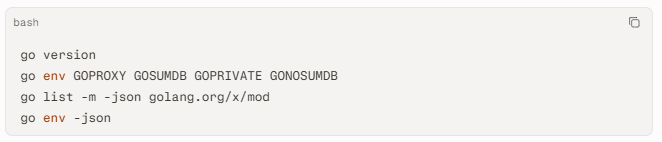
Check whether affected versions are present:

Review build definitions, environment-management systems, container base images, CI variables, shell profiles, and infrastructure-as-code repositories for nonstandard GOPROXY or GOSUMDB values. Go clients making checksum database requests to unexpected domains, or downloading modules from unapproved proxy hosts, are important indicators.
Verification should include a controlled regeneration of module metadata from trusted sources:

Compare regenerated go.sum and go.work.sum files with approved source-control history and release artifacts. Investigate unexpected module versions, altered checksums, unfamiliar vendored code, unusual build-time network calls, or application behavior that began after dependencies were refreshed. The CVE record specifically identifies removal of go.sum, go.work.sum, and vendor/, followed by go mod tidy, as a method to determine possible impact.
Compare regenerated go.sum and go.work.sum files with approved source-control history and release artifacts. Investigate unexpected module versions, altered checksums, unfamiliar vendored code, unusual build-time network calls, or application behavior that began after dependencies were refreshed. The CVE record specifically identifies removal of go.sum, go.work.sum, and vendor/, followed by go mod tidy, as a method to determine possible impact.
C — Mitigation & Remediation
- Immediate (0–24h): Identify all systems that compile, test, package, or download Go modules. Capture the Go version and
GOPROXYandGOSUMDBconfiguration for each system. Restrict build environments from using unapproved proxy and checksum database endpoints. Preserve build logs, dependency lockfiles, module caches, and relevant configuration before cleanup if compromise is suspected. - Immediate (0–24h): Apply the official vendor patch first. Upgrade the Go toolchain to Go 1.25.13 or later for the 1.25 branch, Go 1.26.6 or later for the 1.26 branch, or the corrected 1.27 release candidate or later as applicable. Update
golang.org/x/mod/sumdbto version 0.40.0 or later when your software directly depends on it. Use supported distribution packages or official vendor-provided updates for operating systems and managed images. - Short-term (1–7d): Rebuild affected applications, container images, and release artifacts from clean, patched build environments. Regenerate
go.sum,go.work.sum, and vendor directories using trusted module infrastructure, then review differences. Rotate credentials, tokens, signing keys, and cloud access secrets that were accessible to potentially affected build systems if investigation identifies unexpected dependency changes or suspicious activity. - Short-term (1–7d): Review private module proxy and checksum database architecture. Require authenticated administrative access, protected configuration changes, encrypted connections, audit logging, and documented ownership for every trusted module-delivery endpoint. Remove unused custom settings from developer images and continuous integration templates.
- Long-term (ongoing): Establish a software supply chain control program that includes dependency inventories, approved registries and proxies, isolated builds, artifact provenance, code review for dependency changes, and repeatable rebuild capability. Organizations unable to patch immediately should temporarily use only verified trusted module sources, prohibit custom GOSUMDB endpoints, isolate affected build systems from sensitive credentials, and defer high-risk production releases until validation is complete.
D — Best Practices
- Maintain a centralized inventory of Go toolchains, Go module dependencies, build images, and module-delivery configurations across all development and continuous integration environments.
- Allow module downloads only through approved, monitored proxy infrastructure, and tightly control changes to
GOPROXY,GOSUMDB,GOPRIVATE, andGONOSUMDB. - Use clean, ephemeral build environments so that cached dependencies and inherited environment variables cannot silently affect future releases.
- Require review and automated monitoring of
go.mod,go.sum,go.work.sum, vendored code, and container-image changes before release. - Limit build-system access to production credentials and use short-lived, least-privilege tokens so a dependency compromise has a smaller blast radius.
Leave Comment