
CVE-2026-51992: ClickHouse SQL Injection Report Rejected - What It Means for Your Business and How to Respond
Introduction
CVE-2026-51992 appeared to describe a serious security flaw in ClickHouse Server, a data analytics platform used by organizations to process large volumes of information. Early descriptions characterized the issue as a remotely exploitable SQL injection vulnerability that could lead to arbitrary code execution. That wording understandably attracted attention from security teams, executives, and vulnerability management programs.
However, the vulnerability record has since been rejected. The current record states that the reported behavior does not represent an exploitable ClickHouse vulnerability. Instead, it involves an intentional ClickHouse integration feature and privileges that must already be granted in the connected PostgreSQL environment.
This article explains what the change means for your business, how to determine whether your organization has genuine exposure, and which controls remain important. It also provides technical verification guidance for security engineers and information technology professionals.
S1: Background & History
CVE-2026-51992 was initially published on July 29, 2026, with a description claiming SQL injection in ClickHouse Server versions 26.3.9.8 and earlier through the CREATE DICTIONARY function. The initial description associated the report with remote arbitrary code execution and identified improper neutralization of special elements in SQL commands, commonly known as SQL injection.
The initial report was attributed to ClickHouse as the record source. Early third-party listings described the issue as critical and assigned a high severity score. Those assessments should not be treated as authoritative now because the CVE record was later rejected by the numbering authority.
The current NVD entry identifies the CVE as rejected and was last modified on August 6, 2026. It explains that ClickHouse's PostgreSQL integration intentionally permits users with valid PostgreSQL credentials to execute queries against a remote PostgreSQL server. It further states that code execution occurs on the downstream PostgreSQL server, not because of a ClickHouse vulnerability.
S2: What This Means for Your Business
For your organization, the most important point is that CVE-2026-51992 should not be handled as a confirmed ClickHouse software defect requiring an emergency upgrade. The rejected status means that the original claim does not establish a vulnerability in ClickHouse itself.
That does not mean every related configuration is safe. If your ClickHouse deployment connects to PostgreSQL, the security of that connection still depends on strong credentials, carefully limited permissions, network controls, and appropriate monitoring. A user who already possesses valid database credentials and the specific permission required to execute server-side programs may be able to perform powerful actions in PostgreSQL. That is an authorization and configuration concern rather than evidence of unauthenticated remote compromise through ClickHouse.
Misclassifying the record can create operational disruption. You could divert staff from confirmed vulnerabilities, perform unnecessary emergency changes, or interrupt analytics services without reducing measurable risk. Conversely, dismissing the underlying PostgreSQL permissions issue could expose sensitive data, business processes, or connected systems.
Your compliance obligations also remain practical rather than CVE-specific. You should be able to demonstrate that database access is limited, privileged activities are logged, third-party integrations are reviewed, and security findings are validated before remediation decisions are made. A rejected CVE is a reason to improve vulnerability intelligence processes, not a reason to stop reviewing the associated architecture.
S3: Real-World Examples
Regional bank analytics platform: A regional bank operates ClickHouse for reporting and connects it to PostgreSQL systems containing customer and transaction data. The bank should not describe the environment as vulnerable to CVE-2026-51992 solely because it runs an affected ClickHouse version, but it should verify that service accounts cannot use unnecessary PostgreSQL execution privileges.
Manufacturing data environment: A mid-sized manufacturer uses ClickHouse to analyze production telemetry and connects to a separate PostgreSQL inventory system. If the integration account has broad permissions, a compromise of that account could enable unauthorized database activity. Reviewing account privileges and isolating the connection can reduce the real risk without treating the rejected CVE as a confirmed software flaw.
Healthcare reporting service: A healthcare organization exposes analytics services to internal departments through a controlled application layer. The organization should confirm that users cannot submit arbitrary database definitions or influence connection parameters, even though the CVE itself does not establish a ClickHouse vulnerability. Strong application authorization and database auditing remain appropriate safeguards for sensitive information.
Cloud-hosted startup: A growing software company runs ClickHouse in a cloud environment and permits direct database access from the internet for convenience. The company faces unnecessary exposure if its database interfaces are publicly reachable, particularly when authentication, role restrictions, or network segmentation are weak. Restricting access to approved networks is a sound security improvement independent of CVE-2026-51992.
S4: Am I Affected?
- No, not by a confirmed CVE-2026-51992 vulnerability, if your organization is relying only on the original SQL injection and arbitrary code execution description. The CVE record has been rejected.
- Yes, you may still require review if ClickHouse connects to PostgreSQL or another external data source.
- Yes, investigate further if an integration account has permission to execute server-side programs in PostgreSQL, including the specifically referenced
pg_execute_server_programpermission. - Yes, treat the environment as higher risk if ClickHouse or PostgreSQL interfaces are reachable from untrusted networks.
- No, do not assume that running ClickHouse version 26.3.9.8 or earlier proves exposure to this CVE.
- Yes, review the deployment if applications construct ClickHouse data-definition statements from user-controlled input.
- Yes, escalate for validation if a scanner reports this CVE without showing the current rejected status and the evidence supporting its finding.
Key Takeaways
- CVE-2026-51992 is currently rejected, so it should not be treated as a confirmed ClickHouse SQL injection vulnerability.
- The reported behavior depends on valid PostgreSQL credentials and a specific PostgreSQL permission, rather than an unauthenticated ClickHouse attack.
- Your priority should be validating database privileges, integration architecture, network exposure, and logging.
- You should verify vulnerability scanner results against authoritative records before disrupting production systems.
- A focused penetration test can determine whether your actual configuration permits unauthorized database actions or lateral movement.
Call to Action
Do not let a rejected CVE create unnecessary disruption, or let an associated database configuration risk go unexamined. IntegSec can validate your exposure, review your ClickHouse and PostgreSQL architecture, and perform a penetration test designed to identify meaningful paths to sensitive systems. Visit IntegSec to take the next step toward measurable cybersecurity risk reduction.
Technical Appendix
A: Technical Analysis
The initial record described SQL injection in the ClickHouse CREATE DICTIONARY function and claimed arbitrary code execution in versions up to 26.3.9.8. The current record rejects that description. According to the NVD, ClickHouse's PostgreSQL integration intentionally allows a user with valid PostgreSQL credentials to issue queries against a remote PostgreSQL server.
The relevant execution capability exists on the downstream PostgreSQL server and requires the specific pg_execute_server_program permission. The NVD explicitly compares the situation with the previously disputed CVE-2019-9193 PostgreSQL claim and states that no ClickHouse vulnerability is exploited.
Consequently, there is no validated CVSS vector for CVE-2026-51992 in the current NVD record, and there is no confirmed affected ClickHouse component requiring a vendor patch under this CVE. The initial classification referenced CWE-89, improper neutralization of special elements in SQL commands, but that classification belongs to the withdrawn claim and should not be used as proof of a current ClickHouse defect.
B: Detection & Verification
Version enumeration commands: Administrators can document the deployed ClickHouse version with: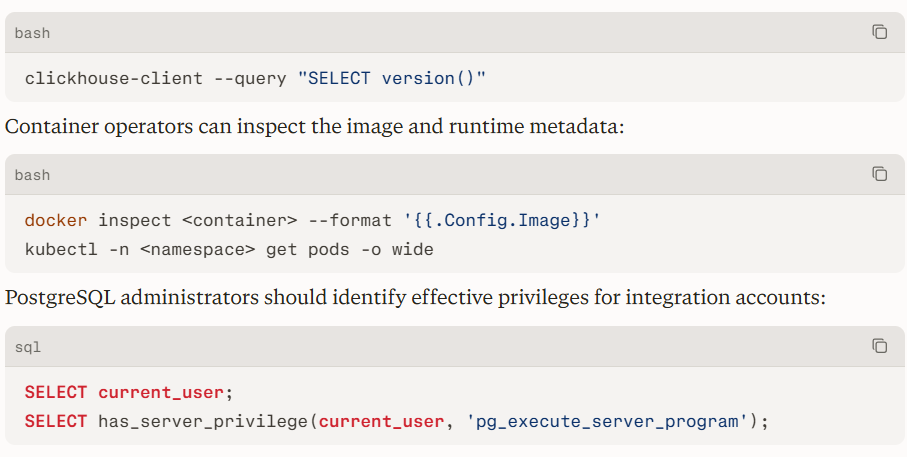
Scanner signatures: A scanner finding for CVE-2026-51992 should be considered unverified if it reports only a version match. The finding should identify the current rejected status, the ClickHouse to PostgreSQL integration, the account involved, and the relevant privilege.
Log indicators: Review ClickHouse query logs, PostgreSQL audit records, authentication events, and operating system process creation logs for unexpected activity by integration accounts. Useful indicators include unusual remote database connections, unexpected server-side program execution, new external data-source definitions, and commands issued outside established reporting schedules.
Behavioral anomalies: Network monitoring should examine outbound connections from ClickHouse to unapproved PostgreSQL hosts. Security teams should also investigate unexplained changes to dictionary definitions, unusual database queries, and privilege changes affecting integration users.
C: Mitigation & Remediation
- Immediate, 0–24 hours: Do not roll back or replace ClickHouse solely because of CVE-2026-51992. Confirm the record's rejected status, inventory ClickHouse to PostgreSQL connections, identify every integration account, and review whether any account has
pg_execute_server_program. Restrict ClickHouse and PostgreSQL interfaces to trusted management networks, private application networks, or approved administrative jump hosts. Require authenticated connections and disable unnecessary internet exposure. - Short-term, 1–7 days: Remove excessive PostgreSQL privileges from service accounts and separate read-only analytics identities from accounts used for administrative operations. Review ClickHouse users, roles, dictionary definitions, connection strings, and stored credentials. Rotate credentials when exposure or inappropriate sharing is suspected. Add database audit coverage for privileged statements and server-side program execution. Applications that generate dictionary definitions or other data-definition statements should use strict allow-lists for identifiers, hosts, ports, and permitted data sources.
- Long-term, ongoing: Maintain an authoritative inventory of ClickHouse and PostgreSQL assets, integrations, versions, identities, and network paths. Add rejected and withdrawn CVE validation to the vulnerability management process so that scanner results are confirmed against the CVE record and vendor guidance. Conduct periodic penetration tests that evaluate credential theft, privilege abuse, database-to-database movement, and access to sensitive information. Apply official vendor patches for genuine ClickHouse or PostgreSQL vulnerabilities as soon as they are validated and approved through change management. Because CVE-2026-51992 has no confirmed ClickHouse defect, no official patch should be represented as remediation for this specific identifier.
D: Best Practices
- Limit PostgreSQL integration accounts to the minimum permissions required for approved analytics queries.
- Keep ClickHouse and PostgreSQL interfaces off the public internet unless a documented business requirement exists.
- Use separate credentials for ingestion, reporting, administration, and emergency support.
- Monitor database privilege changes, external connections, dictionary modifications, and server-side process execution.
- Require vulnerability teams to validate rejected or disputed CVEs against authoritative records before assigning emergency remediation status.
Leave Comment