
CVE-2026-50516: Azure Kubernetes Service Missing Authentication Bug - What It Means for Your Business and How to Respond
Introduction
CVE-2026-50516 is a critical security vulnerability affecting Microsoft Azure Kubernetes Service, a managed platform many organizations use to run customer-facing applications, internal services, data pipelines, and software development workloads. The issue could allow an unauthenticated attacker to gain elevated privileges through the network, making it a material concern for organizations that rely on Azure-hosted Kubernetes environments.
For businesses across the United States and Canada, the priority is not merely determining whether a cluster exists. You need to understand which business services depend on Azure Kubernetes Service, whether the affected service exposure applies to your environment, and whether a successful compromise could provide a route to sensitive systems or data.
This article explains the vulnerability in business terms, outlines likely operational and compliance consequences, and provides a practical checklist for determining whether your organization may be affected. A technical appendix follows for security engineers, cloud administrators, and penetration testers.
S1 — Background & History
Microsoft disclosed CVE-2026-50516 on August 11, 2026. The vulnerability affects Microsoft Azure Kubernetes Service, commonly known as AKS, which is Microsoft’s managed Kubernetes offering. Kubernetes is widely used to deploy and operate applications made up of containers, including web applications, application programming interfaces, and back-end services.
The reported weakness is missing authentication for a critical function. In plain language, an important capability may not adequately verify that a requester is authorized before allowing an action. This can permit an outside attacker to elevate privileges over a network.
The vulnerability is classified as critical, with a Common Vulnerability Scoring System version 3.1 score of 9.4 out of 10. Microsoft is listed as the reporting source in the National Vulnerability Database, which published the record on August 11 and last modified it on August 12. The National Vulnerability Database identifies the weakness as CWE-306, “Missing Authentication for Critical Function,” and links Microsoft’s Security Response Center advisory as the vendor reference.
S2 — What This Means for Your Business
If you use Azure Kubernetes Service, CVE-2026-50516 deserves immediate executive and technical attention because it concerns unauthorized privilege escalation. A successful attacker may be able to obtain a higher level of access than intended without first possessing valid credentials. That can turn an internet-accessible or network-reachable cloud service into an entry point for broader compromise.
Your operational risk depends on what the affected AKS environment supports. If it runs a public application, disruption could affect customer access, sales, support channels, or contractual service commitments. If it hosts internal applications, a compromise could interrupt employee operations, software delivery, or business reporting.
The data risk can be equally serious. Elevated access may provide a path to application secrets, configuration data, connected cloud resources, or customer information, depending on your architecture and access controls. For regulated organizations in the United States and Canada, that can create obligations involving breach investigation, notification, contractual reporting, privacy commitments, and evidence of reasonable safeguards.
Your reputation is also at stake. Customers and partners expect cloud-managed infrastructure to be monitored, maintained, and protected through a shared-responsibility model. Microsoft manages portions of the platform, but you remain responsible for understanding your workloads, identities, network paths, configurations, and response procedures.
S3 — Real-World Examples
A regional bank: A regional bank uses AKS to host components that support online account access and mobile banking features. If an attacker gained elevated access to a connected application environment, the bank could face service interruptions, emergency containment costs, regulatory scrutiny, and customer concern even if core banking systems remained separate.
A mid-sized healthcare provider: A healthcare organization uses AKS to operate patient scheduling, telehealth, and internal integration services. An incident could interrupt appointment workflows and force the organization to investigate whether protected health information, integration credentials, or connected clinical systems were exposed.
A Canadian software-as-a-service provider: A growing software provider runs its multi-tenant platform on AKS and deploys changes frequently. A compromise affecting production clusters could create cross-tenant risk, delay product releases, trigger customer notification obligations, and place contractual service-level commitments at risk.
A North American manufacturer: A manufacturer uses cloud-hosted container services for supplier portals, inventory visibility, and logistics integrations. Disruption or unauthorized access could delay order processing, impair supply-chain coordination, and create downstream costs for distributors and customers.
These are risk scenarios, not confirmed exploitation cases. The U.S. Cybersecurity and Infrastructure Security Agency maintains the Known Exploited Vulnerabilities Catalog as its authoritative list for vulnerabilities exploited in the wild; organizations should monitor that catalog and Microsoft’s advisory as the situation evolves.
S4 — Am I Affected?
- You are running workloads on Microsoft Azure Kubernetes Service in production, development, testing, or disaster-recovery environments.
- You use AKS to host internet-facing applications, application programming interfaces, partner portals, remote employee services, or customer-facing software.
- You do not have a current inventory of every Azure subscription, AKS cluster, Kubernetes version, region, owner, and business service that depends on AKS.
- You have not reviewed Microsoft’s advisory for CVE-2026-50516 to determine whether Microsoft has applied a platform-side remediation or requires customer action.
- Your AKS workloads can access sensitive data stores, cloud secrets, build systems, identity services, payment systems, health information, or other high-value resources.
- Your environment relies on broad workload permissions, shared administrator accounts, excessive service-account privileges, or weak separation between development and production.
- You cannot quickly determine whether your Kubernetes control plane, cluster nodes, workload identities, and connected Azure resources have generated unusual activity.
- You should treat the environment as potentially affected until Microsoft’s official guidance and your internal verification confirm otherwise.
Key Takeaways
- CVE-2026-50516 is a critical Azure Kubernetes Service vulnerability involving missing authentication for a critical function and possible network-based privilege escalation.
- You should prioritize the issue if AKS supports public applications, sensitive business processes, regulated data, or systems with access to valuable cloud resources.
- Your first decision point is asset visibility: identify every AKS cluster, its business owner, its exposure, and the applications and identities connected to it.
- Microsoft’s official advisory should guide patching or platform remediation decisions, while your team validates customer-side configuration, identity, and monitoring requirements.
- Even when a managed cloud provider remediates platform infrastructure, you remain responsible for workload security, access controls, secrets, segmentation, logging, and incident readiness.
Call to Action
CVE-2026-50516 is an opportunity to validate more than one vulnerability response. It is a test of whether your cloud environment can identify critical exposure, limit privilege escalation, and contain risk before it becomes a business incident. IntegSec provides penetration testing and cybersecurity risk-reduction services that assess cloud workloads, identity boundaries, network exposure, Kubernetes configurations, and realistic attack paths. Engage IntegSec to turn vulnerability response into measurable security improvement at integsec.com.
TECHNICAL APPENDIX
A — Technical Analysis
CVE-2026-50516 is an Azure Kubernetes Service elevation-of-privilege vulnerability attributed to missing authentication for a critical function. The National Vulnerability Database describes the issue as allowing an unauthorized attacker to elevate privileges over a network. It maps the weakness to CWE-306, which applies when a product does not perform authentication for functionality that requires a provable identity or authorization boundary.
The published CVSS v3.1 score is 9.4, Critical, with vector CVSS:3.1/AV:N/AC:L/PR:N/UI:N/S:U/C:H/I:H/A:L. This indicates network attackability, low attack complexity, no required privileges, no user interaction, unchanged scope, high confidentiality impact, high integrity impact, and low availability impact.
The affected component is Microsoft Azure Kubernetes Service, an exclusively hosted managed service rather than a conventional customer-installed software package. Public NVD material does not provide exploit mechanics, specific affected cluster versions, or a detailed vulnerable endpoint. Engineers should therefore avoid assuming that node-image upgrades alone resolve the condition and should use Microsoft’s CVE advisory as the definitive remediation source.
B — Detection & Verification
Verification should focus on AKS inventory, Microsoft advisory status, exposure review, and signs of anomalous privilege activity. Because the public CVE record does not identify a customer-side package version or exploit request pattern, detection should not rely on a single scanner signature.
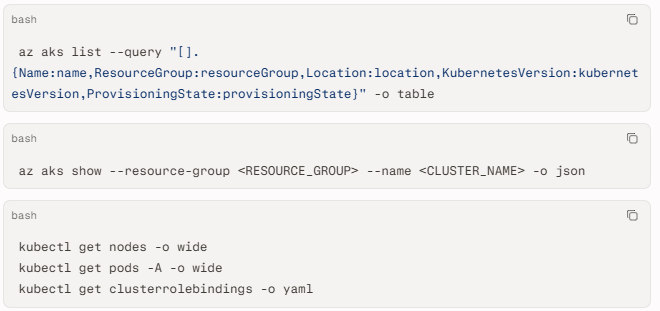
- Query Microsoft Defender for Cloud, Azure Activity Log, Azure Kubernetes Service diagnostic logs, and identity logs for unexpected administrative actions, role changes, new credentials, or anomalous control-plane-related events.
- Review Kubernetes audit logs for unusual cluster role bindings, service-account token use, privileged pod creation, host-path mounts, secret enumeration, and unexpected execution in system namespaces.
- Investigate network telemetry for suspicious connections involving AKS endpoints, unusual east-west traffic, unexplained outbound traffic from workloads, or authentication failures followed by privileged actions.
- Treat commercial scanner findings as supporting evidence only unless the scanner references Microsoft’s official advisory and accurately differentiates AKS platform exposure from customer-managed Kubernetes configuration issues.
C — Mitigation & Remediation
- Immediate (0–24h): Inventory all AKS clusters across every Azure tenant, subscription, region, and environment. Assign a business owner and technical owner to each cluster, identify internet-exposed workloads, and document access to sensitive data and cloud resources. Review Microsoft’s official CVE-2026-50516 guidance first and follow any Microsoft-directed remediation, maintenance, upgrade, or support steps.
- Immediate (0–24h): Enable or confirm collection of Azure Activity Logs, AKS diagnostic logs, Kubernetes audit logs, identity sign-in logs, and workload security telemetry. Preserve relevant logs before modifying systems if compromise indicators appear.
- Short-term (1–7d): Apply Microsoft’s prescribed patch or platform remediation as soon as it is available and operationally approved. Validate completion through Microsoft Azure portal status, Azure command-line output, support case confirmation where needed, and functional tests for critical applications.
- Short-term (1–7d): Reduce blast radius while remediation is pending. Restrict Kubernetes application programming interface access to approved networks, remove unnecessary public exposure, enforce least privilege for Azure roles and Kubernetes roles, rotate high-value secrets where risk warrants, and segment production from non-production environments.
- Long-term (ongoing): Establish a cloud vulnerability-response process that joins platform advisories with asset inventory, configuration review, threat hunting, change control, and executive reporting. Regularly test AKS workloads and connected cloud identities for privilege-escalation paths through independent penetration testing.
For environments that cannot immediately apply vendor-directed remediation, interim controls should prioritize network restrictions, privileged-access reduction, enhanced logging, workload isolation, and continuous monitoring. These measures reduce opportunity and impact, but they are not substitutes for Microsoft’s official corrective action.
D — Best Practices
- Maintain a continuously updated inventory of AKS clusters, subscriptions, owners, exposed services, deployed applications, and business dependencies.
- Apply least privilege to Azure role assignments, Kubernetes cluster roles, service accounts, managed identities, and workload access to secrets and data stores.
- Limit access to Kubernetes management interfaces through private networking, approved source networks, strong identity controls, and monitored administrative paths.
- Centralize Azure, Kubernetes, identity, and network telemetry so teams can correlate unauthorized access attempts with privilege changes and workload activity.
- Conduct recurring cloud and Kubernetes penetration tests that evaluate authentication boundaries, identity escalation paths, workload isolation, secret access, and reachable business systems
Leave Comment