
CVE-2026-45321: TanStack npm Supply Chain Compromise — What It Means for Your Business and How to Respond
Introduction
If your development teams use modern JavaScript tooling, CVE-2026-45321 demands your immediate attention. This critical vulnerability represents a sophisticated supply chain attack that compromised 42 popular @tanstack/* npm packages on May 11, 2026, potentially exposing cloud credentials, API keys, and source code repositories across thousands of organizations. The attack targeted widely-used frontend routing and development tools, meaning your team may have inadvertently installed malicious code without direct dependency on TanStack products. This post explains what happened in business terms, assesses your organizational risk, provides a clear checklist to determine exposure, and outlines concrete steps to respond. Technical teams will find detailed analysis and remediation guidance in the appendix.
Background & History
On May 11, 2026, between 19:20 and 19:26 UTC, attackers published 84 malicious versions across 42 @tanstack/* packages to the npm registry. GitHub, Inc. reported this vulnerability with a CVSS score of 9.6 (Critical), classifying it as embedded malicious code (CWE-506). The attack exploited a chain of three weaknesses in TanStack's GitHub Actions continuous integration pipeline: a misconfigured pull_request_target workflow, cache poisoning across repository trust boundaries, and extraction of OpenID Connect tokens from runner memory. Using these techniques, attackers authenticated as TanStack's legitimate publisher and released credential-stealing malware under a trusted identity. CISA added this vulnerability to its Known Exploited Vulnerabilities catalog on May 27, 2026, with a compliance deadline of June 10, 2026 for federal agencies and contractors. TanStack maintainers deprecated affected versions and published clean replacements within hours of discovery.
What This Means for Your Business
This vulnerability poses direct threats to your operations, data security, reputation, and regulatory compliance. Any system that installed an affected package version during the attack window executed malware designed to harvest credentials from AWS, Google Cloud, Azure, Kubernetes, HashiCorp Vault, GitHub, and SSH key stores. If your developers or build servers pulled these packages, attackers may have gained access to production environments, customer data, proprietary code, and cloud infrastructure. The malware also attempted to propagate by republishing other packages your team maintains, potentially spreading compromise to your customers or partners. Beyond immediate technical damage, this incident triggers notification obligations under data protection regulations if customer or employee information was exposed. Your organization faces reputational harm if clients learn their data was compromised through your development pipeline. Insurance carriers may scrutinize your software supply chain controls during claims assessment or policy renewal. Most critically, the attack demonstrated that cryptographic build verification and trusted publisher systems can be defeated, meaning traditional security controls may have provided false assurance.
Real-World Examples
Regional Bank: A mid-sized financial institution discovered that its frontend development team had installed @tanstack/react-router version 1.169.5 during routine dependency updates on May 11. The malicious code harvested AWS credentials from the build server, giving attackers access to customer account databases and online banking infrastructure. The bank incurred six-figure incident response costs, faced regulatory examination from state banking authorities, and accelerated its cloud credential rotation timeline by 18 months.pragma-core
Healthcare Technology Vendor: A company providing patient management software to clinics found that its CI/CD pipeline had pulled @tanstack/router-plugin version 1.167.38. The credential stealer exfiltrated Azure Active Directory tokens, compromising access to electronic health record systems across 40 client facilities. The vendor initiated breach notifications under HIPAA, engaged forensic investigators, and faced contract penalties from three healthcare systems demanding enhanced supply chain security audits.pragma-core
E-commerce Platform: A retail technology firm learned that a contractor's development machine had installed @tanstack/vue-router version 1.169.5 while building a custom integration. The malware harvested GitHub personal access tokens and published poisoned versions of the company's internal packages, spreading the compromise to two enterprise customers. The platform provider absorbed the cost of customer incident response, provided free security assessments, and revised its contractor security requirements to mandate dependency scanning.pragma-core
SaaS Startup: A business software startup with 50 employees discovered that its entire engineering team had installed affected TanStack packages during a coordinated sprint planning session. The company treated all 50 developer machines as fully compromised, rotated every cloud credential and API key in its infrastructure, and engaged external counsel to assess notification obligations across its customer base. The incident consumed three weeks of engineering time and delayed two planned product releases.pragma-core
Am I Affected?
Answer these questions to determine whether your organization faces exposure from CVE-2026-45321:pragma-core
- Your development teams use npm, pnpm, or yarn to manage JavaScript dependencies.pragma-core
- Your projects directly depend on any @tanstack/* package, including @tanstack/react-router, @tanstack/vue-router, @tanstack/solid-router, @tanstack/router-plugin, or related tooling.
- Your projects indirectly depend on TanStack packages through other libraries or frameworks.pragma-core
- Your continuous integration systems performed fresh dependency installations on May 11, 2026, between 19:20 and 19:30 UTC.
- Your developers installed or updated frontend dependencies on May 11, 2026, without pinning to specific versions published before 19:00 UTC that day.pragma-core
- Your software composition analysis tools have not yet flagged @tanstack/* packages installed during the attack window.pragma-core
- Your organization uses GitHub Actions for builds and has workflows triggered by pull_request_target events.
If you answered yes to any of these items, treat your environment as potentially compromised until verification confirms otherwise.
Key Takeaways
- CVE-2026-45321 is a critical supply chain attack that compromised 42 TanStack npm packages with credential-stealing malware on May 11, 2026.
- Any system that installed affected versions during the attack window must be treated as fully compromised, with all accessible credentials considered exposed.
- The attack defeated cryptographic build verification, demonstrating that trusted publisher systems alone cannot guarantee package integrity.
- Immediate actions include auditing dependency histories, rotating all credentials on potentially affected systems, and hardening continuous integration pipeline configurations.
- Long-term protection requires structural changes: pinning dependencies, disabling lifecycle scripts by default, and auditing GitHub Actions workflows for trust boundary violations.
Call to Action
Your software supply chain is only as strong as your weakest dependency. IntegSec specializes in identifying and remediating exactly this class of vulnerability through comprehensive penetration testing and security assessments. Our team will audit your continuous integration pipelines, test your dependency management controls, and validate that your credential storage practices limit blast radius when incidents occur. Contact IntegSec today at https://integsec.com to schedule a consultation and begin reducing your cybersecurity risk with confidence.
Technical Appendix
A — Technical Analysis
CVE-2026-45321 stems from a chained exploitation of three distinct weaknesses in TanStack's GitHub Actions configuration. The root cause begins with a pull_request_target workflow misconfiguration that allowed attacker-controlled code from a fork to execute in the base repository's trusted context. The attacker poisoned the shared GitHub Actions cache with malicious binaries keyed to match the release workflow's cache lookup pattern. When the legitimate release workflow executed, it restored the poisoned cache, enabling runtime memory extraction of the OpenID Connect token from the runner process. The CVSS v3.1 vector is AV:N/AC:L/PR:N/UI:R/S:C/C:H/I:H/A:H, reflecting network accessibility, low attack complexity, no privileges required, user interaction via package installation, scope change across trust boundaries, and high impact to confidentiality, integrity, and availability. NVD lists this under CWE-506 (Embedded Malicious Code), with GitHub, Inc. as the assigning CNA. The NVD reference is https://nvd.nist.gov/vuln/detail/CVE-2026-45321.
B — Detection & Verification
Version enumeration commands:

Scanner signatures: Check software composition analysis tools for @tanstack/* packages with versions 1.169.5, 1.169.8 (react-router), 1.167.38, 1.167.41 (router-plugin), and related versions published on May 11, 2026.
Log indicators: Search CI/CD logs and npm-debug.log files for installations occurring between 19:20 and 19:30 UTC on May 11, 2026.pragma-core
Behavioral anomalies: Look for unexpected network connections to filev2.getsession.org, seed1.getsession.org, seed2.getsession.org, seed3.getsession.org, or git-tanstack[.]com.pragma-core
Network exploitation indicators: Monitor for GitHub repository creation with descriptions matching "A Mini Shai-Hulud has Appeared" and DNS queries to Session messenger infrastructure from CI runners.
Offline verification without executing scripts:
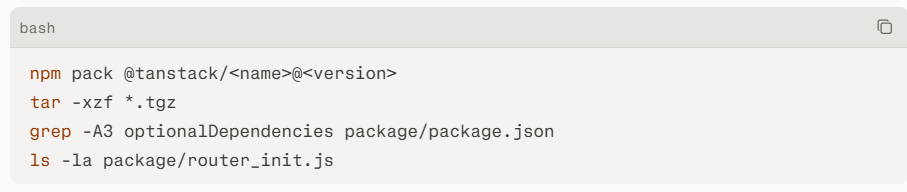
Malicious versions contain an optional Dependencies entry pointing to github:tanstack/router#79ac49eedf774dd4b0cfa308722bc463cfe5885c and an undeclared router_init.js file (~2.3 MB) in the package root.pragma-core
C — Mitigation & Remediation
1. Immediate (0–24h):
- Audit all dependency trees for affected @tanstack/* versions installed on May 11, 2026.pragma-core
- Search for and remove the gh-token-monitor persistence daemon before revoking credentials (check ~/Library/LaunchAgents/ on macOS and user-level systemd units on Linux).
- Snapshot developer home directories before credential rotation to preserve evidence and prevent data loss from the destructive failsafe.pragma-core
- Rotate all credentials accessible from potentially affected systems: GitHub personal access tokens, npm publish tokens, AWS access keys, GCP service account keys, Azure credentials, Kubernetes service account tokens, HashiCorp Vault tokens, SSH private keys, and Docker registry credentials.
- Block network access to known exfiltration endpoints: filev2.getsession.org, seed[1-3].getsession.org, git-tanstack[.]com, and IP 83.142.209[.]194.
2. Short-term (1–7d):
- Pin all @tanstack/* dependencies to versions published before May 11, 2026, 19:00 UTC or to verified clean releases published after deprecation notices.pragma-core
- Delete node_modules directories and lockfiles, then reinstall with --ignore-scripts flag enabled.pragma-core
- Audit GitHub Actions workflows for pull_request_target triggers that check out or execute PR head code.
- Restrict GitHub Actions cache scopes to prevent reads across fork↔base trust boundaries.
- Review .vscode/tasks.json and ~/.claude/settings.json for injected persistence hooks.
3. Long-term (ongoing):
- Replace pull_request_target workflows with pull_request triggers for any workflow executing code from pull requests.
- Pin all GitHub Actions and workflow steps to immutable commit SHAs rather than tags or branches.
- Implement --ignore-scripts=true as the default for npm installs organization-wide, with explicit allowlisting for trusted lifecycle hooks.
- Transition from long-lived filesystem credentials to short-lived tokens and ephemeral CI/CD environments.
- Deploy continuous software composition analysis with malicious package detection and minimumReleaseAge policies to delay automatic installation of newly published versions.
Official vendor patch: TanStack deprecated all affected versions and published clean replacements. Verify versions against the security advisory at https://github.com/TanStack/router/security/advisories/GHSA-g7cv-rxg3-hmpx.
D — Best Practices
- Treat pull_request_target workflows as privilege boundaries: never check out or execute PR head code from such workflows without isolating them in secret-free runners.
- Constrain CI cache scopes to branches you control and treat cached artifacts as untrusted input requiring validation.
- Harden runners against memory extraction attacks using ephemeral hosts, minimal base images, and provenance verification for all build tools.
- Disable npm lifecycle scripts by default and scope any required scripts to separate, throwaway build stages with rotated secrets.
- Monitor the GitHub fork network API for new commits and pull requests from previously unseen forks, especially for popular open-source projects your organization depends on.
Leave Comment