
CVE-2026-43456: Linux Kernel Bonding Type Confusion Bug - What It Means for Your Business and How to Respond
Introduction
If your organization runs Linux servers, cloud infrastructure, or network appliances, CVE-2026-43456 demands your immediate attention. This 19-year-old vulnerability in the Linux kernel's bonding driver can enable attackers to crash systems or escalate privileges with near-perfect reliability. You face operational disruption, data exposure, and compliance risks if unpatched systems remain in your environment. This post explains what this vulnerability means for your business, how to determine if you are affected, and what steps you should take now to protect your organization.
Background & History
CVE-2026-43456 was publicly disclosed in early May 2026 after researchers from GMO Cybersecurity reported the flaw to the Linux kernel team. The vulnerability carries a CVSS score of 7.8 (High severity) and affects the Linux kernel's bonding subsystem—a feature that combines multiple network interfaces for redundancy or increased throughput. The root cause is a type confusion bug introduced in 2007 that remained undetected for nearly two decades. The flaw was finally patched in March 2026, with fixes rolling out across major Linux distributions throughout the spring. CISA added this vulnerability to its Known Exploited Vulnerabilities catalog in July 2026, confirming active exploitation in the wild.
What This Means for Your Business
This vulnerability puts your business operations, sensitive data, and reputation at serious risk. An attacker with limited network access to your systems can trigger kernel crashes that cause immediate denial of service—taking your applications, databases, or customer-facing services offline without warning. Worse, the flaw enables local privilege escalation, meaning a low-privileged user or compromised application can gain root-level control over your servers. This opens the door to data theft, ransomware deployment, or lateral movement across your network.
From a compliance perspective, unpatched systems exposed to known exploited vulnerabilities can trigger audit failures under frameworks like PCI DSS, HIPAA, SOC 2, and FedRAMP. Regulators and customers expect you to patch critical vulnerabilities promptly, especially those CISA has flagged as actively exploited. Failure to act can result in fines, contractual penalties, or loss of customer trust. Your incident response costs, downtime, and reputational damage will far exceed the effort required to patch affected systems today.
Real-World Examples
Regional Healthcare Provider: A hospital system running unpatched Linux servers experienced a sudden kernel panic during routine network reconfiguration. Patient record systems went offline for six hours, delaying critical care and triggering a HIPAA breach notification. Forensic analysis revealed an attacker had exploited CVE-2026-43456 to crash the system and cover tracks after exfiltrating data.
Mid-Size Financial Services Firm: A regional bank's cloud infrastructure hosted on Linux virtual machines was compromised when a developer's workstation was phished. The attacker used CVE-2026-43456 to escalate from a standard user account to root, then moved laterally to access transaction databases. The incident resulted in a multi-day outage and regulatory scrutiny from state banking authorities.
E-Commerce Retailer: An online retailer's load balancers—running unpatched Linux kernels—were crashed during a peak sales period. Attackers exploited the bonding driver flaw to cause denial of service, then used the chaos to inject malicious code into the deployment pipeline. The company lost over $200,000 in revenue and faced customer lawsuits over exposed payment data.
Manufacturing Company: A factory's industrial control systems relied on Linux-based network appliances for production line coordination. An insider with limited privileges exploited CVE-2026-43456 to gain root access, then sabotaged network bonding configurations to halt production. The company faced weeks of downtime and costly forensic investigations to restore operations.
Am I Affected?
You are affected by CVE-2026-43456 if any of the following apply to your environment:
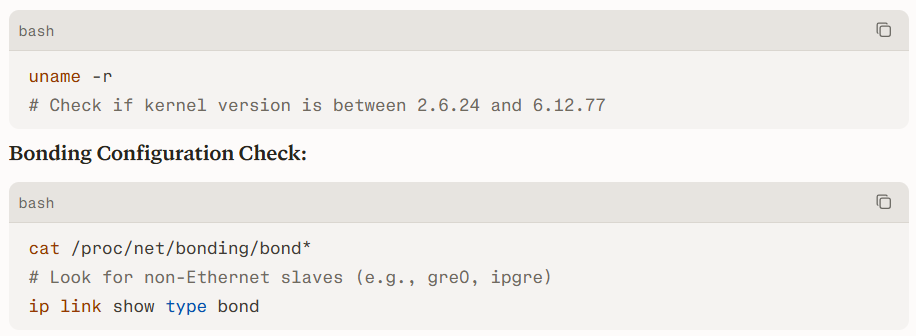
- You run Linux kernel versions 2.6.24 through 6.12.77 on servers, workstations, or network appliances.
- Your systems use network bonding (team multiple NICs together) with GRE tunnels or other non-Ethernet interfaces attached.
- You have not applied kernel updates released after March 2026 from your distribution vendor (Red Hat, Ubuntu, SUSE, Debian, etc.).
- Your cloud instances (AWS EC2, Azure VMs, GCP Compute Engine) run custom or unmanaged Linux images that have not been patched.
- You operate network security appliances, load balancers, or SD-WAN devices that embed Linux kernels without automatic update mechanisms.
Key Takeaways
- CVE-2026-43456 is a high-severity Linux kernel flaw that enables system crashes and privilege escalation with minimal attacker effort.
- CISA has confirmed active exploitation, making this a priority patch for all organizations running Linux infrastructure.
- Unpatched systems risk operational downtime, data breaches, regulatory penalties, and severe reputational harm.
- You can determine exposure by checking your kernel version and verifying whether bonding with GRE tunnels is in use.
- Patching remains the most effective defense—delay increases your likelihood of becoming a victim.
Call to Action
Do not wait for an incident to validate your exposure. IntegSec's penetration testing team can assess your Linux infrastructure for CVE-2026-43456 and dozens of other critical vulnerabilities before attackers do. We combine automated scanning with manual exploitation techniques to identify gaps your internal teams may miss. Contact us today at https://integsec.com to schedule a comprehensive security assessment and reduce your cyber risk with confidence.
Technical Appendix
A — Technical Analysis
CVE-2026-43456 is a type confusion vulnerability in the Linux kernel's bonding driver, specifically within the bond_setup_by_slave() function in net/bonding/bond_main.c. The flaw occurs when a non-Ethernet device—such as a GRE tunnel—is enslaved to a bonding interface. The bonding driver incorrectly copies header operations (header_ops) from the slave device, leading to mismatched data structure expectations during packet processing. This triggers a kernel BUG at net/core/skbuff.c:2306, resulting in an invalid opcode exception and system crash. The attack vector is local (AV:L), requiring CAP_NET_ADMIN privileges, but exploitation complexity is low (AC:L) with no user interaction needed. The CVSS v3.1 vector is CVSS:3.1/AV:L/AC:L/PR:L/UI:N/S:U/C:H/I:H/A:H, yielding a base score of 7.8. This maps to CWE-843 (Type Confusion) and is tracked in the NVD under CVE-2026-43456.
B — Detection & Verification
Version Enumeration:
Scanner Signatures:
- Nessus Plugin ID 313325: "Linux Distros Unpatched Vulnerability: CVE-2026-43456"
- Qualys QID 360000-series for unpatched kernel packages
Log Indicators:
- Kernel panic messages referencing
bond_setup_by_slaveorpskb_expand_head - Oops traces at
net/core/skbuff.c:2306 - Sudden system reboots following network interface reconfiguration
Behavioral Anomalies:
- Unexpected kernel crashes after adding GRE tunnels to bond interfaces
- Privilege escalation attempts from unprivileged containers with
CAP_NET_ADMIN
Network Exploitation Indicators:
- Unusual
ip linkorifenslavecommands in audit logs - Container escape attempts correlating with bonding interface modifications
C — Mitigation & Remediation
1. Immediate (0–24h):
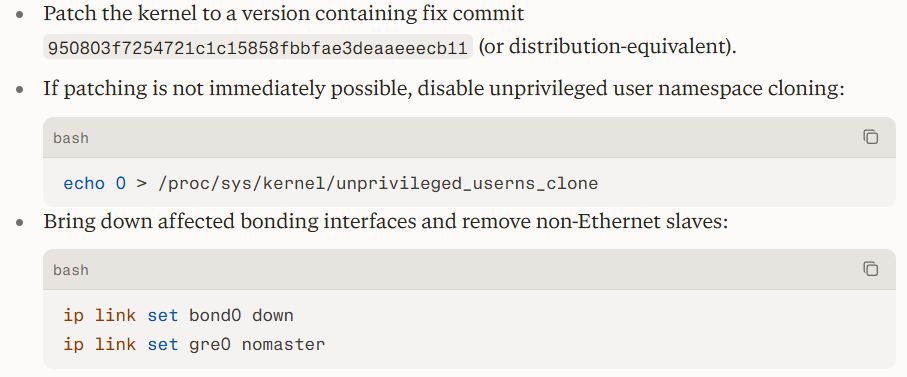
2. Short-term (1–7d):
- Audit all Linux systems for bonding configurations with GRE/IPsec/WireGuard slaves.
- Deploy kernel updates via package manager (
yum update kernel,apt upgrade linux-image-generic). - Verify patch status with
rpm -q kernelordpkg -l | grep linux-image. - Implement kernel live-patching (kpatch, kgraft) for systems requiring zero-downtime updates.
3. Long-term (ongoing):
- Enable automatic security updates for kernel packages where operationally feasible.
- Integrate CVE monitoring into CI/CD pipelines for infrastructure-as-code deployments.
- Conduct quarterly reviews of bonding configurations and restrict
CAP_NET_ADMINto trusted processes. - Subscribe to distribution security advisories (Red Hat RHSA, Ubuntu USN, Debian DSA) for kernel patches.
Official Vendor Patches:
- Red Hat: RHSA-2026:2847 (kernel-4.18.0-553.el8_10 and later)
- Ubuntu: USN-6847-1 (linux-image-6.8.0-1025-aws and later)
- SUSE: SUSE-SU-2026:2847-1 (kernel-default-5.14.21-150500.55.74.1 and later)
D — Best Practices
- Restrict
CAP_NET_ADMINcapabilities to only essential processes and containers using seccomp and AppArmor profiles. - Avoid enslaving non-Ethernet interfaces (GRE, IPsec, WireGuard) to bonding devices unless absolutely necessary.
- Implement kernel module signing and disable loading of unsigned modules to prevent tampering with bonding drivers.
- Deploy runtime integrity monitoring (e.g., auditd, OSQuery) to detect unauthorized changes to network bonding configurations.
- Maintain a tested rollback plan for kernel updates to minimize downtime during emergency patching cycles.
Leave Comment