
CVE-2026-21718: Copeland XWEB Pro Authentication Bypass - What It Means for Your Business and How to Respond
Introduction
If your organization operates commercial refrigeration, cold storage, food processing, healthcare facilities, or other environments that depend on Copeland XWEB Pro controllers, CVE-2026-21718 deserves immediate attention. This critical flaw allows an attacker with network access to bypass login protections and potentially take control of affected equipment without valid credentials. The risk is not limited to information technology systems; it extends to the operational technology that keeps temperature-sensitive products safe, facilities running, and regulatory obligations met. This post explains who is exposed, what the business consequences can be, how to determine whether your organization is affected, and the practical steps to reduce risk now and over time.
Background & History
CVE-2026-21718 was published on February 27, 2026, and concerns Copeland XWEB Pro refrigeration controllers, specifically the XWEB 300D Pro, XWEB 500D Pro, and XWEB 500B Pro models running firmware version 1.12.1 or earlier. The vulnerability was reported through CISA’s Industrial Control Systems Cyber Emergency Response Team, ICS-CERT, which issued advisory ICSA-26-057-10.
In plain language, the issue is an authentication bypass: the controller can be tricked into treating an unauthenticated network request as an authorized session. That can allow an attacker to reach privileged functionality and execute code on the device without a username, password, or other login step.
The severity is critical. NVD assigns a CVSS 3.1 base score of 9.8, while ICS-CERT assigns 10.0 because it assesses the weakness as capable of affecting systems beyond the initially compromised device. Copeland has released updated firmware, and users can obtain it through Copeland’s software update portal or, where internet access is available, directly from the controller’s system update menu.
What This Means for Your Business
For a business that relies on refrigeration controls, the central danger is loss of control over equipment that must operate within narrow environmental limits. An attacker who compromises an XWEB Pro controller may be able to interfere with settings, alarms, monitoring, or the controller itself. That can lead to spoiled inventory, interrupted production, failed quality checks, and costly emergency repairs.
The exposure is especially serious because the weakness can be reached without authentication. An attacker does not need stolen credentials or an employee’s assistance; network reachability is the primary barrier. If these controllers are exposed to the internet, a partner network, a poorly segmented facility network, or remote-access infrastructure, the practical risk rises substantially.
There are also compliance and reputational consequences. Temperature excursions can create evidence problems for food safety, pharmaceutical storage, and regulated cold-chain operations. Investigating an incident, notifying customers or regulators, replacing product, and demonstrating that controls were restored can consume management time and budget. A publicized compromise of operational equipment can also weaken customer confidence, particularly if it affects delivery commitments or product safety.
Finally, this is a reminder that cybersecurity risk is not confined to laptops and servers. Controllers, sensors, gateways, and remote-management tools are part of your attack surface. Treating them as unmanaged appliances leaves a gap that attackers can exploit.
Real-World Examples
Regional Grocery Chain: A regional grocery operator uses XWEB Pro controllers across distribution centers and store back rooms. A compromise could alter refrigeration monitoring or delay alarms, forcing the chain to discard perishable stock, pause deliveries, and conduct store-by-store temperature verification.
Specialty Pharmaceutical Distributor: A distributor storing temperature-sensitive medicines depends on continuous cold-chain records. If an attacker disrupts controllers or falsifies operational state, the business may need to quarantine inventory, notify customers, and prove that affected products remained within required storage conditions.
Mid-Sized Food Processor: A processor with connected refrigeration assets could face production downtime if controllers become unavailable or unreliable. Beyond direct losses, delayed shipments and quality-control investigations can damage relationships with retail and food-service customers.
Regional Healthcare Facility: A hospital or clinic using connected refrigeration for vaccines, blood products, or laboratory samples could face patient-safety and regulatory exposure. Even a suspected compromise may require conservative disposal or requalification of high-value inventory.
Am I Affected?
- You are running Copeland XWEB 300D Pro, XWEB 500D Pro, or XWEB 500B Pro hardware.
- The affected controller is running firmware version 1.12.1 or earlier.
- You cannot immediately confirm the installed firmware version through your asset inventory, vendor documentation, or controller interface.
- The controller is reachable from the internet, a vendor remote-access platform, a corporate network, or another network segment beyond its immediate equipment room.
- Your facility relies on the controller for refrigeration monitoring, alarm generation, temperature control, or cold-chain recordkeeping.
- You have not yet applied the latest Copeland-provided firmware update or verified that the update completed successfully.
- You are unsure whether operational technology devices are included in vulnerability scanning, patch management, and incident-response processes.
Key Takeaways
- CVE-2026-21718 affects Copeland XWEB 300D Pro, 500D Pro, and 500B Pro controllers running firmware 1.12.1 or earlier.
- The flaw is an authentication bypass that can permit unauthenticated code execution on affected devices.
- The business impact can include spoiled inventory, operational disruption, compliance investigations, and reputational harm.
- Network exposure is a major risk multiplier, especially where controllers are reachable from the internet or broadly accessible internal networks.
- Copeland has issued updated firmware; organizations should inventory affected devices, update them promptly, and restrict their network access.
Call to Action
If you operate Copeland XWEB Pro controllers or other connected operational technology, do not wait for a security event to reveal gaps in visibility or access control. IntegSec can help you identify exposed devices, validate exploitation risk, test segmentation and remote-access controls, and prioritize remediation across your environment. Visit https://integsec.com to discuss a penetration test and a practical plan for reducing cybersecurity risk across your business.
Technical Appendix
A — Technical Analysis
CVE-2026-21718 is an authentication bypass in Copeland XWEB Pro firmware version 1.12.1 and earlier. ICS-CERT classifies the root weakness as CWE-327, Use of a Broken or Risky Cryptographic Algorithm, indicating that the affected authentication mechanism relies on cryptography that does not provide adequate protection against forgery or bypass.
The affected component is the XWEB Pro controller firmware used on XWEB 300D Pro, XWEB 500D Pro, and XWEB 500B Pro hardware. The attack vector is network-based: an unauthenticated remote attacker can send crafted requests to an accessible controller, bypass authentication, and achieve code execution. The weakness requires low attack complexity, no privileges, and no user interaction.
NVD records a CVSS 3.1 vector of CVSS:3.1/AV:N/AC:L/PR:N/UI:N/S:U/C:H/I:H/A:H and a base score of 9.8. ICS-CERT assigns CVSS:3.1/AV:N/AC:L/PR:N/UI:N/S:C/C:H/I:H/A:H and a score of 10.0, reflecting concern that compromise may extend beyond the vulnerable controller. The authoritative technical reference is NVD entry CVE-2026-21718.
B — Detection & Verification
Version enumeration commands
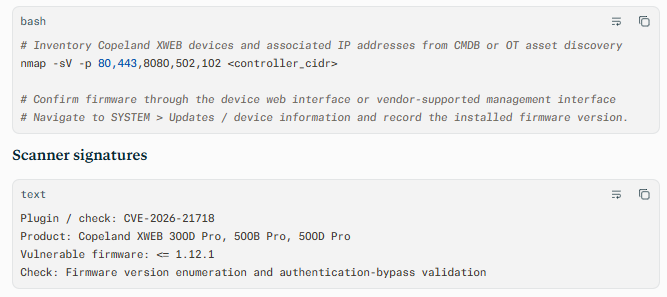
Log indicators
- Authentication events with no corresponding successful credential validation.
- Unexpected administrative requests from non-management IP addresses.
- Firmware, configuration, or service changes outside approved maintenance windows.
- Access from internet-facing IPs, VPN ranges, or vendor remote-access infrastructure that is not expected for the site.
Behavioral anomalies
- Sudden changes to refrigeration setpoints, alarm thresholds, or monitoring configuration.
- Controller reboots, service interruptions, or unexplained loss of telemetry.
- New outbound connections from controllers to unfamiliar external addresses.
- Alarm suppression or delayed alarm delivery during a suspected intrusion window.
Network exploitation indicators
- Crafted unauthenticated requests to XWEB Pro management services.
- Repeated requests from a single source followed by privileged actions.
- Unexpected HTTP, HTTPS, or industrial-protocol traffic from non-engineering subnets.
- Lateral connection attempts from a controller toward other OT assets, domain services, or internet destinations.
C — Mitigation & Remediation
- Immediate (0–24h): Inventory all Copeland XWEB 300D Pro, 500B Pro, and 500D Pro devices and identify firmware versions. Remove internet exposure immediately where feasible. Restrict management access to dedicated OT administration hosts, enforce firewall rules, and place controllers in a segmented OT network. Preserve relevant logs before making broad changes.
- Short-term (1–7d): Apply the official Copeland firmware update first, using the vendor’s software update portal or the controller’s
SYSTEM > Updates | Networkfunction where supported. Confirm the post-update firmware version, validate controller functionality, and test alarms, telemetry, and integration with monitoring platforms. If immediate patching is impossible, isolate the device, limit access to required engineering systems only, disable unnecessary remote access, and monitor all traffic to and from the controller. - Long-term (ongoing): Incorporate OT assets into vulnerability management, patch cycles, asset inventories, and incident-response plans. Use network segmentation to prevent controllers from reaching corporate IT systems or the internet. Require approved jump hosts and multi-factor authentication for remote OT administration, retain controller and network logs, and conduct periodic penetration testing focused on OT exposure and segmentation controls.
D — Best Practices
- Maintain a current inventory of OT controllers, firmware versions, IP addresses, and business owners.
- Apply vendor firmware updates promptly after validation in a non-production or controlled maintenance window.
- Prevent direct internet access to industrial controllers and restrict management interfaces to dedicated administrative networks.
- Segment OT environments from corporate IT, guest networks, and third-party remote-access systems.
- Monitor controller traffic, authentication activity, configuration changes, and alarm behavior for anomalies.
- Include OT scenarios, such as refrigeration controller compromise, in incident-response playbooks and recovery testing
Leave Comment