
CVE-2026-19387: GStreamer IMA/DVI ADPCM Audio Decoding Bug - What It Means for Your Business and How to Respond
CVE-2026-19387 is a high-severity vulnerability in GStreamer, a widely deployed open-source multimedia framework used across Linux servers, workstations, media applications, and content-processing pipelines. The issue becomes relevant when an affected application processes a specially crafted WAV audio file containing IMA/DVI ADPCM audio data. For your organization, that can turn a seemingly ordinary uploaded, emailed, downloaded, or ingested audio file into a service-disruption or security risk.
You should prioritize this issue if you operate Linux-based systems that accept untrusted media, including customer upload portals, media conversion services, digital-asset workflows, video-conferencing infrastructure, kiosks, or endpoints that play externally sourced audio. The vulnerability can cause application crashes and may create a path to memory corruption or code execution. This post explains the business impact, helps you determine whether you may be affected, and provides technical detection and remediation guidance for security and IT teams.
S1 — Background & History
CVE-2026-19387 was published by the National Vulnerability Database on August 10, 2026. It affects the adpcmdec component in GStreamer’s gst-plugins-bad package, specifically while decoding IMA/DVI ADPCM audio in multi-channel WAV files. Red Hat is the CVE Numbering Authority for the record and credits security researcher Seonwook Kim with reporting the issue.
Red Hat assigned a Common Vulnerability Scoring System version 3.1 score of 7.6 out of 10, categorized as High severity. In plain language, the flaw occurs because the software does not adequately verify audio sample-count values before writing decoded data into memory. A maliciously formed audio file can cause the application to write beyond the memory space allocated for it.
The resulting impact can range from instability and crashes to memory corruption and possible unauthorized code execution. GStreamer upstream addressed the issue in the 1.28.6 release stream, while Linux vendors are issuing or tracking distribution-specific updates. As of the current advisories, fixed package versions differ by operating system and supported release.
S2 — What This Means for Your Business
Your exposure depends less on whether GStreamer exists somewhere in your environment and more on whether affected applications process media from outside your trust boundary. If customers, partners, employees, or automated feeds can introduce WAV files into a workflow, the vulnerable decoder may be activated without a traditional network intrusion.
Operationally, a successful attack could crash a media player, transcoding worker, upload-processing service, or desktop application. In a high-volume workflow, repeated crashes can delay content publication, interrupt customer-facing services, consume IT response time, and create backlogs in media-processing queues.
The security consequences may be more serious where a media-processing application runs with broad permissions or has access to sensitive data, cloud credentials, shared storage, or production systems. Memory corruption can sometimes enable an attacker to interfere with application behavior or execute unauthorized code, although practical exploitation depends on the environment and defenses in place.
You should also consider governance obligations. Organizations subject to privacy, contractual, or sector-specific security requirements may need to document exposure assessment, patch decisions, compensating controls, and monitoring actions. A preventable interruption involving customer content can affect trust, service commitments, and incident-response costs across the United States and Canada.
S3 — Real-World Examples
A regional bank: You use Linux-based workstations and media tools to prepare customer education videos, record training materials, or process uploaded evidence and audio documents. A malicious WAV file sent through email or an external collaboration channel could crash a vulnerable application, interrupting normal workflows and requiring investigation. If the affected workstation has access to internal systems or sensitive files, the incident scope could expand beyond a single application.
A mid-sized healthcare provider: You operate a patient portal or communications platform that accepts audio attachments, recordings, or multimedia messages. A crafted file could disrupt the service that scans, previews, or converts incoming media. The operational impact may include delayed communications, recovery work, and additional scrutiny of whether protected health information was exposed.
An e-commerce marketplace: You use automated content-processing workers to normalize seller-generated product videos and audio before publication. An attacker could submit a malicious file designed to cause worker crashes, reducing throughput or disrupting listings. If the workers run with unnecessary access to other systems, a contained processing flaw could become a broader environment risk.
A Canadian public-sector agency: You accept multimedia files through public forms, records requests, or public-engagement platforms. A successful denial-of-service attempt against media-processing infrastructure could slow service delivery and force staff to handle submissions manually. Strong file isolation and timely vendor patches reduce the chance that externally supplied content affects core systems.
S4 — Am I Affected?
- You may be affected if you run GStreamer or distribution packages such as
gst-plugins-bad1.0,gstreamer1-plugins-bad-free, or related multimedia dependencies on Linux systems. - You may be affected if an application on your servers, workstations, containers, appliances, or kiosks automatically processes WAV audio uploaded by users or received from external sources.
- You may be affected if you operate media players, transcoding services, digital-asset management platforms, video-processing systems, or communication tools that use GStreamer under the hood.
- You should investigate if you run Red Hat Enterprise Linux 7, which is listed as affected in the NVD record, or if you use an unpatched supported Red Hat Enterprise Linux package below the listed fixed builds.
- You should investigate if you run Debian Bookworm with
gst-plugins-bad1.0version1.22.0-4+deb12u7, which Debian currently lists as vulnerable. - You are less likely to be affected if your GStreamer packages are vendor-patched and your environment does not process untrusted multi-channel IMA/DVI ADPCM WAV files.
- You still need confirmation from your software inventory because applications may bundle or install GStreamer dependencies indirectly.
Key Takeaways
- CVE-2026-19387 is a High-severity GStreamer vulnerability with a CVSS 3.1 score of 7.6 and potential impact on availability, confidentiality, and integrity.
- The flaw is triggered when an affected GStreamer component processes a specially crafted multi-channel IMA/DVI ADPCM WAV file.
- Your highest-risk systems are those that accept, preview, play, convert, or otherwise process media files from untrusted sources.
- A successful attack can crash applications and may lead to memory corruption or potential unauthorized code execution, depending on your deployment and controls.
- You should apply your operating-system vendor’s official security update first, then reduce exposure through file controls, sandboxing, and least-privilege service design.
Call to Action
CVE-2026-19387 is a practical reminder that file-processing workflows can become an entry point into critical business systems. IntegSec can help you identify exposed media-processing paths, validate patch coverage, test containment controls, and prioritize remediation based on actual business risk. A focused penetration test can reveal where untrusted content reaches sensitive workloads and whether your defenses limit the impact of exploitation. Contact IntegSec to strengthen your security posture with evidence-driven testing and meaningful risk reduction.
Technical Appendix
A — Technical Analysis
CVE-2026-19387 is a heap out-of-bounds write, classified as CWE-787, in GStreamer’s adpcmdec element within the gst-plugins-bad component. The vulnerable logic decodes IMA/DVI ADPCM audio carried in multi-channel WAV files. It insufficiently validates the per-block sample count before writing decoded samples to the allocated output buffer. A crafted file can therefore cause writes beyond the intended heap allocation.
The attack vector is network-based in the CVSS assessment because an attacker can deliver a malicious file through a remote workflow, such as an upload service, shared file location, email-delivered attachment, or content pipeline. The attack complexity is low, no prior privileges are required, and user interaction is required because a vulnerable application must process the attacker-controlled file. Red Hat’s vector is CVSS:3.1/AV:N/AC:L/PR:N/UI:R/S:U/C:L/I:L/A:H, producing a 7.6 High score.
The NVD record remains marked as awaiting enrichment, but it references upstream GStreamer remediation work and multiple Red Hat errata.
B — Detection & Verification
Version verification should begin with package inventory and then move to application-level dependency validation. Package names and installed versions vary by distribution, so teams should check both operating-system repositories and container images.
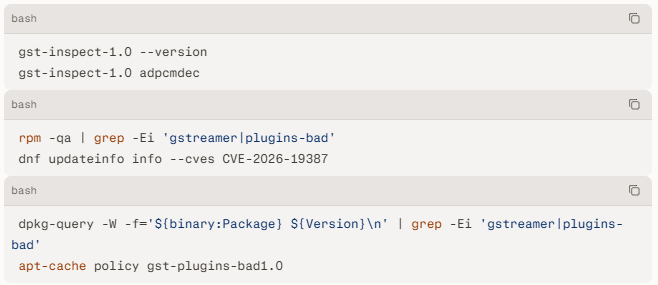
- Identify installations of GStreamer’s bad-plugin package, especially on systems that process external media.
- Compare installed vendor package builds against supported fixed builds rather than relying only on the upstream GStreamer version.
- Flag container images containing vulnerable multimedia packages, even when the host is fully patched.
- Review application, service-manager, and crash-report logs for recurring failures in GStreamer pipelines,
adpcmdec, media-preview services, or transcoding workers shortly after WAV-file ingestion. - Investigate unexpected restarts, segmentation faults, heap-corruption errors, abnormal memory usage, and repeated failed processing attempts involving multi-channel WAV files.
- Inspect inbound file telemetry and upload logs for unusual WAV attachments, repeated submissions, malformed metadata, or submissions followed by application crashes.
C — Mitigation & Remediation
- Immediate (0–24h): Identify all externally reachable services, batch jobs, desktops, containers, and appliances that process untrusted audio with GStreamer. Block or quarantine untrusted multi-channel IMA/DVI ADPCM WAV files where business operations permit. Disable nonessential media preview and transcoding paths until affected packages are verified and patched.
- Immediate (0–24h): Use vendor-supported updates as the primary remediation. For Red Hat environments, apply the relevant published errata for the operating-system release in use. For Debian environments, update to the vendor-fixed package for the supported distribution release. Do not substitute an arbitrary upstream package build for a vendor-supported security update in production without testing.
- Short-term (1–7d): Update affected packages, rebuild and redeploy container images, and restart applicable services so the patched library is actually loaded. Confirm the installed build with package-management tools and maintain evidence of remediation for audit or incident-response purposes.
- Short-term (1–7d): Place media-processing services in isolated execution environments. Run them under dedicated low-privilege accounts, restrict filesystem access, avoid mounting secrets or production credentials, and segment worker networks from databases and management systems.
- Long-term (ongoing): Require file-type validation before processing, maintain allowlists for supported formats where feasible, and route public uploads through layered malware scanning and content inspection. Treat media decoders as high-risk parsers because untrusted files can exploit defects before an application presents the content to a user.
- Long-term (ongoing): Establish software bill of materials coverage and continuous vulnerability monitoring for operating-system packages, containers, third-party applications, and embedded systems. Test media-ingestion workflows during penetration tests to verify that a crash or compromise remains contained. Red Hat specifically recommends avoiding untrusted multi-channel IMA ADPCM WAV files and sandboxing applications that must handle untrusted media.
D — Best Practices
- Treat uploaded and externally received media as untrusted input, even when it appears to be a standard audio or video file.
- Patch multimedia libraries through your operating-system or application vendor’s supported security channel and verify the running version after deployment.
- Run media conversion, previews, and transcoding in isolated, least-privilege worker processes with restricted network and filesystem access.
- Prevent media-processing workers from accessing production databases, administrative interfaces, cloud metadata services, or broadly scoped credentials.
- Monitor media-processing crashes and unexpected worker restarts as potential security events, not only reliability issues
Leave Comment