
CVE-2026-19200: Velociraptor Artifact Overwrite Bug - What It Means for Your Business and How to Respond
CVE-2026-19200 is a high-severity authorization flaw in Rapid7 Velociraptor, a platform many organizations use for digital forensics and incident response. The issue allows a user with limited notebook-editing permissions to overwrite security artifacts that should require higher privileges, potentially undermining the integrity of the very tools your team relies on during an incident. Organizations in the United States and Canada that operate Velociraptor, use a managed detection and response provider that deploys it, or include it in their security operations stack should treat this as a priority update. This post explains the practical business risk, helps you determine whether you are exposed, and provides a clear response plan, with technical detail reserved for security and IT teams in the appendix.
Background & History
Rapid7 published CVE-2026-19200 on August 24, 2026, and the National Vulnerability Database last updated the record on August 28, 2026. The vulnerability affects Velociraptor versions before 0.77.2 and is rated High with a CVSS 3.1 base score of 8.9 out of 10.
In plain language, Velociraptor uses reusable instructions called artifacts to collect and analyze evidence from computers and servers. The flaw is in the platform’s verify() function, which is intended to check whether an artifact is valid. Instead of safely checking a proposed change, it can modify an artifact in the global repository without confirming that the user has permission to do so. A user who only has the NOTEBOOK_EDIT permission, such as an analyst, can therefore overwrite an existing artifact.
The vendor’s fix is available in Velociraptor 0.77.2 and was implemented through the project’s pull request 4962. Rapid7 is the CVE numbering authority for this issue, and its advisory and patch references were published alongside the disclosure.
What This Means for Your Business
If your organization uses Velociraptor, this vulnerability threatens the trustworthiness of your incident response evidence and automated security checks. An attacker does not need to compromise a server or obtain administrator access. A person with an ordinary analyst-level account may be able to alter the instructions that tell Velociraptor what to collect, how to interpret it, or what actions to take.
The immediate operational risk is that your security team could receive misleading results during an investigation. For example, an altered artifact could cause important evidence to be missed, produce false assurances that a system is clean, or direct collection activity toward the wrong systems. That can extend the time it takes to contain an incident and increase recovery costs.
There is also a governance concern. Many organizations depend on Velociraptor to support incident response, internal investigations, and evidence preservation. If artifacts can be changed without proper approval, it becomes harder to demonstrate that security findings and forensic records are reliable. This can complicate audits, customer security reviews, cyber insurance claims, and regulatory obligations that require accurate records and controlled access to sensitive systems.
Finally, the issue can damage confidence in your security function. A tampered investigation tool is especially damaging because leadership, legal teams, and external partners may rely on its output during a crisis. Prompt patching and clear communication about the fix help preserve that confidence.
Real-World Examples
Regional financial institution: A bank uses Velociraptor across its corporate endpoints and server estate. If an insider or compromised analyst account modifies collection artifacts, fraud or account-takeover investigations could overlook key evidence, delaying containment and increasing regulatory and customer-communication burdens.
Mid-market healthcare provider: A hospital system relies on endpoint forensics to investigate suspicious access to patient systems. Tampered artifacts could produce incomplete findings about unauthorized access, making it harder to assess whether protected health information was exposed and to meet notification and audit expectations.
SaaS company with a distributed security team: A software company gives several contractors analyst access to support customer investigations. Because the flaw requires only notebook-editing permission, a contractor account could alter shared artifacts, affecting investigations across multiple customer environments and undermining contractual security assurances.
Public-sector agency: A government department uses Velociraptor for internal investigations and incident response. Modified artifacts could compromise the reliability of evidence used in administrative or legal proceedings, creating reputational and operational consequences beyond the immediate technical issue.
Am I Affected?
- You are running Rapid7 Velociraptor version 0.77.1 or any earlier release; all versions before 0.77.2 are affected.
- You operate Velociraptor yourself, whether on premises, in a private cloud, or in a public cloud environment.
- You use a managed security provider or incident response retainer that deploys Velociraptor in your environment; ask the provider to confirm its version and patch status.
- You have granted
NOTEBOOK_EDITpermission to analysts, contractors, support staff, or other non-administrative users; those accounts are the relevant attack path. - You allow multiple teams or third parties to use the same Velociraptor deployment and share its global artifact repository; shared environments increase the potential impact of unauthorized artifact changes.
- You are already running Velociraptor 0.77.2 or later and have confirmed the update through your normal patch-management process; the vendor fix addresses this issue.
Key Takeaways
- CVE-2026-19200 is a high-severity flaw in Velociraptor that can let a user with limited notebook-editing rights overwrite security artifacts without the required authorization.
- The main business risk is loss of confidence in investigation results, which can delay incident response and weaken evidence integrity.
- Organizations using Velociraptor versions before 0.77.2 should assume they are exposed until they verify otherwise.
- Shared security platforms and third-party analyst access increase the importance of prompt patching and permission reviews.
- A fast, documented response protects operations, supports compliance efforts, and preserves trust in your security program.
Call to Action
If Velociraptor is part of your security operations or incident response capability, do not wait for an incident to test whether your defenses and permissions are working as intended. IntegSec can assess your exposure, validate your remediation, and identify the broader access-control weaknesses that vulnerabilities like this exploit. Visit https://integsec.com to schedule a penetration test and take a practical step toward reducing cybersecurity risk.
Technical Appendix
A — Technical Analysis
CVE-2026-19200 is a missing-authorization and code-injection weakness in the verify() VQL function of Rapid7 Velociraptor. The function is intended to validate an artifact for syntax and other issues, but its implementation references the global artifact repository. As a result, a caller can overwrite an existing artifact without holding the permissions normally required to modify it.
The attack requires network access to the Velociraptor interface or API and an authenticated account with the NOTEBOOK_EDIT permission, commonly assigned to an analyst role. User interaction is required in the CVSS model, and the vulnerability has low attack complexity. The scope is changed because a low-privileged user can affect resources outside their normal authorization boundary.
Rapid7 assigned a CVSS 3.1 base score of 8.9 High, with the vector CVSS:3.1/AV:N/AC:L/PR:L/UI:R/S:C/C:H/I:H/A:L. The associated weaknesses are CWE-862, Missing Authorization, and CWE-94, Improper Control of Generation of Code, also known as code injection. Velociraptor releases before 0.77.2 are affected.
B — Detection & Verification
Version enumeration commands:
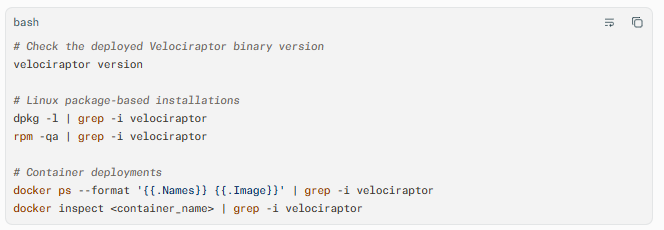
Scanner signatures should identify Velociraptor installations below version 0.77.2 and flag accounts or roles holding NOTEBOOK_EDIT. Because NVD enrichment was still pending at disclosure, prioritize vendor inventory, configuration reviews, and targeted version checks over reliance on generic vulnerability scans.
Log indicators include artifact update or overwrite events initiated by accounts whose role should not permit artifact modification. Review audit logs for verify() invocations followed by changes to built-in or global artifacts, particularly changes made outside approved change windows.
Behavioral anomalies include unexpected edits to core collection artifacts, altered artifact descriptions or query logic, and investigation results that diverge from known-good baselines. Network exploitation indicators may include authenticated API calls to artifact verification or modification endpoints from analyst accounts, especially when followed by writes to the global repository.
C — Mitigation & Remediation
- Immediate (0–24h): Inventory all Velociraptor deployments and confirm whether each instance runs version 0.77.2 or later. Upgrade affected instances to the official vendor release as the primary remedy. Until patching is complete, restrict
NOTEBOOK_EDITto a minimal set of trusted personnel and temporarily suspend or closely supervise analyst access where feasible. - Short-term (1–7d): Review artifact repository change history for unauthorized modifications, compare current artifacts with known-good copies or version-control baselines, and restore any altered artifacts from trusted sources. Rotate or review credentials for accounts with notebook-editing access, and confirm that third-party and contractor accounts follow least-privilege access.
- Long-term (ongoing): Formalize permission boundaries so artifact creation, modification, and approval require distinct roles. Maintain artifacts in version control, require peer review for changes to global artifacts, and continuously monitor artifact changes and privileged actions. Include Velociraptor and other security tooling in routine vulnerability management, configuration reviews, and penetration testing.
For environments that cannot patch immediately, the key interim control is to prevent untrusted users from invoking artifact verification or modification functions. Limit NOTEBOOK_EDIT, segment administrative functions from analyst workflows, and monitor the global artifact repository for unexpected writes.
D — Best Practices
- Apply vendor security updates promptly, especially for forensic and incident response platforms that produce evidence used in business and legal decisions.
- Enforce least privilege by separating the ability to edit notebooks from the ability to modify global security artifacts.
- Maintain version-controlled, reviewed baselines for critical artifacts so unauthorized changes can be detected and reversed.
- Monitor security-tool audit logs for unexpected artifact writes, privilege anomalies, and changes made by non-administrative accounts.
- Include third-party analysts, contractors, and managed providers in access reviews and incident response readiness testing
Leave Comment