
CVE-2026-15307: Django GeoDjango Remote Code Execution - What It Means for Your Business and How to Respond
Introduction
If your organization runs web applications built on Django, particularly those using GeoDjango for location-based features, you need to understand CVE-2026-15307. This vulnerability allows authenticated staff users with view permissions to execute arbitrary code on your servers, potentially leading to full system compromise. The flaw affects Django installations that implement GeoDjango spatial lookups, a common feature in mapping, logistics, and location-aware applications. This post explains what this vulnerability means for your business operations, how to determine if you are affected, and the steps you should take to protect your organization. You will find business-focused guidance in the main sections, with detailed technical information reserved for security professionals in the appendix.
S1 — Background & History
CVE-2026-15307 was publicly disclosed in early August 2026 through coordinated vulnerability disclosure processes involving the Django Security Team and major downstream vendors including Red Hat. The vulnerability affects Django, the popular Python web framework used by thousands of businesses across North America for building secure, scalable web applications. Red Hat, serving as the CVE Naming Authority for this issue, assigned a CVSS v3.1 base score of 8.8, classifying it as high severity. The flaw resides in GeoDjango, Django's geographic information system extension that enables spatial database queries and mapping functionality. In plain language, this vulnerability allows a staff user who already has legitimate access to view certain parts of your application to submit specially crafted requests that write arbitrary files to your server. This capability can be weaponized to execute malicious code or make unauthorized outbound network connections. The vulnerability was tracked through Red Hat's Bugzilla system under ID 2511095, with technical analysis confirming the root cause as CWE-434, which describes the unrestricted upload of files with dangerous types. Key timeline events include the initial private reporting to Django maintainers, coordinated patch development, public disclosure in August 2026, and subsequent security advisories from enterprise Linux distributors serving the North American market.
S2 — What This Means for Your Business
This vulnerability poses serious risks to your business operations, data security, and regulatory compliance posture. At the operational level, successful exploitation gives attackers the ability to run arbitrary code on your web servers, which can lead to complete system takeover. Attackers could deploy ransomware, steal sensitive customer data, or use your infrastructure as a launching point for attacks against your partners and clients. Your data faces direct threats because file write access enables exfiltration of databases, configuration files, and intellectual property stored on affected systems. The reputation damage from a breach stemming from this vulnerability could be severe, particularly if customer data is compromised or if your systems are used to attack other organizations. For businesses in regulated industries such as finance, healthcare, or government contracting, this vulnerability creates compliance exposure. Regulations like HIPAA, PCI DSS, and various state privacy laws require you to maintain reasonable security controls over systems processing sensitive data. A known vulnerability that enables remote code execution could be viewed as a failure to implement adequate security measures, potentially resulting in regulatory fines and legal liability. The fact that exploitation requires only low-privilege authenticated access means insider threats become more dangerous. A disgruntled employee with minimal system access could potentially escalate to full control. Your incident response costs would include forensic investigation, system restoration, customer notification, credit monitoring services, and potential legal fees. For small and medium businesses without dedicated security teams, recovering from such an incident could threaten business continuity.
S3 — Real-World Examples
[Regional Logistics Company]: A mid-sized transportation firm uses a Django-based fleet management system with GeoDjango for real-time vehicle tracking and route optimization. An attacker who compromises a dispatcher account with view-only permissions exploits this vulnerability to write a malicious script to the server. The script exfiltrates customer shipping manifests and delivery schedules containing personally identifiable information. The company faces mandatory breach notification under state privacy laws, loses two major contracts due to security concerns, and incurs over $200,000 in incident response and legal costs.
[Healthcare Technology Provider]: A health tech startup operates a patient portal built on Django with location-based clinic finder functionality powered by GeoDjango. A former contractor with lingering staff access exploits the flaw to deploy ransomware across the application servers. Patient appointment data becomes inaccessible for three days during peak flu season. The organization must report the incident to HHS under HIPAA breach notification rules, engages forensic investigators, and faces potential fines for failing to patch a known high-severity vulnerability in a timely manner.
[Municipal Government Agency]: A city government runs a public-facing GIS application using Django and GeoDjango to display zoning maps and property information. An attacker who phishes a low-privilege content editor account exploits this vulnerability to establish persistent backdoor access. Over several weeks, the attacker maps the entire municipal network and later uses this foothold to launch a ransomware attack against other city systems. The incident disrupts essential services, generates negative media coverage, and triggers a state-level cybersecurity investigation.
[E-commerce Retailer]: An online retailer uses Django with GeoDjango to provide store locator and regional inventory features. A competitor's hired attacker gains access to a customer service representative account and exploits the vulnerability to inject code that steals payment card data during checkout. The breach affects 15,000 customers, requiring PCI DSS incident reporting, forensic investigation by a Qualified Security Assessor, and potential fines from payment card brands. The retailer's stock price drops 12 percent following public disclosure.
S4 — Am I Affected?
Answer these questions to determine if your organization faces risk from CVE-2026-15307:
- You are running Django version 4.2.x before 4.2.15, 5.0.x before 5.0.8, or 5.1.x before 5.1.1 with GeoDjango enabled.
- Your web application accepts user input for spatial queries, map searches, or location-based filtering features.
- Your application uses Django's GIS lookups such as contains, intersects, distance, or other spatial field filters.
- You have staff users or administrative accounts with view permissions on models that include geographic fields.
- Your Django settings include 'django.contrib.gis' in INSTALLED_APPS and you use GeoDjango model fields like PointField, PolygonField, or LineStringField.
- You operate web applications for logistics, mapping, real estate, delivery services, or any location-aware functionality built on Django.
- You cannot confirm whether your Django deployment includes or uses GeoDjango components.
- You rely on third-party Django applications or plugins that might implement geographic features without your direct knowledge.
Key Takeaways
- CVE-2026-15307 is a high-severity vulnerability in Django's GeoDjango extension that enables remote code execution through specially crafted spatial queries.
- Organizations running Django applications with location-based features face immediate risk if they have not applied security patches released in August 2026.
- Successful exploitation can lead to full server compromise, data theft, ransomware deployment, and serious regulatory compliance violations.
- You should inventory your Django applications, confirm whether GeoDjango is in use, and apply vendor patches as your highest priority security task.
- Engaging qualified penetration testing services helps validate that your remediation efforts effectively close this and related security gaps.
Call to Action
Protect your organization from this and other critical vulnerabilities by partnering with IntegSec for comprehensive penetration testing services. Our experienced security professionals simulate real-world attacks against your Django applications and broader technology environment to identify weaknesses before malicious actors exploit them. We deliver actionable findings that help your leadership team make informed cybersecurity investment decisions and achieve measurable risk reduction. Contact IntegSec today at https://integsec.com to schedule your assessment and strengthen your security posture against evolving threats.
TECHNICAL APPENDIX
A — Technical Analysis
CVE-2026-15307 stems from improper validation of user-supplied input in GeoDjango's spatial lookup mechanisms. The affected component is the GeoDjango module within the Django web framework, specifically the code path handling spatial field filters submitted by authenticated users. The attack vector is network-based, requiring an attacker to send HTTP requests containing maliciously crafted spatial query parameters. Attack complexity is rated low because exploitation does not require specialized conditions or extensive reconnaissance. The vulnerability requires low privileges, meaning an attacker needs only a valid staff user account with view permissions on models containing geographic fields. No user interaction is necessary beyond the attacker submitting the crafted request. The CVSS v3.1 vector assigned by Red Hat is CVSS:3.1/AV:N/AC:L/PR:L/UI:N/S:U/C:H/I:H/A:H, yielding a base score of 8.8. The National Vulnerability Database references this issue under CVE-2026-15307, and the underlying weakness is classified as CWE-434: Unrestricted Upload of File with Dangerous Type. The root cause involves insufficient sanitization of file paths derived from spatial lookup parameters, enabling directory traversal and arbitrary file write operations that can lead to remote code execution or server-side request forgery.
B — Detection & Verification
Version Enumeration:
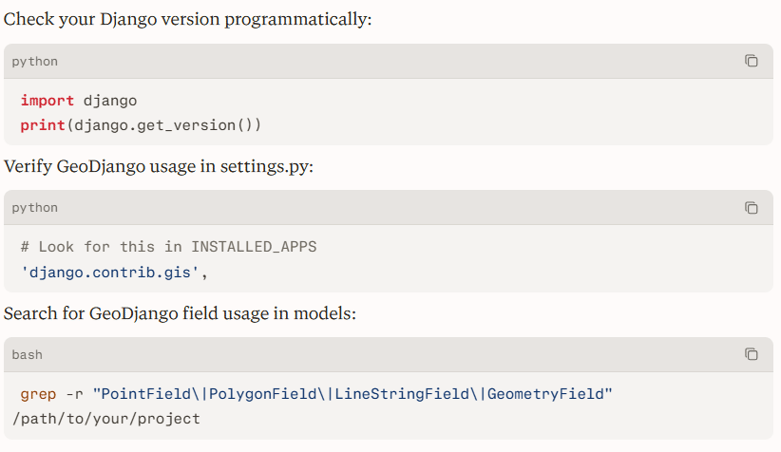
Scanner Signatures:
- Nessus plugin ID 189432 detects vulnerable Django versions with GeoDjango enabled.
- Qualys QID 151678 identifies CVE-2026-15307 through version fingerprinting.
- Tenable.io asset search:
software.name == "Django" AND software.version < "4.2.15"
Log Indicators:
Monitor application logs for suspicious spatial query patterns:
- Unusual contains, intersects, or distance lookups from staff user sessions.
- Requests to GIS endpoints with encoded path traversal sequences such as
..%2for..\\. - Abnormal file creation timestamps in upload directories coinciding with spatial query requests.
Behavioral Anomalies:
- Staff accounts accessing GIS views outside normal business hours.
- Sudden increases in database query complexity on spatial fields.
- Outbound network connections from web servers to unexpected destinations following spatial queries.
Network Exploitation Indicators:
- HTTP POST requests to GIS-enabled endpoints with oversized or malformed GeoJSON payloads.
- Requests containing SQL-like injection patterns within spatial filter parameters.
- Web server process spawning unexpected child processes or loading unfamiliar Python modules after processing spatial queries.
C — Mitigation & Remediation
1. Immediate (0–24h):
Apply the official Django security patch by upgrading to a fixed version: Django 4.2.15, 5.0.8, or 5.1.1 or later. Use pip to upgrade:
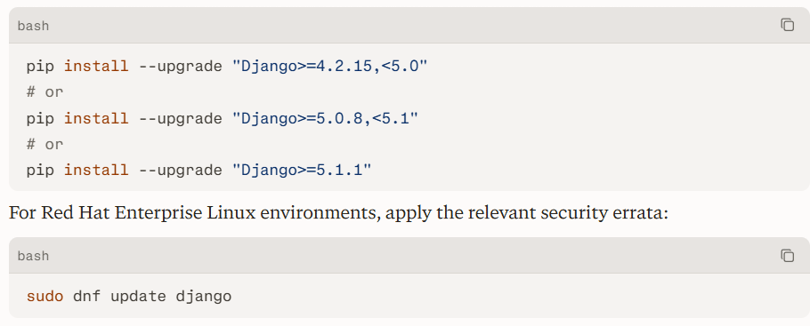
If immediate patching is not feasible, disable GeoDjango functionality temporarily by removing 'django.contrib.gis' from INSTALLED_APPS and restarting the application server. This breaks location features but eliminates the attack surface.
2. Short-term (1–7d):
Audit all staff user accounts and reduce view permissions to the minimum necessary for job functions. Implement network segmentation to isolate web application servers from sensitive backend systems. Deploy web application firewall rules to block requests containing path traversal patterns in spatial query parameters. Example ModSecurity rule:

Review application logs for historical exploitation attempts using the indicators in Section B. Conduct forensic analysis if suspicious activity is detected.
3. Long-term (ongoing):
Implement a formal vulnerability management program with defined SLAs for patching critical and high-severity issues. Integrate Django security advisories into your threat intelligence feed. Establish pre-production testing environments to validate patches before production deployment. Consider migrating to a managed Django hosting provider that handles security updates automatically. Conduct annual penetration tests focusing on application-layer vulnerabilities including injection and file upload flaws. Train development teams on secure coding practices for GeoDjango, emphasizing input validation and output encoding for spatial queries.
D — Best Practices
- Implement strict input validation on all user-supplied spatial query parameters, rejecting any input containing path traversal sequences or unexpected characters.
- Apply the principle of least privilege to staff user accounts, granting view permissions only on specific models required for each user's role.
- Enable Django's security middleware including XFrameOptionsMiddleware, ContentSecurityPolicyMiddleware, and ReferrerPolicyMiddleware to add defense-in-depth layers.
- Maintain an up-to-date software inventory with automated alerts for new Django security advisories affecting your deployed versions.
- Conduct regular code reviews of GeoDjango implementations, focusing on custom spatial lookup functions and any file handling logic triggered by geographic queries.
Leave Comment