
CVE-2026-14952: Frauscher FDS 102 Sensitive File Disclosure - What It Means for Your Business and How to Respond
Introduction
CVE-2026-14952 is a high-severity information disclosure flaw in the Frauscher Sensortechnik FDS 102 diagnostic system, a technology used in railway signaling environments. It allows an attacker with network access to download sensitive operational files without a username, password, or valid session.
For rail operators, transit authorities, infrastructure maintainers, and their technology partners, the concern is not simply that files can be taken. The exposed material can reveal signaling and track layout details that support reconnaissance against critical transportation infrastructure.
This post explains who is affected, what the vulnerability means for business operations and compliance, and how to prioritize detection and remediation. A technical appendix provides practical guidance for security engineers, penetration testers, and IT teams responsible for industrial and operational technology environments.
Background & History
Frauscher Sensortechnik published the issue through CERT@VDE, and the CVE was publicly recorded on August 20, 2026. The affected product is FDS 102 for FAdC/FAdCi R2, with versions 2.1.0 through 2.13.3 listed as affected.
The weakness is classified as CWE-306, Missing Authentication for Critical Function. In practical terms, the FDS Web server serves certain backup and download files over HTTP without checking whether the requester is authorized.
CERT@VDE assigned a CVSS v4.0 base score of 8.7, High, using the vector CVSS:4.0/AV:N/AC:L/AT:N/PR:N/UI:N/VC:H/VI:N/VA:N/SC:N/SI:N/SA:N. The score reflects remote exploitation, low complexity, no privileges, no user interaction, and high confidentiality impact.
The vulnerability was disclosed alongside seven related FDS 102 issues, CVE-2026-14946 through CVE-2026-14953. Vendor guidance directs affected operators to update to FDS 102 version 2.14.0.
What This Means for Your Business
If your organization operates, maintains, integrates, or supplies railway signaling systems, this vulnerability creates a direct confidentiality risk. An attacker does not need credentials or employee cooperation; network reachability to the FDS Web server may be enough to retrieve protected files.
The most immediate operational concern is exposure of railway signaling and track layout information. That information can help an adversary understand infrastructure design, identify valuable targets, and plan more sophisticated intrusion or disruption activity.
There is also a supply-chain and contractual dimension. If your business manages FDS 102 devices for a rail customer, a disclosure involving their environment can affect service commitments, incident-response obligations, audit findings, and customer trust. Transportation operators increasingly expect vendors and maintenance partners to demonstrate control over operational technology access.
Compliance exposure may follow as well. Critical infrastructure operators in the United States and Canada face heightened scrutiny around industrial control system security, incident reporting, and protection of sensitive operational information. Even where this flaw does not directly disrupt train movements, failure to patch an internet-reachable or poorly segmented diagnostic system can become evidence of weak operational technology governance.
The positive news is that the disclosed impact is confidentiality-focused: no integrity or availability impact is indicated for this specific CVE. That does not make it low priority, because leaked operational details can become the foundation for a later, more damaging attack.
Real-World Examples
Regional passenger rail operator: A regional rail operator uses FDS 102 diagnostic systems across several depots. If one device is reachable from a corporate network or vendor remote-access path, an attacker could retrieve signaling and track layout files and use them to map the operator’s infrastructure before attempting a broader intrusion.
Track maintenance contractor: A contractor maintains signaling equipment for multiple rail clients. An exposed FDS 102 system could expose client-specific operational details, creating contractual, reputational, and legal consequences beyond the contractor’s own network.
Transit authority with aging segmentation: A transit authority has strong controls around train control systems but less mature segmentation around diagnostic and maintenance tools. An attacker who reaches the diagnostic network could collect sensitive files without touching safety-critical systems, then use that intelligence to identify weaker points elsewhere.
Small signaling integrator: A smaller integrator hosts a test or demonstration FDS 102 environment that was never removed from a reachable network. Even a non-production system can leak realistic layouts, configurations, and operational documentation that attackers can use for reconnaissance or social engineering.
Am I Affected?
- You are running Frauscher Sensortechnik FDS 102 for FAdC/FAdCi R2.
- Your FDS 102 version is 2.1.0 through 2.13.3, inclusive.
- The FDS Web server is reachable from the internet, a partner network, a corporate network, a maintenance network, or another untrusted segment.
- Your environment permits HTTP access to
/FdsBackup.zipor files under/downloads/*. - You have not confirmed an upgrade to FDS 102 version 2.14.0 or later.
- You cannot demonstrate that network access controls, segmentation, firewall rules, or a reverse proxy prevent unauthenticated access to the affected paths.
- Your asset inventory does not clearly identify where FDS 102 systems are deployed, who can reach them, and which version each device runs.
Key Takeaways
- CVE-2026-14952 lets an unauthenticated remote attacker download sensitive files from affected Frauscher FDS 102 Web servers.
- The exposed files can include railway signaling and track layout information, creating reconnaissance risk for transportation infrastructure.
- FDS 102 versions 2.1.0 through 2.13.3 are affected, and the vendor-directed fix is version 2.14.0.
- The vulnerability is high severity because exploitation requires only network access, no privileges, and no user interaction.
- Patching is the primary response, but network isolation and access restrictions are essential while remediation is underway.
Call to Action
If your organization operates railway, transit, or other critical infrastructure technology, do not wait for an exposed diagnostic system to become an entry point. IntegSec can help you identify vulnerable assets, validate exposure, test segmentation and access controls, and build a practical remediation plan. Visit https://integsec.com to schedule a penetration test and strengthen your cybersecurity risk reduction program.
Technical Appendix
A — Technical Analysis
CVE-2026-14952 is a missing authentication vulnerability in the Frauscher Sensortechnik FDS 102 Web server for FAdC/FAdCi R2. The server does not enforce authentication or authorization checks on selected HTTP endpoints that provide backup archives and downloadable files.
An unauthenticated remote attacker can issue direct HTTP requests for /FdsBackup.zip and files beneath /downloads/*. Successful requests return files containing detailed railway signaling and track layout information that should be restricted to authorized users.
The attack vector is network-based, with low attack complexity, no required privileges, and no user interaction. CERT@VDE’s CVSS v4.0 assessment is 8.7 High: CVSS:4.0/AV:N/AC:L/AT:N/PR:N/UI:N/VC:H/VI:N/VA:N/SC:N/SI:N/SA:N.
The weakness is tracked as CWE-306, Missing Authentication for Critical Function. The NVD record identifies CERT@VDE as the source and points to advisory VDE-2026-078 for vendor guidance.
B — Detection & Verification
Version enumeration commands:
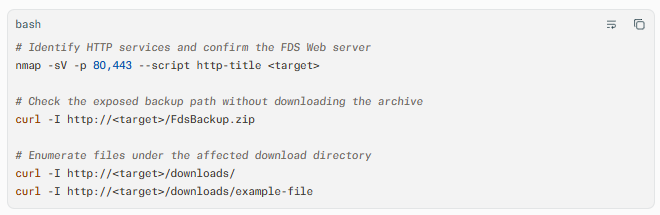
Scanner signatures:
- Configure authenticated and unauthenticated web scans for requests to
/FdsBackup.zipand/downloads/*. - Flag any HTTP 200 response from those paths when no session cookie, authorization header, or prior login is present.
- Correlate positive findings with an FDS 102 product fingerprint and a version at or below 2.13.3.
- Use an authenticated configuration check, where supported, to verify the installed firmware or software version before remediation.
Log indicators:
- HTTP GET requests for
/FdsBackup.zipwithout a corresponding authenticated session. - Repeated requests to
/downloads/*, especially sequential file enumeration or large-volume downloads. - Requests originating from unfamiliar internal subnets, vendor networks, VPN ranges, or internet-facing sources.
- Access attempts outside maintenance windows or from sources with no established operational need.
Behavioral and network indicators:
- Unexpected outbound transfer of a large archive shortly after a request to
/FdsBackup.zip. - Direct HTTP access to diagnostic interfaces from networks that should not reach operational technology assets.
- Scanning or enumeration activity against the FDS Web server followed by retrieval of downloadable files.
- A sudden increase in requests to the affected paths from a single source address, which may indicate automated exploitation or reconnaissance.
C — Mitigation & Remediation
- Immediate (0–24h): Identify every FDS 102 deployment and determine whether it runs version 2.1.0 through 2.13.3. Remove internet exposure immediately, restrict the Web server to authorized administrative networks, and block or closely monitor requests to
/FdsBackup.zipand/downloads/*. - Short-term (1–7d): Upgrade affected systems to FDS 102 version 2.14.0, following the vendor’s official release and deployment procedures. Before upgrading, preserve approved backups, validate compatibility with the rail environment, schedule maintenance windows, and test the updated system in line with operational safety requirements.
- Long-term (ongoing): Place diagnostic and maintenance systems in segmented operational technology zones, with firewall rules that allow access only from approved jump hosts, administrator workstations, and vendor support paths. Require VPN or another controlled remote-access method, enforce least privilege, retain HTTP access logs, and include FDS 102 and similar diagnostic systems in recurring vulnerability management and penetration testing.
Where immediate patching is not possible, restrict access to the FDS Web interface at the network or reverse-proxy layer. Do not expose the interface to untrusted networks or the internet, and apply additional segmentation, firewalling, or VPN controls where the device must connect to a higher-risk network category.
D — Best Practices
- Maintain a current asset inventory that includes diagnostic systems, maintenance tools, and operational technology devices, not only servers and endpoints.
- Prevent diagnostic interfaces from being reachable from the internet or broadly accessible corporate networks.
- Use network segmentation, firewall policies, and controlled remote access to limit who can reach sensitive operational technology services.
- Require authentication and authorization for every endpoint that exposes backups, configuration data, or operational documentation.
- Test both external and internal attack paths during penetration tests, because this vulnerability depends on network reachability rather than stolen credentials.
- Monitor access to sensitive file paths and investigate unauthenticated retrieval attempts as potential reconnaissance activity
Leave Comment